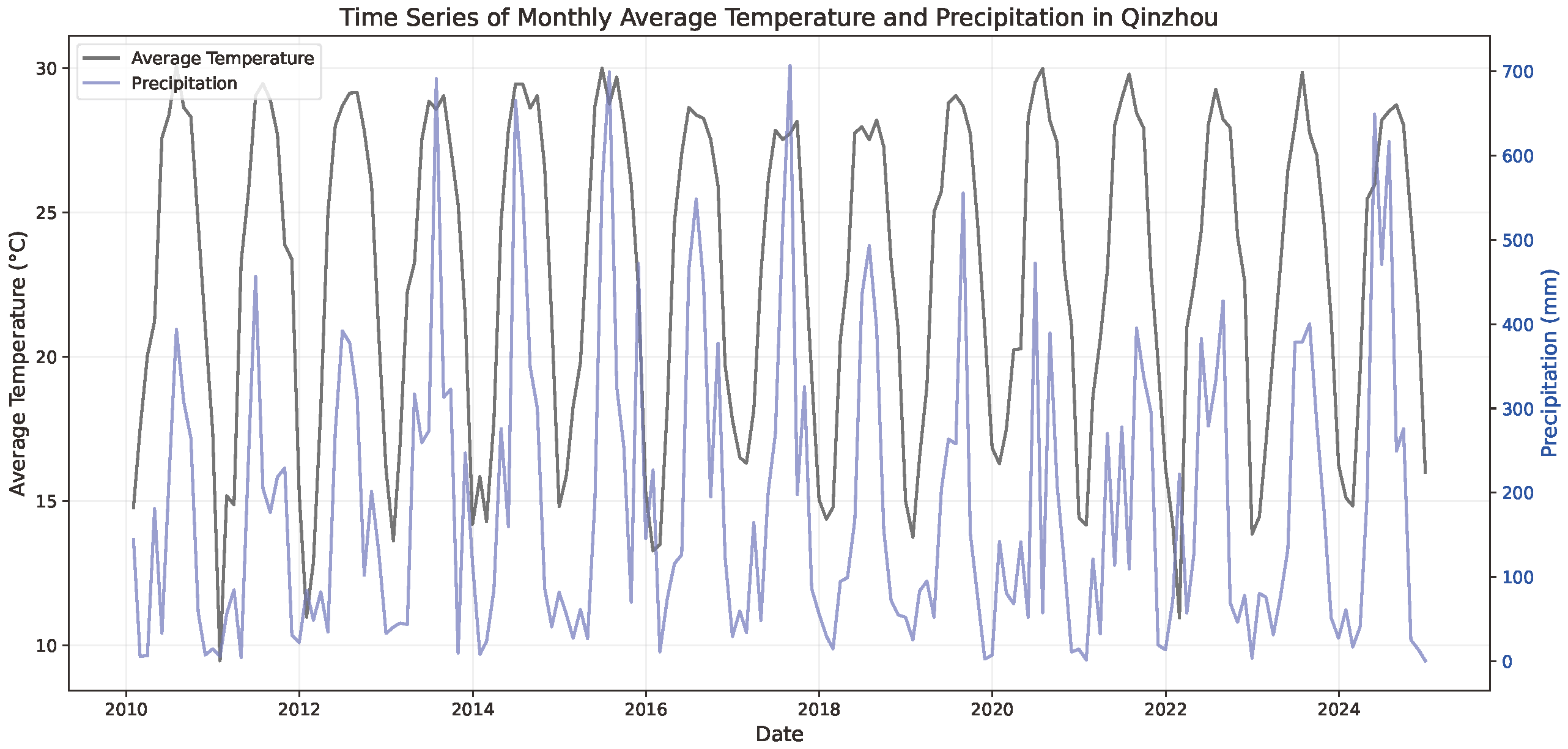
Qinzhou, Guangxi Zhuang Autonomous Region, China, experiences intense seasonal precipitation and relatively high temperatures, which often lead to droughts or floods. Forecasting precipitation and temperature is an essential step in taking precautions against damages caused by weather. The Seasonal Autoregressive Integrated Moving Average (SARIMA) model is effective for forecasting time series with regular patterns. This paper uses the SARIMA model to forecast the monthly precipitation and average temperature of Qinzhou. The training set comprises data provided by the National Oceanic and Atmospheric Administration (NOAA) from 2010 to 2022, inclusive, while data from 2023 to 2024 are used as the test set. By analyzing the augmented Dickey-Fuller (ADF) test results, and comparing Akaike information criterion (AIC) values and models' accuracy, sets of reasonable model parameters are selected. Coefficients of determination (R2) suggest the SARIMA model can effectively forecast monthly average temperature and precipitation, but it shows shortcomings in capturing unexpected extreme values.