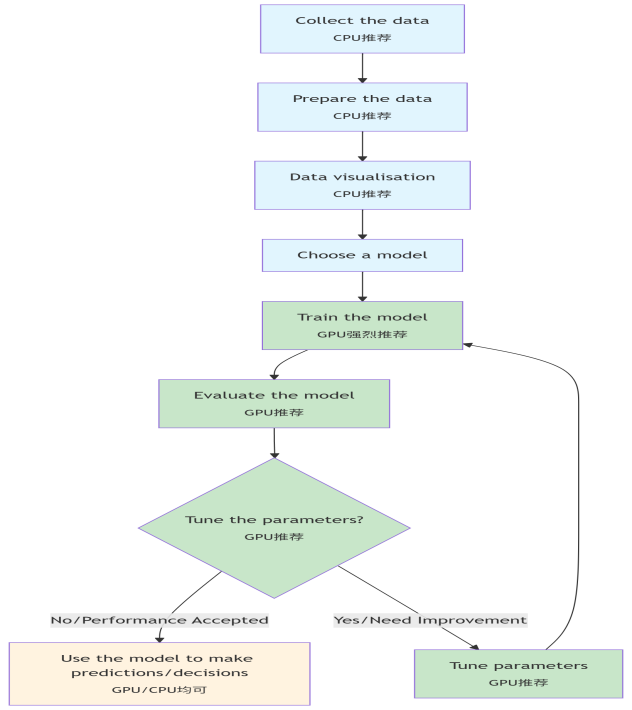
Machine learning models have significantly progressed toward automation in many financial operations, including stock market prediction and investment portfolio development. Due to the volatility of the stock market, stock selection and asset allocation remain challenging for investors. The modern portfolio theory (MPT) has faced challenges in real-world cases due to its heavy reliance on variance, which fails to account for non-normal, heavy-tailed investment losses. In this research study, three advanced models are implemented and compared with the standard MPT framework, including conditional value-at-risk (CVaR), hierarchical risk parity (HPR), and a genetic algorithm (GA) for cardinality-constrained optimisation. The dataset includes historical prices for 18 US stocks from 2016 to 2025. Strict constraints are imposed during the implementation of these models, including long-only positioning and a per-asset cap. An evaluation of risk-adjusted performance using the sortino ratio (STR) demonstrates that clustering-driven HRP and tail-consistent CVaR models outperform MPT significantly. The CVaR-based portfolio has achieved a Sharpe ratio (SR) of 1.58 and a 2.42 STR, demonstrating its ability to mitigate downside risk. GA has achieved the highest annual return of 45.8% and 2.03 SR; simultaneously, drawdown and volatility are also high, proving the inherent trade-offs between maximising empirical SR and robust risk management. The research findings indicated that GA can efficiently build a risk-adjusted optimal investment portfolio while imposing real-world constraints.