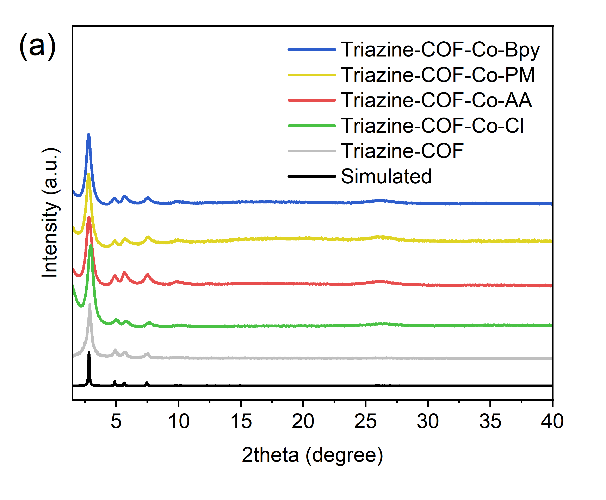
Against the backdrop of energy conservation, emission reduction and green low-carbon development, traditional syngas production processes are plagued by high energy consumption and excessive greenhouse gas emissions. In contrast, the photocatalytic CO2reduction technology, driven by solar energy, enables the conversion of CO2into syngas. It combines the values of environmental protection and resource recycling, thus becoming a current research hotspot. In the design of high-efficiency single-atom catalysts (SACs) for photocatalytic CO2reduction, the microenvironment design of single-atom metal sites is of crucial importance. Based on this, in this work, a series of Co-coordinated COF catalysts named Triazine-COF-Co-Cl were synthesized to regulate the Co-coordination microenvironment for enhancing syngas production via photocatalytic CO2reduction. Among them, the Triazine-COF-Co-AA catalyst with the best performance achieved a syngas production rate of 381.7 mmol g−1h−1, and the H2/CO molar ratio could be continuously adjusted in the range of 1-3, which is sufficient to cover the commonly used syngas ratio range in industry. This paper improves the performance of COF-based photocatalysts for syngas production via CO2reduction through the regulation of Co-coordination environment, and provides ideas and certain data support for the research on solving energy and environmental problems and reducing CO2emissions.