


About ACEThe proceedings series Applied and Computational Engineering (ACE) is an international peer-reviewed open access series that publishes conference proceedings from various methodological and disciplinary perspectives concerning engineering and technology. ACE is published irregularly. The series contributes to the development of computing sectors by providing an open platform for sharing and discussion. The series publishes articles that are research-oriented and welcomes theoretical and applicational studies. Proceedings that are suitable for publication in the ACE cover domains on various perspectives of computing and engineering. |
| Aims & scope of ACE are: ·Computing ·Machine Learning ·Electrical Engineering & Signal Processing ·Applied Physics & Mechanical Engineering ·Chemical & Environmental Engineering ·Materials Science and Engineering |
Article processing charge
A one-time Article Processing Charge (APC) of 450 USD (US Dollars) applies to papers accepted after peer review. excluding taxes.
Open access policy
This is an open access journal which means that all content is freely available without charge to the user or his/her institution. (CC BY 4.0 license).
Your rights
These licenses afford authors copyright while enabling the public to reuse and adapt the content.
Peer-review process
Our blind and multi-reviewer process ensures that all articles are rigorously evaluated based on their intellectual merit and contribution to the field.
Editors View full editorial board

United Kingdom
anil.fernando@strath.ac.uk

United Kingdom
yilun.shang@northumbria.ac.uk

Portsmouth, UK
ella.haig@port.ac.uk

The United Arab Emirates
moayad.aloqaily@mbzuai.ac.ae
Latest articles View all articles
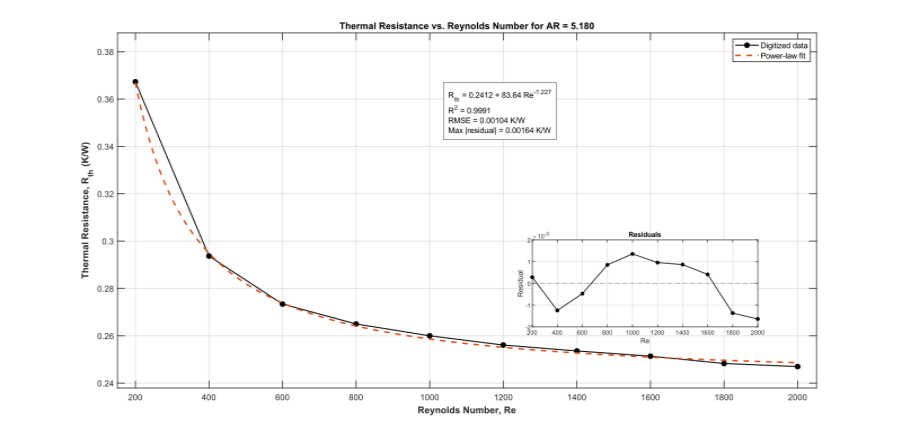
Increasing coolant flow in rectangular microchannel heat sinks can enhance cooling performance but also increase pressure drop and pumping requirements, creating a thermo-hydraulic trade-off. This study investigates the effect of Reynolds number on this trade-off for a fixed rectangular microchannel heat sink under steady single-phase water flow. Published numerical and experimental data are analyzed, with a rectangular configuration of aspect ratio AR = 5.180 selected for quantitative evaluation over Re = 200–2000. The thermal-resistance and pressure-drop data are then analyzed using curve fitting and normalization, and normalized thermal-benefit and hydraulic-penalty indicators are introduced to evaluate their combined behavior. The results show that thermal resistance decreases rapidly at relatively low Reynolds numbers but exhibits diminishing improvement as Reynolds number increases, whereas pressure drop continues to rise sharply. A normalized comparison identifies approximately Re = 600–800 as a favorable compromise range for the selected configuration, providing substantial cooling improvement with a relatively limited hydraulic penalty. Although this range is configuration-specific, the proposed normalized framework can be adapted to evaluate Reynolds-number selection in other microchannel thermal-management systems.

 View pdf


Maritime logistics involves closely connected decisions in vessel operations, port calls, cargo handling, and container transport. Many of these decisions give rise to optimization problems that combine continuous and discrete variables under operational, resource, time, and cost constraints. This paper reviews the application of quantum-inspired algorithms to maritime logistics optimization, focusing on quantum-behaved particle swarm optimization and quantum genetic algorithms. Three application areas are considered: vessel speed optimization, berth allocation and vessel scheduling, and multi-resource scheduling at container terminals. Rather than comparing reported results directly, the review considers how these problems are formulated, how quantum-inspired mechanisms are introduced into the solution procedures, and how the resulting methods are tested. Existing studies suggest that such algorithms can be adapted to both continuous and combinatorial problems in maritime logistics. Their reported performance, however, is sensitive to encoding schemes, parameter choices, problem size, and the treatment of constraints. The available results are also difficult to compare because the studies use different datasets, objectives, benchmarks, and evaluation criteria. In addition, empirical validation is often limited to a particular route, port, or predefined operating scenario, while uncertainties arising from vessel arrivals, weather, and equipment availability are less frequently represented. More evidence from operational data, together with consistent comparisons against established optimization methods, is therefore needed to assess when quantum-inspired approaches offer practical advantages for maritime logistics problems.
View pdf
UAVs have been successfully used in a variety of fields including aerial light shows, crop protection, power line inspection and disaster relief. Cluster operations have strict requirements on both the transmission timeliness of communication systems and the reliability of communication systems, but traditional Wi-Fi and cellular communications have many shortcomings in terms of coverage area, anti-interference capability, and multi-UAV channel contention. This paper systematically summarises the four key challenges of UAV cluster communication, compares the mainstream optimisation methods from four aspects: aerial relay networking, directional antenna dynamic beamforming, onboard RIS and multi-mode adaptive communication switching, and comprehensively discusses the latency and communication reliability of different technologies through experimental data from public publications. The research shows that there is no single optimisation technology that can meet the requirements of large-scale cluster access and anti-interference in complex environments at the same time, while multiple technology combinations can better reduce the communication latency and improve the stability of the communication link. Finally, this paper summarises the practical limitations hindering the deployment of existing technologies and provides an outlook on future development directions for UAV cluster communication.
View pdf
Air temperature is measured directly at weather stations, with small spatial coverage. Weather observations, geographic information systems (GIS), and machine learning can be used to estimate the temperatures in these areas based on the conditions around them. This paper uses literature synthesis and case study analysis to review the data and methods used in spatial prediction of urban air temperature. It investigates the aspects of meteorological observation, spatial and environmental predictors of the city, GIS-based feature extraction, machine learning models, and temperature mapping. Three case studies in Zurich, Oslo, and Szeged demonstrate the application of high-resolution mapping, the predictive value of urban features, and seasonal and day/night variations in model results. The reviewed studies indicate that machine learning can represent complex relationships between air temperature and meteorological and spatial variables. GIS can bring support in this process by integrating data, extracting features, and mapping predictions. The choice of model and the resolution of the mapping depend on the research question being asked and the data available, and must match the station distribution, quality of input data, spatial scale, and local urban conditions. Future efforts should enhance observation coverage and data completeness, increase independent site validation, and test model transferability between cities.
View pdf
Volumes View all volumes
Volume 277October 2026
Find articlesProceedings of the 4th International Conference on Functional Materials and Civil Engineering
Conference website: https://2026.conffmce.org/
Conference date: 9 October 2026
ISBN: 978-1-80915-048-6(Print)/978-1-80915-049-3(Online)
Editor: Anil Fernando
Volume 276October 2026
Find articlesProceedings of CONF-MLA 2026 Symposium: Learning and Decision Making in Multi Agent Software Systems
Conference website: https://2026.confmla.org/
Conference date: 26 October 2026
ISBN: 978-1-80915-046-2(Print)/978-1-80915-047-9(Online)
Editor: Jie Zhang , Hisham AbouGrad
Volume 275October 2026
Find articlesProceedings of the 7th International Conference on Signal Processing and Machine Learning
Conference website: https://2027.confspml.org/index.html
Conference date: 26 February 2027
ISBN: 978-1-80915-044-8(Print)/978-1-80915-045-5(Online)
Editor: Md. Jalil Piran
Volume 274October 2026
Find articlesProceedings of CONF-FMCE 2026 Symposium: Smart City and Infrastructure Engineering
Conference website: https://2026.conffmce.org/
Conference date: 9 October 2026
ISBN: 978-1-80915-032-5(Print)/978-1-80915-033-2(Online)
Editor: Marwan Omar , Anil Fernando
Announcements View all announcements
Applied and Computational Engineering
We pledge to our journal community:
We're committed: we put diversity and inclusion at the heart of our activities...
Applied and Computational Engineering
The statements, opinions and data contained in the journal Applied and Computational Engineering (ACE) are solely those of the individual authors and contributors...
Indexing
The published articles will be submitted to following databases below: