


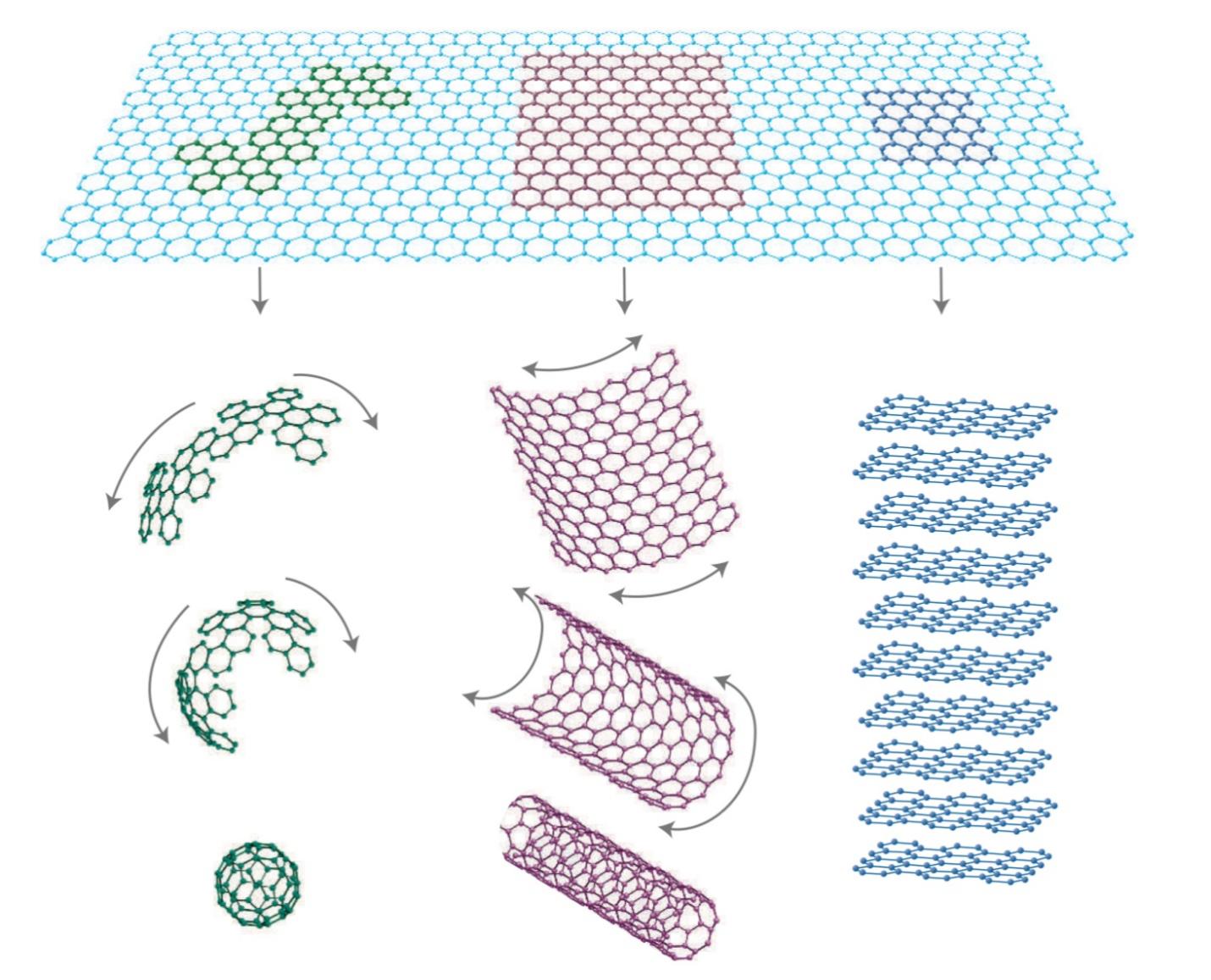
Graphene is well known as a leading two-dimensional (2D) material. It is a single atomic layer of sp²-bonded carbon. This material shows outstanding mechanical strength, extremely high charge carrier movement speed, high thermal conductivity, and optical transparency at the same time. These special properties make graphene a useful base for next-generation electronics, sensing technologies, flexible devices, photonics, and quantum applications. This paper first gives a general look at the wide range of 2D materials. Then it focuses on graphene as a key case to compare major ways of making it. Mechanical exfoliation can produce flakes of the best quality. It is still the best method for basic physics research. On the other hand, liquid-phase exfoliation and oxidation–reduction methods help make many dispersible flakes in large amounts, though these flakes have relatively higher defect densities. Chemical vapour deposition (CVD) is a bottom-up method. It can make continuous graphene films as big as a wafer, but the quality of these films depends heavily on catalyst selection, process control, and clean transfer steps. Besides fabrication, the paper also explains van der Waals heterostructures. These structures are made by stacking atomically thin crystals without the need for lattice-matched epitaxy. They bring a powerful way to design materials through interface engineering and twist-angle control. In particular, when graphene is stacked on hexagonal boron nitride (hBN), it forms a moiré superlattice. The long-wavelength periodic potential of this superlattice changes graphene's band structure into minibands. This change leads to special transport features like secondary Dirac points and fractal quantum Hall spectra, which are also called Hofstadter butterfly. The paper also points out key challenges and chances for scaling up 2D materials to make reliable device architectures. These include making wafer-scale materials with uniform quality, ensuring contamination-free transfer, creating low-resistance contacts, and using metrology to assess twist-angle and interface quality.

