Articles in this Volume

Research Article Open Access
Aerodynamic Performance and Flow Characteristics of the 2D NACA 2412 Airfoil Using CFD
Article thumbnail
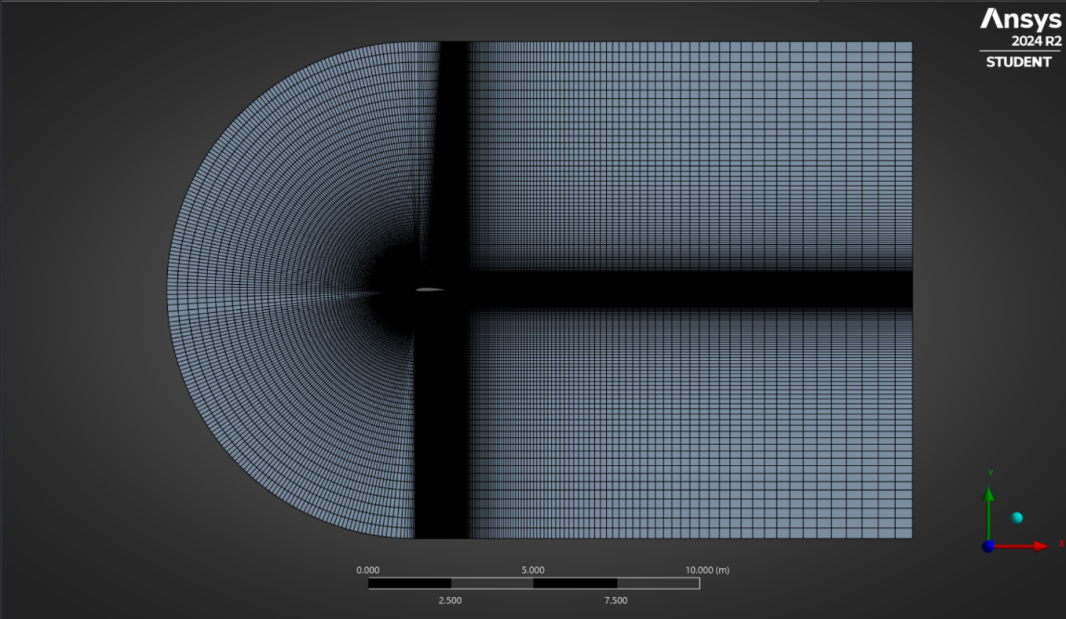
the Lift on a cambered airfoil depends on the interaction of pressure, vorticity, and the boundary layer. Classical inviscid flow theory alone cannot describe this process completely. In real flow conditions, viscosity becomes significant. The way circulation develops therefore influences the aerodynamic loading on the airfoil surface. Previous research has examined vortex behavior near the trailing edge. Liu’s review points out that the starting vortex helps satisfy the Kutta condition and allows circulation to form. Other studies compare lifting-surface approaches with CFD methods. These works show that geometric features, such as camber and thickness, lead to nonlinear pressure effects. Simplified potential-flow models often struggle to predict these effects accurately. This study uses CFD to investigate the NACA 2412 airfoil at a Reynolds number of approximately3.1×106. A C-type computational domain is applied with a structured quadrilateral mesh. The mesh maintains a near-wall resolution ofy+≈1, which enables reliable boundary-layer resolution. The pressure, velocity, and streamline results display clear suction peaks and smooth pressure recovery. The flow field also shows stable circulation around the airfoil. The numerical results agree well with available experimental data. Similar trends appear in Reynolds-number sensitivity and boundary-layer stability reported in earlier studies. This analysis demonstrates that CFD provides an effective connection between aerodynamic theory and real flow behavior.
Show more
Read Article PDF
Cite
Research Article Open Access
The Applications of Artificial Intelligence in Fault Data Collection and Fault Analysis
Against the backdrop of Industry 4.0, the intelligent transformation of industrial production accelerates. Equipment failures and process anomalies during production are likely to cause significant losses, while traditional fault management models have failed to meet modern demands. Artificial intelligence (AI) technology has achieved phased progress in fault data collection and analysis. This paper adopts a systematic literature review method to analyze relevant studies and cases, focusing on the application of AI in fault data collection and analysis. It aims to improve the research framework in this field, provide references for the application of AI technology in production, and thus enhance industrial safety and efficiency. This study identified key challenges, including data quality issues, difficulties in data sharing, and imbalanced dataset classification, as well as high costs and insufficient accuracy of data annotation. To address these problems, technical solutions such as data cleaning, federated learning, and resampling methods were proposed. In addition, it was recommended to adopt active learning and semi-supervised learning to reduce annotation costs and improve model performance. Looking to the future, the integration of generative AI and digital twins is expected to further overcome the problem of data scarcity, while self-evolving AI systems will drive the realization of more autonomous and accurate predictive maintenance. This research provides theoretical and practical references for the intelligent development of industrial fault management.
Show more
Read Article PDF
Cite
Research Article Open Access
FPGA Implementation of Low Power IIC Controller with EEPROM and Multi-Protocol Performance Analysis
Article thumbnail
As the embedded system in intelligent devices is progressing, hardware implementation of low-power communication protocols has become a significant research direction in the field of electronic and information engineering. This study presents an overall design technique for a low-power inter-integrated circuit (IIC) protocol master/slave device controller in Verilog hardware description language (HDL) and achieves full read-write operation in FPGA board-level simulation setting, electrically erasable programmable read-only memory (EEPROM) as the verification device. This study employs a finite state machine (FSM) technique to model the hardware implementation of IIC communication process, followed by the integration of a clock gating strategy to mitigate dynamic power consumption. Vivado is utilized for synthesis, power analysis, and hardware implementation on a field-programmable gate array (FPGA) board. The results indicate that the optimized IIC controller exhibits relatively low energy consumption. Simultaneously, to assess the performance level of the proposed IIC interface, the study constructs Serial Peripheral Interface (SPI) and Universal Asynchronous Receiver/Transmitter (UART) protocols, synthesizes, implements them with ModelSim and Vivado, and compares them with IIC protocol in resource usage, power consumption and structure. Experiments show that IIC offers the lowest power consumption which is 0.093W and excellent scalability, SPI achieves the highest data transfer rate which can be over 10 Mb/s, while UART has a simple structure and moderate resource usage. This provides a clear and feasible path for the hardware implementation of an appropriate and low-power communication interface in an embedded system.
Show more
Read Article PDF
Cite