Articles in this Volume

Research Article Open Access
Intelligent Classification Model for Animation Style Based on Machine Learning Algorithm
Article thumbnail
This study aims to improve the accuracy of animation style classification and provide more effective machine learning algorithm support for the intelligent retrieval, personalized recommendation, and intelligent development of creative assistance tools on animation content platforms. This paper innovatively proposes an optimization model (BiLSTM Transformer) that integrates bidirectional long short-term memory network (BiLSTM) and Transformer architecture to address the complex sequence features contained in animation data. In order to comprehensively evaluate the performance of the model, we conducted systematic comparative experiments with various representative models such as random forest, decision tree, XGBoost, CatBoost, and BP neural network. The experimental results show that the proposed BiLSTM Transformer model has achieved a significant breakthrough of 95.7% in classification accuracy, far exceeding the performance of the suboptimal model (91.8%), demonstrating a performance advantage of a discontinuous approach. Moreover, the model has consistently achieved over 95% accuracy, recall, and F1 score in key evaluation metrics, demonstrating its outstanding comprehensive performance and robustness. In contrast, the accuracy of all compared models is below 92% and shows a stepwise downward trend: the decision tree model (81.2%) has obvious overfitting problems; Random forest, as the best traditional method, still lags behind the new model by 3.9 percentage points in accuracy (91.8%); XGBoost and CatBoost are limited in their effectiveness due to the difficulty of fully learning the complex dependencies between sequences; BP neural network performs the weakest in nonlinear modeling ability due to the vanishing gradient problem. These comparative results fully verify that the BiLSTM Transformer model can effectively model and understand complex sequence patterns and style features in animation data by combining the powerful capturing ability of BiLSTM for long-distance contextual information and the focusing advantage of Transformer's self attention mechanism on key features. As a result, it has achieved excellent predictive performance in animation style classification tasks, providing strong technical support for related intelligent applications.
Show more
Read Article PDF
Cite
Research Article Open Access
Discussion on the Algorithm for Determining the Optimal Rod Length of a Five Link Closed Chain Double Wheel Leg Robot
Article thumbnail
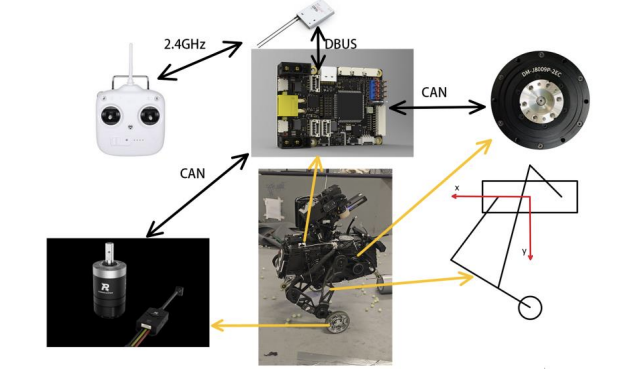
This paper proposes a novel obstacle-crossing method for wheeled bipedal robots with specialized leg configurations, addressing the limitations of existing jumping-based approaches that suffer from high landing impacts, suboptimal jump heights, and extreme demands on joint torque/battery discharge. Experimenter first derive the robot's dynamics model and establish an Obstacle-Climbing Wheeled Inverted Pendulum (OCWIP) model corresponding to the asymmetric five-bar linkage mechanism, replacing spring forces with virtual forces. Trajectory planning synchronized with body-wheel motion is then implemented based on the OCWIP model, dividing obstacle-crossing into three phases for dynamic analysis. Compared to jumping methods, our approach utilizes passive body tilting followed by leg retraction to ascend steps, significantly reducing mechanical shock on leg structures and extending the lifespan of actuators/batteries. A hierarchical controller integrates leg motion, aerial attitude adjustment, and trajectory tracking to achieve real-time stabilization and robust execution. Experimental validation demonstrates >90% success rate on a physical platform. Key contributions are: 1) A GPU-accelerated solver for optimal linkage combination; 2) Development of the asymmetric five-bar OCWIP model; 3) Hardware validation of the obstacle-crossing framework.
Show more
Read Article PDF
Cite
Research Article Open Access
Optimizing AdaBoost for Bitcoin Price Prediction Based on Long and Short Term Memory Network Models
Article thumbnail
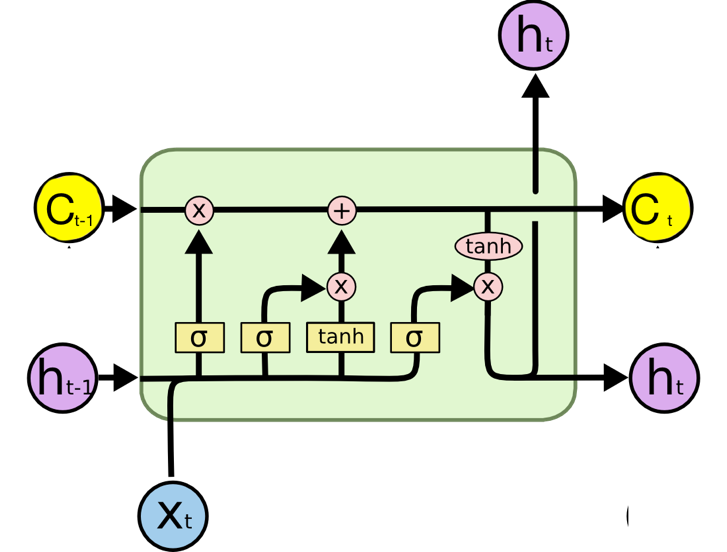
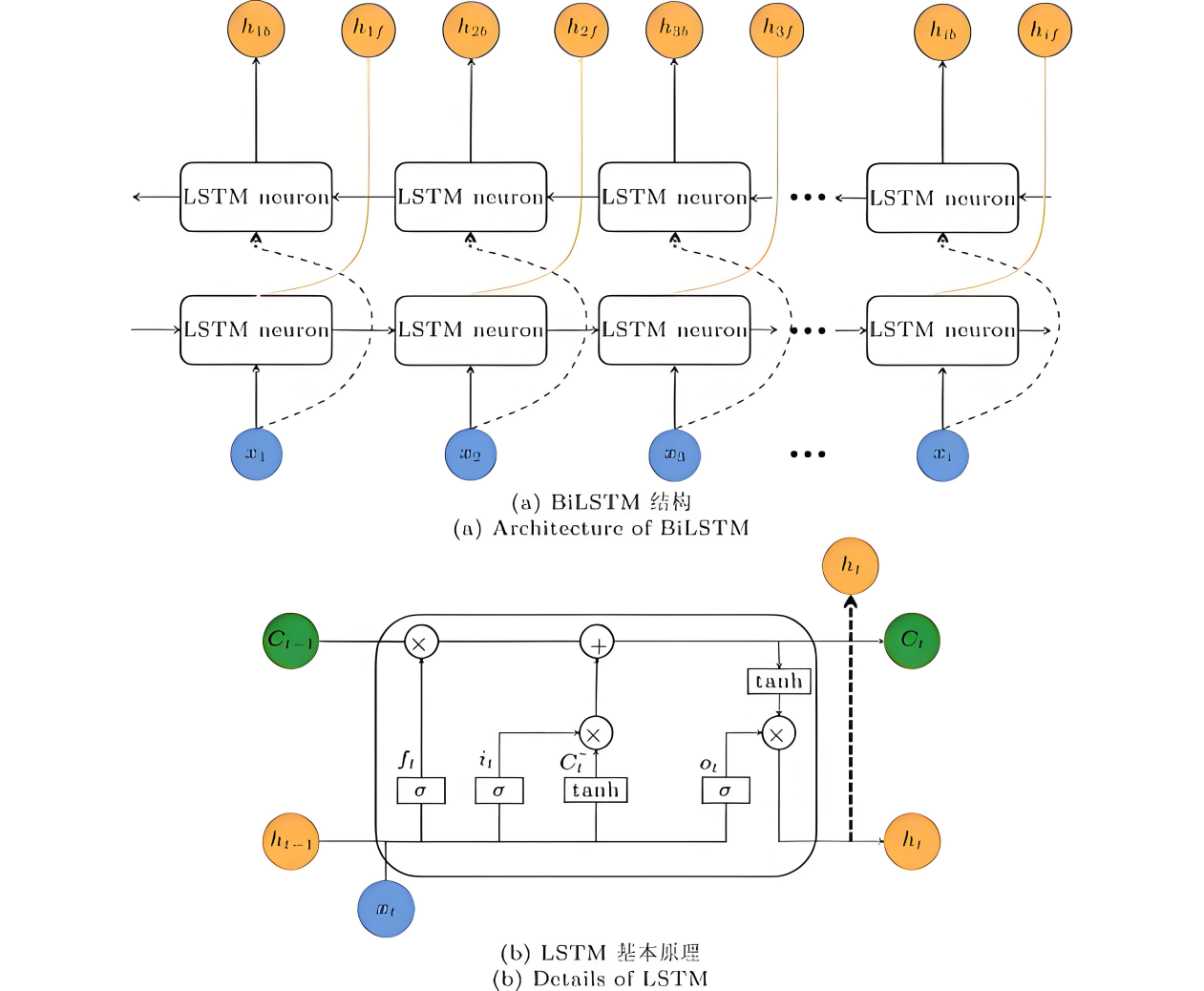
In this paper, a hybrid time series analysis model for bitcoin price forecasting is constructed by introducing a long short-term memory network (LSTM) to deeply optimize the traditional AdaBoost integrated learning model. Experimental results show that the fusion model exhibits excellent dual adaptability in the field of financial time series forecasting: in the training phase, the model achieves a high degree of fit to historical data with an excellent performance of MAE 1.3574, MSE 3.4279, and MAPE 0.412%, and its coefficient of determination, R², breaks through 0.97105, which intuitively verifies the ability of the LSTM module in capturing the non-linear time-series characteristics of the The synergy between the LSTM module and the AdaBoost framework in strengthening the generalization ability of the model; in the testing phase, although facing the challenge of increased market volatility, the model still maintains a stable performance of MAE 1.914, RMSE 2.7893 and MAPE 0.586%, especially the prediction error rate is continuously controlled within 1% of the industrial-grade accuracy threshold, and its test set R² value of 0.88675 significantly exceeds the benchmark interval of 0.6-0.8 for conventional prediction systems, confirming the strong explanatory power and robustness of the model in unknown data environments.
Show more
Read Article PDF
Cite
Research Article Open Access
A Survey and Prospects on Unit Test Case Generation Techniques Based on Large Language Models
Automated unit test case generation is a critical research topic in the field of software engineering. Numerous scholars at home and abroad have devoted considerable efforts to addressing this problem and have achieved fruitful results. In recent years, the emergence of large language models (LLMs), such as the GPT series, LLaMA series, DeepSeek series, T5, and their variants tailored for source code, has introduced new technical pathways for unit test case generation, thereby reigniting widespread scholarly interest in this area. To further promote the theoretical and practical development of LLM-based unit test case generation, this study presents a comprehensive survey and an outlook on future research. It reviews and analyzes the evolution of unit test case generation techniques, from early exploratory efforts to the current stage driven by large models. Starting from two main categories—techniques that rely solely on LLMs and those that integrate traditional static analysis—the current state of research and recent advancements in LLM-based test generation are discussed. On this basis, the study summarizes the major issues and challenges in the field and envisions possible future research directions. This work systematically presents the developmental trajectory, latest progress, and future prospects of this domain, offering valuable insights and guidance for subsequent research and innovation.
Show more
Read Article PDF
Cite
Research Article Open Access
The Formation Mechanism of Social Media Public Opinion Polarization under Algorithmic Bias
Article thumbnail
In the era of Web 3.0, data-driven recommendation systems dominate the dissemination of social media information, leading to issues such as cognitive imbalance, public opinion polarization, group opposition, and hidden risks of social fragmentation. This study reveals the mechanism of algorithmic bias on public opinion polarization, providing reference for understanding the social media public opinion ecology.
Show more
Read Article PDF
Cite
Research Article Open Access
Research on Optimal Design of Robotic Arm Joint Angle Path Based on Optimization Algorithms
This paper takes a six-degree-of-freedom robotic arm as the research object and proposes a unified framework for "joint angle path optimization": First, a zero-position precise kinematic model is established using D-H parameters; then, four typical working conditions are sequentially solved—under only precision constraints, the Whale Optimization Algorithm (WOA) yields joint angles [97.34, –103.88, 13.55, 21.68, 94.19, 89.49] in a single search, with an end-effector error of 2.5×10⁻⁶ m; when introducing an energy consumption model and targeting both error and energy consumption, the WOA-Monte Carlo hybrid algorithm provides [43.56, –57.16, 38.46, –67.52, –90, 0], with an error of 198 mm and energy consumption of 98.1 J; in obstacle avoidance scenarios, an A* algorithm first plans a collision-free base path, and then the same optimizer is called at each station, resulting in [44.73, –44.72, 38.53, –67.19, –89.62, 0.23], with performance comparable to previous results; for multi-objective grasping tasks, after A* generates a traversal path, each target is independently optimized, achieving a cumulative error of 510 mm and total energy consumption of 119 J. Experiments demonstrate that the integrated method of "D-H kinematics + A* base planning + WOA-MC joint optimization" significantly outperforms baseline approaches in terms of precision, energy consumption, obstacle avoidance, and multi-objective scenarios, showcasing strong potential for engineering applications.
Show more
Read Article PDF
Cite
Research Article Open Access
Task Specialization via Generative Behavior Clustering and Reinforced Distillation: Building Lightweight Experts from LLMs
Article thumbnail
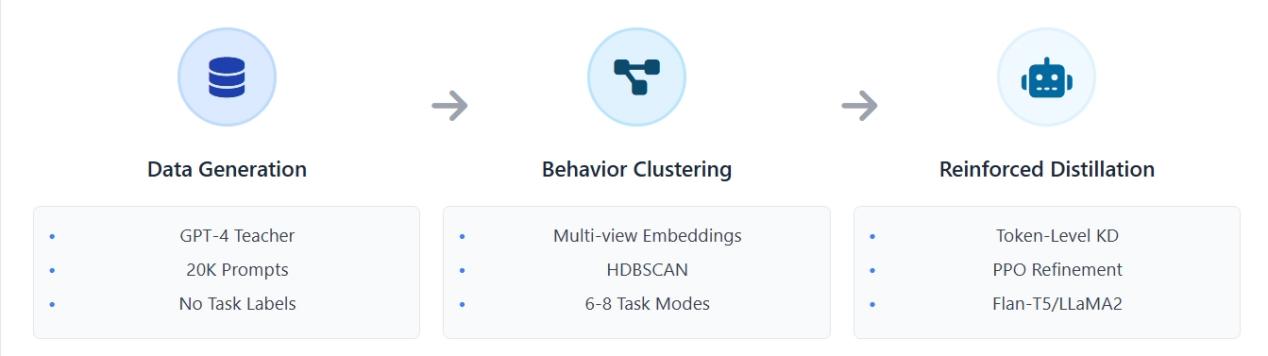
Large language models (LLMs) now routinely contain hundreds of billions of parameters, making them prohibitively expensive to run in latency- or resource-constrained settings. Knowledge distillation offers a principled way to compress such models, yet prevailing approaches train a single, general-purpose student and therefore fail to exploit the rich, task-specific behaviours latent in the teacher. We propose a three-stage framework that (i) clusters teacher responses to uncover coherent behavioural modes, (ii) trains a lightweight student on each cluster by token-level imitation, and (iii) reinforces each student with a self-refinement loop guided by task-aligned rewards. Using GPT-4 as the teacher and Flan-T5-Small or LLaMA2-7B as the base students, our method produces “task-specific experts” that equal or surpass a distilled generalist while reducing inference cost by an order of magnitude. The framework thus bridges the gap between the versatility of large models and the practical demands of specialised, deployable systems.
Show more
Read Article PDF
Cite
Research Article Open Access
Institutional Investors’ Preference for Supply-Chain Firms with High ESG Transparency and Frequent On-Chain Disclosure
Article thumbnail
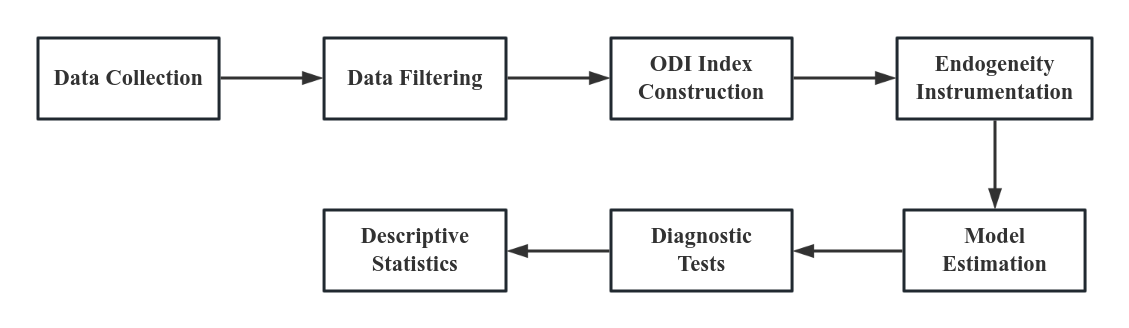
Blockchain technology offers the potential for immutable, real-time Environmental-Social-Governance (ESG) data streams, yet robust causal evidence on their capital-market impact remains limited. Using 43,896 firm-quarter observations (2018-2024) across 1,829 Chinese A-share supply-chain firms, we develop an On-Chain Disclosure Intensity (ODI) index by parsing 9.4 million ESG-tagged smart-contract events from Ethereum-based decentralised autonomous organisations. Our identification strategy combines an instrumental-variables two-stage least squares (IV-2SLS) approach, leveraging DAO vote density and provincial blockchain-for-sustainability subsidies, with a staggered difference-in-differences design exploiting 2023-2024 disclosure mandates. A one-standard-deviation increase in instrumented ODI raises institutional ownership by 1.32 percentage points and reduces the weighted-average cost of capital by 38 basis points; treatment firms subject to policy shocks see an additional 6.05-point ownership gain. Robustness checks, including entropy-weighted TOPSIS scoring, placebo reforms, alternative clustering, and non-parametric randomisation, corroborate the transparency premium. The findings indicate that tamper-proof ESG data can complement conventional narrative reports, providing managers with a pathway to lower financing costs and offering regulators quantitative benchmarks for standardising blockchain-based disclosure.
Show more
Read Article PDF
Cite
Research Article Open Access
An Empirical Study on the Impact of Xiamen Institute of Technology Campus Marathon on the Local Economy: An Analysis Based on the Perspective of Big Data
Article thumbnail
This study aims to evaluate the direct, indirect, and induced economic impacts of the campus marathon hosted by Xiamen Institute of Technology (XIT), and to explore the conceptual application of big data methodologies in assessing the economic effects of small-scale, localized sports events. With the growing popularity of marathons both in China and globally, their role in enhancing public health and stimulating economic development has become increasingly evident. Using the 2024 XIT Campus Marathon as a case study, this research analyzes its influence on key local sectors, including tourism, hospitality, retail, and dining. Findings suggest that despite the modest scale of the campus marathon, it has generated measurable economic stimulus in the surrounding community and contributed to the broader marathon economy in Xiamen by promoting a culture of sports and urban vitality. The study proposes a framework that integrates traditional economic impact evaluation models with the analytical potential of big data, offering a methodological foundation for future real-time and granular assessments. The results provide actionable policy suggestions for both XIT and the Xiamen municipal government to maximize the economic and social value of campus-level sports events.
Show more
Read Article PDF
Cite
Research Article Open Access
Data-Driven Investigation of Socio-Emotional Support Patterns and Their Influence on Learning Resilience Among Youths in Rural Compulsory Education
Article thumbnail
Rural compulsory education systems often operate under persistent resource constraints that intensify students’ exposure to academic setbacks and socio-emotional strain. This study analyzes a multimodal, four-term longitudinal dataset collected from 27 rural middle schools in western China (N = 4,362), combining classroom observations, teacher–student interaction logs, and fortnightly wellbeing surveys to uncover latent patterns of socio-emotional support and estimate their effects on learning resilience. Unsupervised sequence clustering and temporal network motif analysis recover three dominant trajectories, consistent‑high, fluctuating, and latent‑low. A multilevel growth model with random intercepts and slopes, complemented by a gradient-boosted decision tree ensemble, explains a substantial share of variance in resilience growth and achievement rebounds. Consistent‑high scaffolding is associated with a 0.42 σ improvement in resilience after baseline adjustment, while latent‑low support shows cumulative risk effects. Out-of-sample validation confirms stable predictive performance (median RMSE = 0.37 σ; cross-validated R² = 0.44), and robustness checks across alternative operationalizations (buoyancy scale vs. grade recovery slope) and sample restrictions support generalizability. The findings provide actionable levers for teacher professional development focused on maintaining support consistency and furnish a data-informed blueprint for monitoring socio-emotional climates in resource-limited schools.
Show more
Read Article PDF
Cite