Articles in this Volume

Research Article Open Access
Deep learning-based sentiment analysis for social media: A focus on multimodal and aspect-based approaches
Article thumbnail
Commonly referred to as opinion mining, sentiment analysis harnesses the power of deep learning systems to discern human emotions and subjective sentiments towards a wide array of subjects. As such, it has become an integral tool in identifying and distinguishing sentences that harbor emotional biases or trends. By systematically examining sentiment-tinged data, researchers can unearth pivotal insights that not only reflect current perspectives but also predict future behaviors and trends. This process involves intricate computational models that analyze and interpret the emotional undertones embedded within a body of text. Whether these undertones are positive, negative, or neutral, sentiment analysis allows us to delve into the subtle nuances of human communication. This ability to "understand" and quantify sentiment is particularly vital in our modern digital age, where opinions and reviews shared through social media and online platforms can greatly influence public sentiment and consumer behavior. By extending beyond the literal meanings of words and phrases, sentiment analysis can provide a more comprehensive understanding of how people truly feel. It is instrumental in fields as diverse as marketing, politics, social science, and even artificial intelligence development, given its potential to gauge public opinion and predict societal trends. This paper aims to consolidate relevant research within the field of sentiment analysis conducted in recent years. Furthermore, it seeks to prognosticate the future trajectories and impacts of this rapidly evolving domain. Emphasis is placed on the role of deep learning and its transformational effects on the approach and capabilities of sentiment analysis, anticipating how its further advancement will continue to refine this intricate process of emotion recognition and interpretation.
Show more
Read Article PDF
Cite
Research Article Open Access
Sentiment analysis in online education: An analytical approach and application
Article thumbnail
This paper presents a groundbreaking approach to the application of sentiment analysis within the domain of online education. By introducing an innovative methodology, the aim is to streamline the process of automatically evaluating sentiments and extracting opinions from the vast sea of content produced by learners during their online interactions. This not only aids educators in swiftly gauging the general mood and perspective of their student body, but also allows them to delve deeper into the nuanced feedback provided, thus ensuring the continual improvement of course quality. In an era where digital learning platforms are growing exponentially, understanding students' attitudes, concerns, and overall satisfaction is paramount. Our methodology, therefore, is not just a technical advancement, but also a strategic tool for educational institutions aiming to thrive in the digital age. The current research landscape, while expansive, has often overlooked the significance of real-time sentiment analysis in e-learning environments. This study, therefore, bridges an important gap, bringing to the forefront the importance of harnessing student feedback in a digital format, allowing educators to tailor their approach for optimal student engagement and success.
Show more
Read Article PDF
Cite
Research Article Open Access
Analyzing sentiment and its application in deep learning: Consistent behavior across multiple occasions
This article offers a systematic review of the evolution in sentiment analysis techniques, moving from unimodal to multimodal to multi-occasion methodologies, with an emphasis on the integration and application of deep learning in sentiment analysis. Firstly, the paper presents the theoretical foundation of sentiment analysis, including the definition and classification of affect and emotion. It then delves into the pivotal technologies used in unimodal sentiment analysis, specifically within the domains of text, speech, and image analysis, examining feature extraction, representation, and classification models. Subsequently, the focus shifts to multimodal sentiment analysis. The paper offers a survey of widely utilized multimodal sentiment datasets, feature representation and fusion techniques, as well as deep learning-based multimodal sentiment analysis models such as attention networks and graph neural networks. It further addresses the application of these multimodal sentiment analysis techniques in social media, product reviews, and public opinion monitoring. Lastly, the paper underscores that challenges persist in the area of multimodal sentiment fusion, including data imbalance and disparities in feature expression. It calls for further research into cross-modal feature expression, dataset augmentation, and explainable modeling to enhance the performance of complex sentiment analysis across multiple occasions.
Show more
Read Article PDF
Cite
Research Article Open Access
Vehicle detection and tracking in intelligent transportation systems based deep learning
Article thumbnail
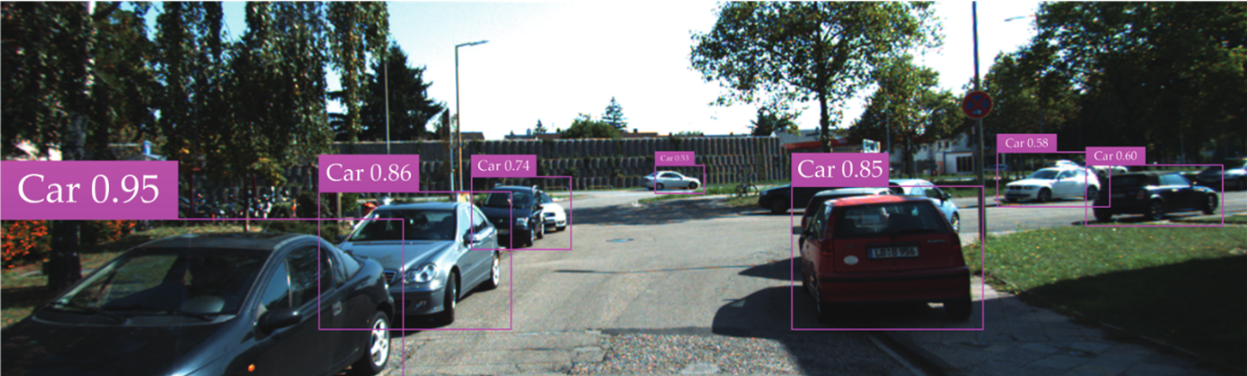
This research paper focuses on the advancements and optimizations made to fundamental object detection algorithms in vehicle detection. The study explores integrating and reusing CNN (Convolutional Neural Networks) models with other techniques to enhance performance. Three main models, namely Faster R-CNN (Faster Region-based Convolutional Neural Network), Improved SSD (Single Shot Multibox Detector), and YOLOv4 (You Only Look Once v4), are analyzed, showcasing their incremental improvements in accuracy and overall detection performance. However, the increased computational complexity and time demands are trade-offs. The study also presents EnsembleNet, a model combining Faster R-CNN and YOLOv5, which achieves higher average precision values. Another approach involves fusing edge features with CNN models, resulting in faster and more accurate vehicle recognition. The paper predicts future deep learning trends, emphasizing the need for improved hardware capabilities to handle complex models. Integrating deep learning with sensor fusion and edge computing holds promise for intelligent transportation systems.
Show more
Read Article PDF
Cite
Research Article Open Access
Implementing the AlphaZero algorithm for Connect Four: A deep reinforcement learning approach
Article thumbnail
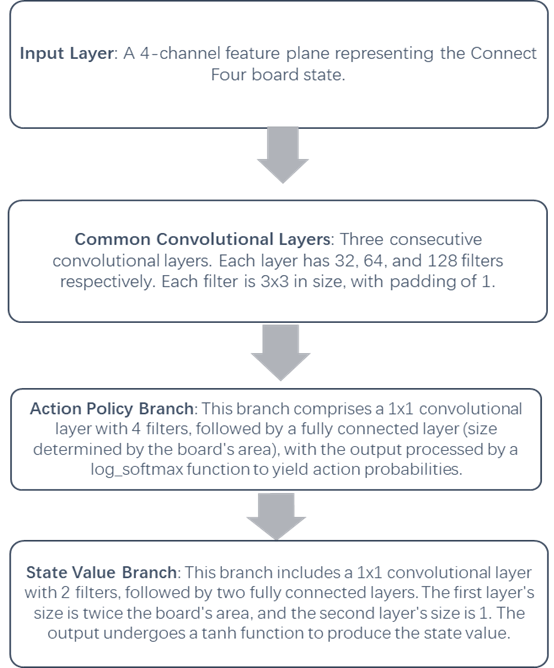
The realm of board games presents a challenging domain for the application of artificial intelligence (AI), given their vast state-action space and inherent complexity. This paper explores the development of a proficient AI for Connect Four using DeepMind's AlphaZero algorithm. The algorithm employs a policy-value network for concurrent prediction of action probabilities and state values, and Monte Carlo Tree Search (MCTS) for decision-making, guided by the policy-value network. Through extensive self-play and data augmentation, our AI learns without the need for explicit prior knowledge. Our experiment demonstrated that the AI player showed significant capability in playing Connect Four, exhibiting strategic decision-making that sometimes-surpassed human performance. These results underline the potential of deep reinforcement learning in advancing AI performance in complex board games.
Show more
Read Article PDF
Cite
Research Article Open Access
Deep learning applications in MRI for brain tumor detection and image segmentation
Article thumbnail
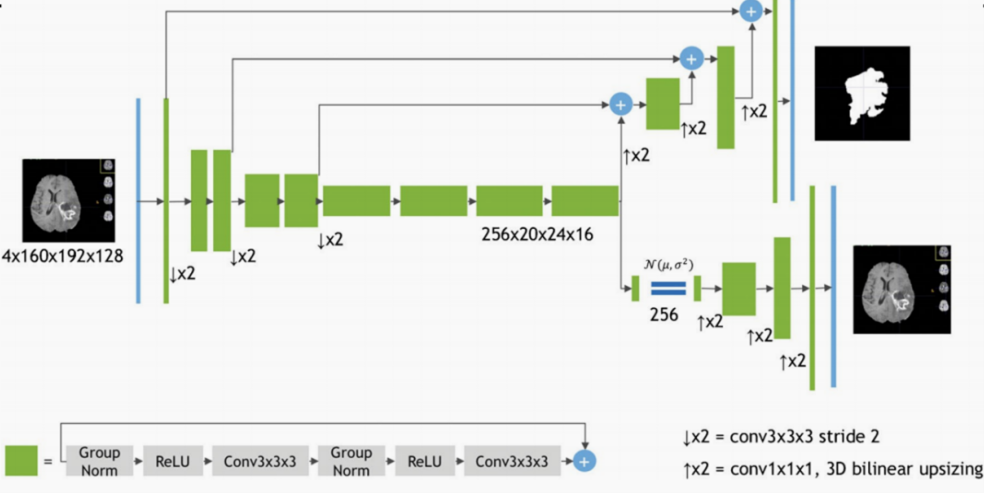
Deep learning holds great potential in the field of MRI applications. By leveraging its advanced algorithms and neural networks, it can effectively analyze and interpret intricate patterns in medical images, aiding in precise disease detection, segmentation, and classification. Integrating deep learning techniques with MRI technology is expected to revolutionize radiology practice, facilitating enhanced diagnostic accuracy and customized treatment strategies, ultimately leading to improved patient outcomes. This article provides an overview of of the latest advancements in deep learning techniques applied to magnetic resonance imaging, specifically focusing on brain tumor detection and segmentation. The study examines eight different deep learning methods, including a multi-scale convolutional neural network, U-Net-based fully convolutional networks, cascaded anisotropic convolutional neural networks, missing modality-based tumor segmentation, Hough-CNN for deep brain region segmentation, k-Space deep learning for accelerated MRI, Multi-level Kronecker Convolutional Neural Network, and a heuristic approach for clinical brain tumor segmentation. Each method is analyzed, highlighting its specific techniques, advantages, and limitations. The comparative performance of these methods in terms of accuracy and efficiency, addressing key factors such as computational requirements, training time, and robustness, was discussed in this article. By assessing the merits and limitations of different approaches, this review seeks to offer valuable perspectives on effective utilization of deep learning techniques in clinical MRI settings for detecting and delineating brain tumors.
Show more
Read Article PDF
Cite
Research Article Open Access
Data correlation and causal analysis for traffic flow prediction
Article thumbnail
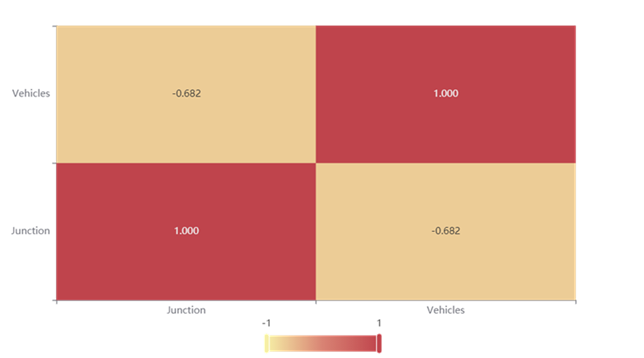
Globally, traffic congestion has become a major issue due to several issues, including the rapid urban population increase, deteriorating infrastructure, improper and disorganized traffic signal timing, and a lack of real-time data. According to INRIX, a well-known provider of traffic data and analytics, the effects of this problem on U.S. travelers in 2017 were astronomical, totaling $305 billion in wasted fuel, lost time, and increased transportation costs in congested locations. Given the limitations of building new roads, communities must investigate cutting-edge tactics and technology to ease traffic while taking practical and economical restraints into account. This study employs the Granger causality test on a dataset of 48,120 entries, primarily focusing on the variables: number of VEHICLEs and number of intersection JUNCTIONs. The objective is to ascertain the potential mutual influence between these two variables. Initial results indicate a two-way Granger-causality between the variables, implying a feedback relationship. This discovery is fundamental in understanding traffic data dynamics and could be instrumental in enhancing traffic data prediction models.
Show more
Read Article PDF
Cite
Research Article Open Access
Converting graphs to ASCII art with convolutional neural network
Article thumbnail
In an era marked by data's rapid proliferation, novel data representation and analysis methods have become increasingly significant. However, translating complex graphical structures into character-based representations remains a largely unexplored territory. This problem holds considerable importance due to its potential applications in fields like data compression and the development of innovative graphical interfaces. This study seeks to address this gap by proposing a unique methodology that uses a Convolutional Neural Network (CNN) model to translate graphical images into corresponding character arrangements. The approach involves preprocessing graphical inputs using edge detection techniques, slicing the pre-processed graph into specific columns, and feeding the resulting slices into the trained Convolutional Neural Network (CNN) model for character prediction. I interpret the SoftMax output of the model to determine the most probable character for each slice. The results indicate that the granularity of slicing impacts the accuracy of the generated character-laden graph, with higher granularity producing more precise translations. This finding demonstrates the model's ability to effectively translate graphical data into character-based representations, offering promising prospects for future study in this domain.
Show more
Read Article PDF
Cite
Research Article Open Access
A review-based approach to user profiling
Article thumbnail
With the popularity of social media, sentiment analysis and text categorisation by analysing the information people post online has become an effective method to study personality prediction. This paper focuses on how to use a personality prediction model based on Bidirectional LSTM for personality prediction. Accurate personality prediction results can provide personalised recommendation services for individuals, which has certain commercial value. In this paper, the dataset of Kaggle is first preprocessed, and then the Bidirectional LSTM model is constructed and the hyperparameters are set.The processed data are then put into the model for training and testing. Finally, the above steps are repeated using other different machine learning models. After comparison experiments with other common machine learning models, it was found that the Bidirectional LSTM model showed significant advantages in the personality prediction task, and its accuracy reached 93.5%, which was significantly higher than the traditional machine learning model.
Show more
Read Article PDF
Cite
Research Article Open Access
Subway network optimization and passenger travel experience
This conference paper examines the significance of subway network optimization in relation to passenger travel experience. It begins with an introduction that highlights the importance of subway networks in urban transportation and establishes the objectives of network optimization. A comprehensive literature review explores previous research on subway network optimization and passenger travel experience, identifying strengths, limitations, and research gaps. The paper then explores various methods of subway network optimization, including network structure optimization, train scheduling optimization, and station layout optimization, providing explanations of their principles and application scenarios. The impact of these methods on passenger travel experience is discussed, considering evaluation metrics such as crowding level, punctuality, transfer efficiency, and comfort. A case study of the China Metro system is then presented to illustrate the implementation process of network optimization and an analysis of its impact on passenger travel experience using evaluation metrics. The findings emphasize the importance of subway network optimization and its potential to enhance passenger satisfaction, connectivity, and sustainable urban development. The conclusion connects with the paper thesis and main findings that underscore the significance of subway network optimization, proposing future research directions and exploring the relationship between optimization efforts and passenger travel experience. Therefore, the paper will help understand why subway network optimization and gives insights for enhancing passenger travel experience in urban subway systems.
Show more
Read Article PDF
Cite