Articles in this Volume

Research Article Open Access
A Review of Hybrid Models Combining Convolutional Neural Networks and Vision Transformers in Medical Image Processing
Medical image processing is a very important role in modern healthcare diagnosis and treatment. However, traditional manual analysis faces challenges like high variances, low efficiencies and low accuracies. Recently, deep learning techniques like Convolutional Neural Networks (CNNs) have rapidly improved and achieved remarkable success and improvements in areas like medical image classification, segmentation, and detection tasks due to their powerful feature extraction capabilities. Nevertheless, CNNs exhibit limitations in modeling global contextual information and rely heavily on large-scale annotated datasets. The emergence of Vision Transformers (ViTs) offers a new perspective by effectively modeling global image features through self-attention mechanisms. Hybrid models that combine the strengths of CNNs and Transformers have thus become a research hotspot. This paper aims to make reviews for fusion methods between CNN and Transformers in medical image processing, including typical strategies such as early fusion, intermediate fusion, and late fusion, and summarizes their application performance and advantages in various tasks. Experimental results show that hybrid models are able to show better performance than areas like single-architecture models in terms of accuracy, generalization ability, and adaptability to complex tasks. Finally, this paper discusses the future challenges faced by hybrid models in terms of data scarcity, computational efficiency, and interpretability, and outlines future research directions.
Show more
Read Article PDF
Cite
Research Article Open Access
Investigating Foreground Background Separation in Vision Transformers for Image Classification
Article thumbnail
Image categorization is a key part of computer vision. It may be used for a wide range of things, from self-driving cars to medical imaging. Most traditional methods look at an image as a whole, which makes it hard for them to pick up on the different contributions of front items and background context. Contour information, which is very important for finding important structures, is often not used enough. Vision Transformers (ViTs) and other recent developments have greatly improved classification performance, but they still depend on a single representation of the image. In this study, we investigate the potential advantages of deliberately segregating picture components for categorization purposes. We suggest a dual-stream ViT framework that works with foreground and background areas separately before putting their representations together. The experimental results indicate that the suggested dual-stream model does not surpass the performance of ordinary single-stream ViTs, but rather demonstrates equivalent efficacy across several benchmarks. More examination shows that the fundamental problem is that it is hard to separate the foreground from the backdrop. In complicated or messy scenarios, improper region extraction adds noise that makes the dual-stream approach less useful. These results show that component-aware designs have a lot of potential, but their success depends a lot on how well foreground–background segmentation works, which is still a big problem for the future.
Show more
Read Article PDF
Cite
Research Article Open Access
Deep Q-network in the Iterated Prisoner's Dilemma under Noise
Article thumbnail
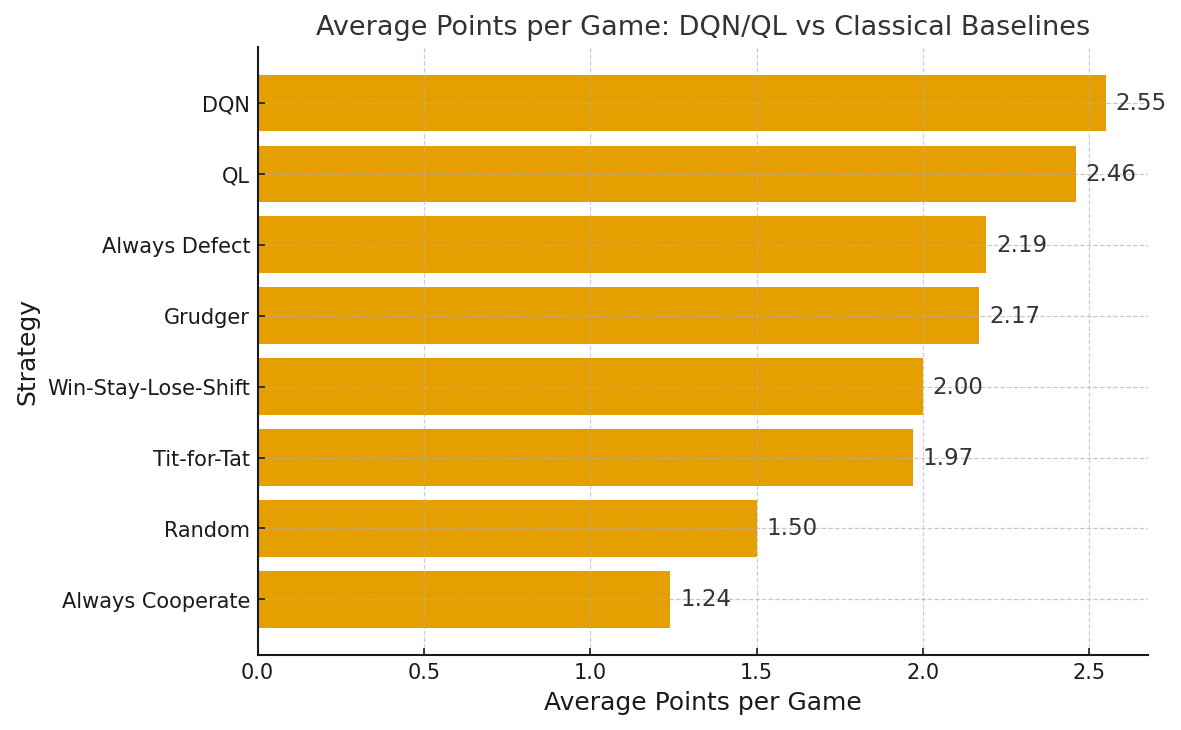
In game theory, there is a fundamental challenge about maintaining cooperation among selfish players, especially under practical noise. This study applies a noisy Iterated Prisoner’s Dilemma (IPD) model to investigate how learning strategies perform against classical strategies when players may receive false or misleading signals due to random observation errors. More specifically, this study compares Deep Q-Network (DQN) agents with basic Q-learning (QL) and several classical strategies such as Tit-for-Tat, Win-Stay-Lose-Shift, and Grudger. The experiment results show that when noise emerges, DQN agents not only achieve higher cumulative rewards than other strategies but also maintain more stability, adaptability, and resilience across repeated interactions. DQN agents’ deep neural structure helps them to capture long-term temporal dependencies, effectively differentiate accidental defections from intentional ones, and recover cooperation after disturbances by noise. These findings indicate that deep reinforcement learning is effective in noisy and imperfect settings. The findings also offers valuable insights for understanding the emergence of cooperation and for designing robust multi-agent decision-making mechanisms in noisy or uncertain environments.
Show more
Read Article PDF
Cite
Research Article Open Access
Enhancing Youth Engagement with Chinese Ancient Instruments Through Interactive Digital Tools and Pop Music Fusion
Article thumbnail
This research addresses how an interactive digital tool might emotionally connect the youth with their culture, concentrating on one of the oldest and richest traditions of China - ancient music. The application enables the user to be the instrumentalist of the virtual world through playing the guqin, bianzhong and some popular songs as well, all this while getting step-by-step instructions, a scoring feature, a playback feature, and cultural insights presented in the form of trivia tied to high scores. The purpose of the app is to use the emotional and cultural aspects to bring the past into the young people's present time and thus get them more involved. It was the systematic measures of cultural and musical engagement together with emotional reactions to learning and music that I used for the research whose participants were thirty-six young adults aged 18 to 25 and who completed a 14-day study, where the influence of the traditional cultural activities was compared with this interactive gamified method. The data imply that the app users practice the culture more deeply than other users, so interactive digital instruments can become a powerful tool to revive cultural heritage and, at the same time, make it more fun and educational. The research outcome can shape not only the future of cultural preservation but also that of education.
Show more
Read Article PDF
Cite