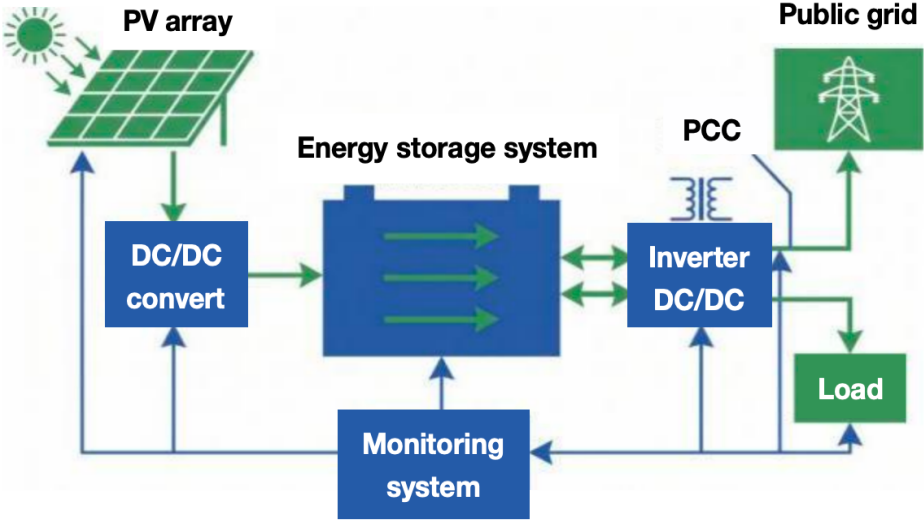
Against the backdrop of dual carbon targets and the rapid development of new energy systems, large-scale grid integration of distributed photovoltaic (PV) generation and battery energy storage system (BESS) has emerged as a crucial pathway for the energy transition. This paper systematically investigates the advantages and risks associated with grid-connected PV-BESS integration. This paper reviews the structural configurations and key technologies of distributed PV-BESS systems, and analyzes representative engineering projects and control/optimization methods, including AC-coupled and DC-coupled demonstration cases, grid-forming control based on virtual synchronous generator technology, and two-stage coordinated optimization using second-order cone programming (SOCP) relaxation. Results indicate that properly coordinated PV-BESS integration can effectively improve voltage quality, mitigate power fluctuations, enhance PV hosting capacity, and provide ancillary services. Nevertheless, it may also introduce voltage violations, power quality degradation, relay protection coordination challenges, and elevated investment costs. Furthermore, this paper presents constructive recommendations from technical, planning, economic, and policy perspectives, providing a reference for the safe and stable planning and operation of distributed PV-storage integration.