Articles in this Volume

Research Article Open Access
Robustness of Convolutional Neural Networks to Partial Test-Set Image Corruption on Fashion-MNIST
Article thumbnail
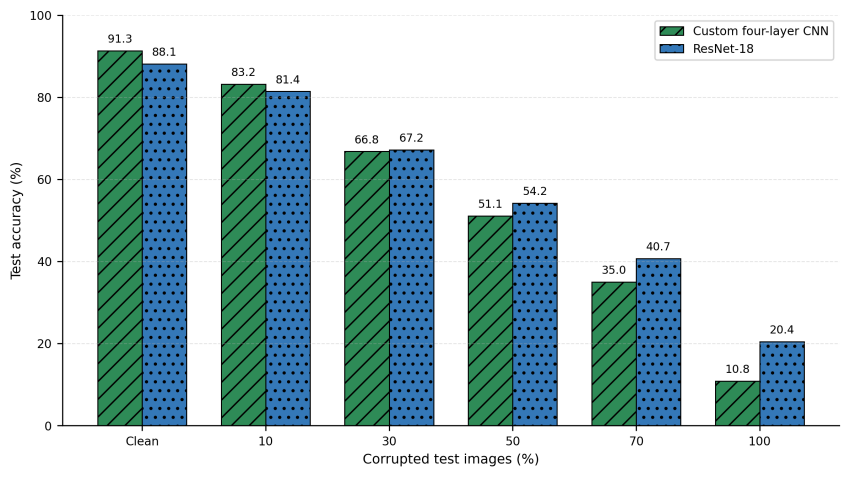
Image classifiers often report high accuracy on clean benchmark data, but in the real world, their inputs are not always clean. This paper tests how two convolutional models respond when part of the fashion-MNIST test set is deliberately corrupted. A custom four-layer convolutional neural network and an ImageNet-pretrained ResNet-18 were trained only on clean Fashion-MNIST images. A fixed corruption, Gaussian blur followed by contrast enhancement, was then applied to 0%, 10%, 30%, 50%, 70%, and 100% of the official test images. Both models used the same corrupted image set. Accuracy, mean predictive entropy, and t-distributed stochastic neighbor embedding plots were used to compare the runs. The custom model reached 91.31% accuracy on clean data but fell to 10.82% when every test image was corrupted. ResNet-18 started lower, at 88.10%, but reached 20.44% at 100% corruption. Entropy also rose with the corrupted percentage, from 0.1729 to 0.5379 for the custom model and from 0.1517 to 0.3073 for ResNet-18. These suggest that both clean-trained models were fragile under this specific corruption, while ResNet-18 held up better in this run. A possible explanation is that its deeper residual structure and ImageNet-pretrained layers preserved more coarse shape information after blur weakened fine local details.
Show more
Read Article PDF
Cite
Research Article Open Access
Research on Competitive Discourse Identification and Equity-Oriented Evaluation of Education Policy Based on Natural Language Processing
Article thumbnail
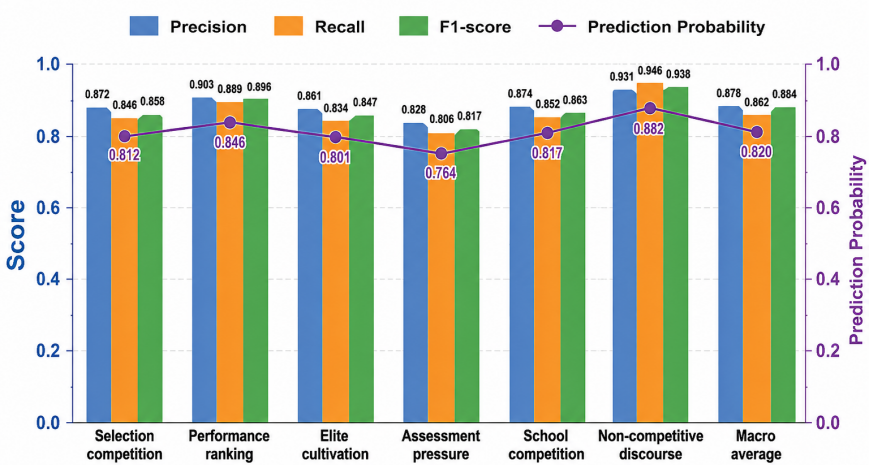
The current study offers a sentence-level natural language processing approach aimed at detecting competitive discourse and measuring equity orientation in education policy statements. The sample contains 800 policy statements published from 2015 to 2024 by national and provincial educational authorities. After being preprocessed and checked manually, 60,284 sentences from official education policies have been selected for further analysis. Competitive discourse is classified into five categories: selection competition, performance ranking, cultivation of elites, assessment pressures, and school competition. Meanwhile, equity orientation is measured on four levels: access, resource, process, and outcome equity. The BERT-Base model for Chinese was fine-tuned using a training set of 5,000 annotated sentences, and policy balance scores were obtained with the help of discourse and equity measurement indicators. Experiments based on simulated policy statements show that the accuracy of the classifier can be assessed as 0.884 ± 0.017. In addition, the findings confirm that policy balance scores improved starting from 2021 and concerning compulsory education and provincial-level policies.
Show more
Read Article PDF
Cite