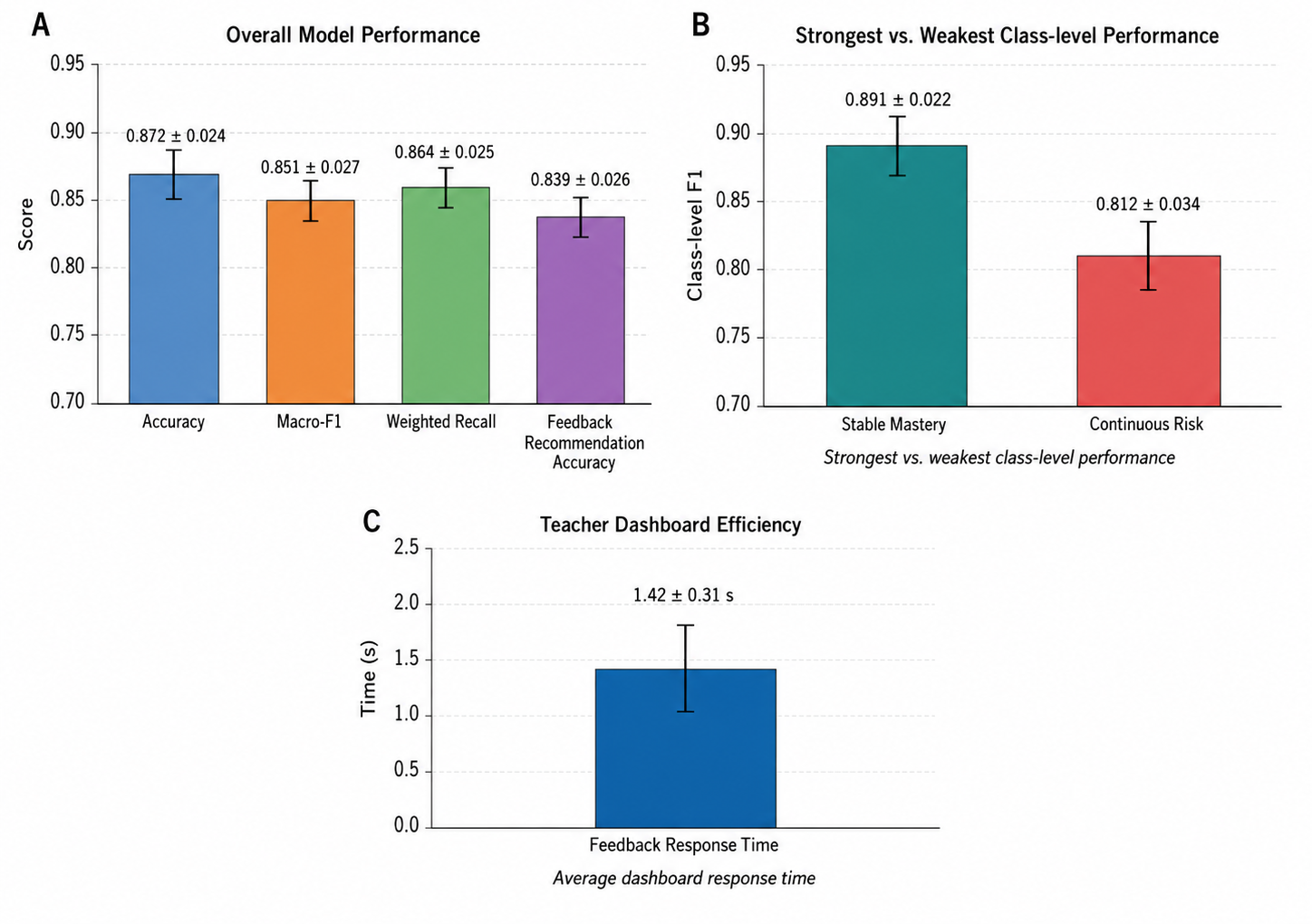
The proposed research presents a structure of a human-AI collaboration agent to provide dynamic feedback for a Chinese large-unit instruction context. The dataset consists of eight cycles of Chinese large-unit teaching sessions in Grade 5. It includes 320 participants from 32 lessons conducted in 32 classes. Data types involved include lesson plans, dialogue between students and teachers, workbooks, reading notes, vocabulary assignments, short compositions, test scores, graded rubrics for reading and writing, and teacher's feedback notes. The project was designed with Python 3.11, MySQL 8.0, BERT Base Chinese, LightGBM, and Vue teacher dashboard. Learning states of learners can be predicted through features connected with text understanding, task accomplishment, interaction engagement, and progress monitoring. The fixed target labels include stable mastery, partial knowledge, problems with expression, and constant vulnerability. The results prove that the learning state recognition model obtains accuracy of 0.872 ± 0.024, F1 score of 0.851 ± 0.027, and weighted recall of 0.864 ± 0.025. As compared to conventional human-only feedback, the human-AI collaboration improves performance at the following task by +0.184 ± 0.036, reduces mistakes repetitions by −0.217 ± 0.041, and increases unit posttest scores by +6.84 ± 1.27.