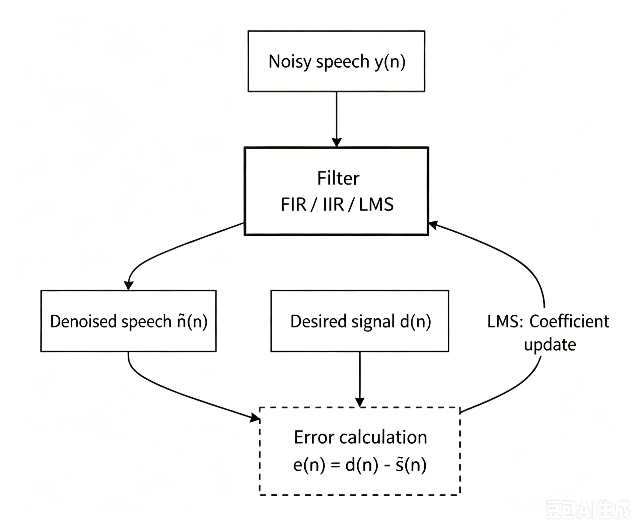
With the rapid development of information technology, communication systems are increasingly required to support stable, reliable, and real-time information transmission in complex environments. However, during practical communication transmission, signals are often affected by noise interference, channel fading, network jitter, multi-user interference, and packet loss. These problems may reduce speech intelligibility, increase bit error rates, cause video freezing, and weaken the continuity and reliability of communication services. Traditional enhancement techniques rely on stationary assumptions or fixed redundancy, and thus perform poorly under non-stationary noise or dynamically fluctuating network conditions. In recent years, deep learning-based methods have shown strong potential in learning nonlinear mappings from degraded to clean signals, offering better adaptability to diverse distortions. Nevertheless, the analysis shows that AI technology still faces practical deployment challenges, including high computational complexity, heavy dependence on large-scale labeled training data, and limited cross-scenario generalization capability, which require further optimization before such approaches can be reliably integrated into real-time audio/video communication systems.
Research Article
Open Access