Articles in this Volume

Research Article Open Access
Personalized Learning Path Optimization Based on Generative Artificial Intelligence
Article thumbnail
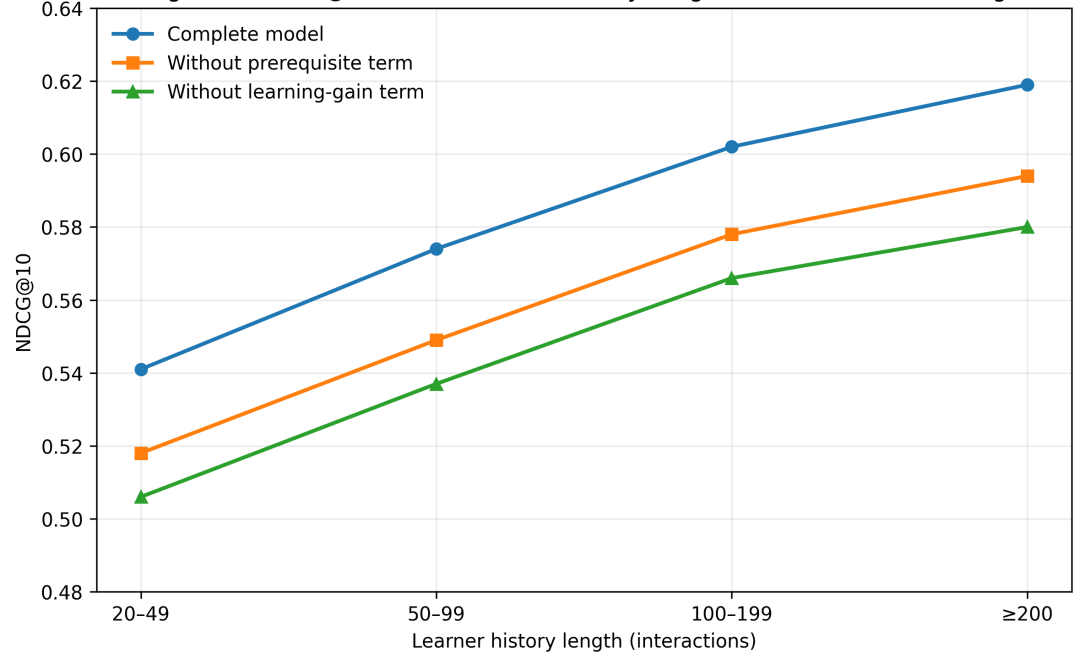
Learning paths personalized by behavior have become common among personalized learning systems. However, the traditional methods are usually inefficient at building coherent paths as the learner's knowledge state changes dynamically, and the prerequisite structure exists. In light of this problem, we present a generative learning-path optimization framework based on EdNet-KT1 interaction dataset, Transformer knowledge tracing model, Qwen2.5-7B-Instruct candidate generator, and constraint-aware reranking. Mastery profiles of learners are extracted, and then five ten-resource candidate paths are generated and sorted according to learning gain, prerequisites, difficulty deviation, and repetition. We compare our method to collaborative filtering, GRU4Rec, and knowledge-tracing greedy recommendation on offline experiments. The generative optimizer gets NDCG@10 of 0.589, future-concept coverage of 0.721, and prerequisite violation rate of 0.031, and thus outperforms the best baseline on all three metrics. Ablation analysis shows that the prerequisite violation rate rises to 0.091 without constraints, and the learning gain drops to 0.104 without the learning gain term, respectively. Moreover, the full model still achieves better NDCG@10 performance on all learner history categories than other baselines, costing 0.84 s per learner with the memory peak of 13.6 GB. This research demonstrates the effectiveness of combining the generation of learning paths with pedagogical constraints.
Show more
Read Article PDF
Cite
Research Article Open Access
Planning Paths for All-Terrain Vehicles in Unknown Environments
Autonomous all-terrain vehicles (ATVs) must be able to generate paths and maintain stable, executable vehicle motion in the face of varying, unknown conditions in off-road environments. This paper provides an overview of recent advances in terrain-aware motion modeling and autonomous path planning for ATVs. The first part of the manuscript discusses how characteristics of terrain such as slope, roughness, loose surfaces, vegetation, and uncertainty will impact slip, steering, vibrations, stability, and control of a vehicle. More recent studies rely on learning-based approaches, and uncertainty and motion are integrated into models of the terrain–vehicle interaction. The second part of manuscript focuses on planning methods for unknown environments.It discusses graph search,sampling-based approaches,and hierarchical planner,while also showing how these methods connect route selection with vehicle motion.In many cases,factors such as stability,uncertainly,and traversability are considered directly during the planning process. The planning methods reviewed in the manuscript integrate perception and control, actively leveraging the interaction with the environment. Planning methods have moved toward closed-loop control and interaction-based navigation. The integration of planning methods across vehicles, terrain types, and sensing and operational conditions will be the focus of future research to reduce planning complexity while ensuring planning and control methods operate safely and efficiently. This integration is important because it allows autonomous vehicles to operate more safety and efficiently in off-road environments that are both unfamiliar and constantly changing.
Show more
Read Article PDF
Cite
Research Article Open Access
Full-Process Protection Technology Path for Copyright Risks in Generative AI Training Data
Article thumbnail
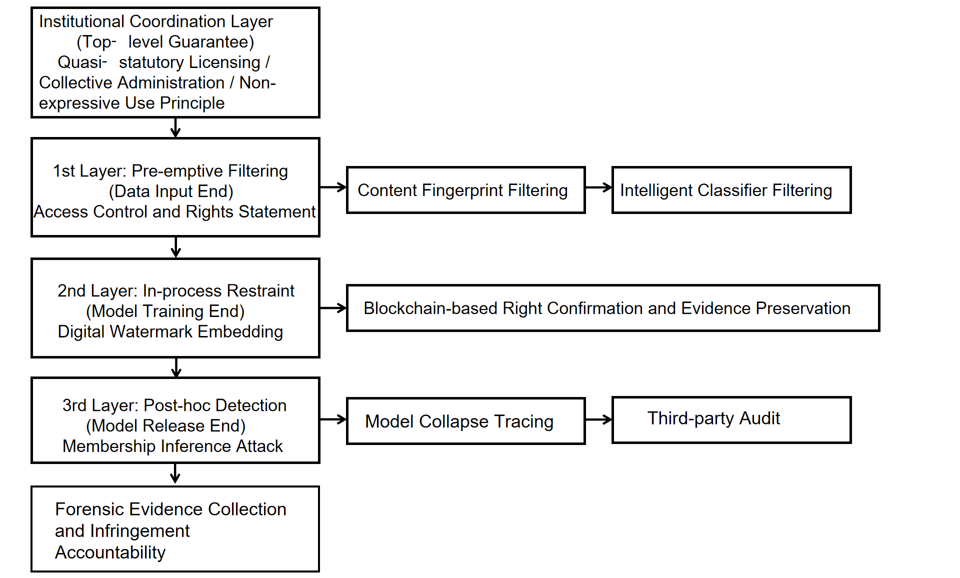
The rapid iterative development of generative AI technology is highly dependent on the supply of massive training data. The industry generally uses crawlers to grab Internet copyright works on a large scale for pre-training, which has led to global copyright disputes. The risk of copyright infringement in the acquisition and use of training data has become the core challenge restricting the development of industrial compliance. This article focuses on the complete life cycle of training data and explores three cutting-edge technological paths: pre-filtering of training data, in-process training constraints, and post-detection and evidence collection. Analyze the underlying operating principles of various technologies, conducts horizontal quantitative comparisons of mainstream technologies from four dimensions: detection accuracy, computing power cost, black-box adaptability, and judicial evidence collection effectiveness, and clarifies the practical bottlenecks of the existing protection system. The multi-layer technology defense and intellectual property system collaborative integrated protection framework is constructed in this article. It can achieve full process risk management of training data, reduce the probability of copyright infringement of large models, improve the efficiency of infringement tracing and evidence collection, and balance the protection of creator rights and the needs of AI technology innovation and development. This study can provide a complete theoretical basis for the construction of data compliance pipelines for large model enterprises, the development of industry compliance technical standards, and the improvement of digital supervision of intellectual property rights.
Show more
Read Article PDF
Cite
Research Article Open Access
Current Development Status and Application Scenarios of Exoskeleton Robot Technology
Exoskeleton robotics technology is a new kind of wearable bionic device that has been applied in various fields, such as healthcare and industry. However, there are still many development bottlenecks in the technology due to market and core-technology problems. The development history of exoskeleton robot technology, its applications in medical rehabilitation, outdoor walking assistance and industrial production, problems and future development directions of this technology are introduced in this paper. This paper studies the concept of passive exoskeletons and the development of the Hardiman project in the 1960s, and also analyzes the current progress in core technology and the emergence of commercial products. The first is to introduce the technical features of some typical products and compare differences in driving modes, intention recognition, safety and application subjects for exoskeleton robots in different use cases. Finally, this paper will summarize the current problems in technology for cost control, energy supply and human-computer interaction, and look ahead to the future development direction of new materials, integration of artificial intelligence and multi-area expansion
Show more
Read Article PDF
Cite
Research Article Open Access
Drive Structures and Whole-Body Coordinated Control Methods for Humanoid Robots
Humanoid robots require both high-performance drive structures and effective whole-body coordinated control to achieve dynamic motion, load transportation, and complex whole-body movements. This paper reviews the relationship between mechanical drive design and coordinated control methods for humanoid robots, with particular emphasis on the constraints imposed by actuator torque, mass distribution, transmission characteristics, and real-robot dynamics. At the hardware level, high-torque-density modular joints, lightweight transmissions, hybrid serial-parallel mechanisms, and drive-layout optimisation are examined in terms of their effects on joint torque, moving mass, and motion capability. At the control level, multi-joint coordinated motion control, model predictive control, reinforcement learning, and dynamics adaptation methods are discussed for maintaining stability and improving actuator utilisation under contact and joint constraints. The review further considers the differences between idealised simulation models and physical robots caused by friction, hysteresis, drive-torque deviations, contact compliance, and communication delays. The analysis indicates that drive structures establish the hardware boundaries of humanoid motion capability, while whole-body coordinated control determines how effectively these capabilities can be realised during operation. The paper therefore highlights the importance of integrated electromechanical and control co-design, including joint parameters, drive layouts, mass distribution, state estimation, and dynamics adaptation, as a potential direction for improving the robustness and efficiency of humanoid robots.
Show more
Read Article PDF
Cite
Research Article Open Access
Open-Vocabulary Object Detection Based on Context-Awareness and Hierarchical Classification
In real-world open-scene scenarios, object detection often suffers from bottlenecks such as uneven distribution of tail classes, failure to detect small objects and corruption due to background noise and that is why traditional closed domain detection algorithms will behave badly when presented with new or unlabeled classes. The paper proposes an object detection architecture that can support open vocabulary conditions, named APOVD-Net (Adaptive Prompt Open Vocabulary Detection Network). To address the issue, the network adopts a hierarchical classifier, which follows a coarse-to-fine, large-to-small framework and uses hierarchical semantics routing to provide finer disambiguation. Additionally, a dual-confidence adaptive evaluation is suggested to get a dynamic trade-off in the spatial localization accuracy and cross-modal semantic agreement. Experiments conducted on the official LVIS v1.0 validation set show that APOVD-Net outperforms in both average precision (mAP) and rare category detection rate (Rare AP), although with a very high inference rate, and can be regarded as a viable intelligent visual perception framework for open environments.
Show more
Read Article PDF
Cite
Research Article Open Access
Powering Development? Chinese Energy Investment, Artificial Intelligence, and Local Electrification in Africa
Article thumbnail
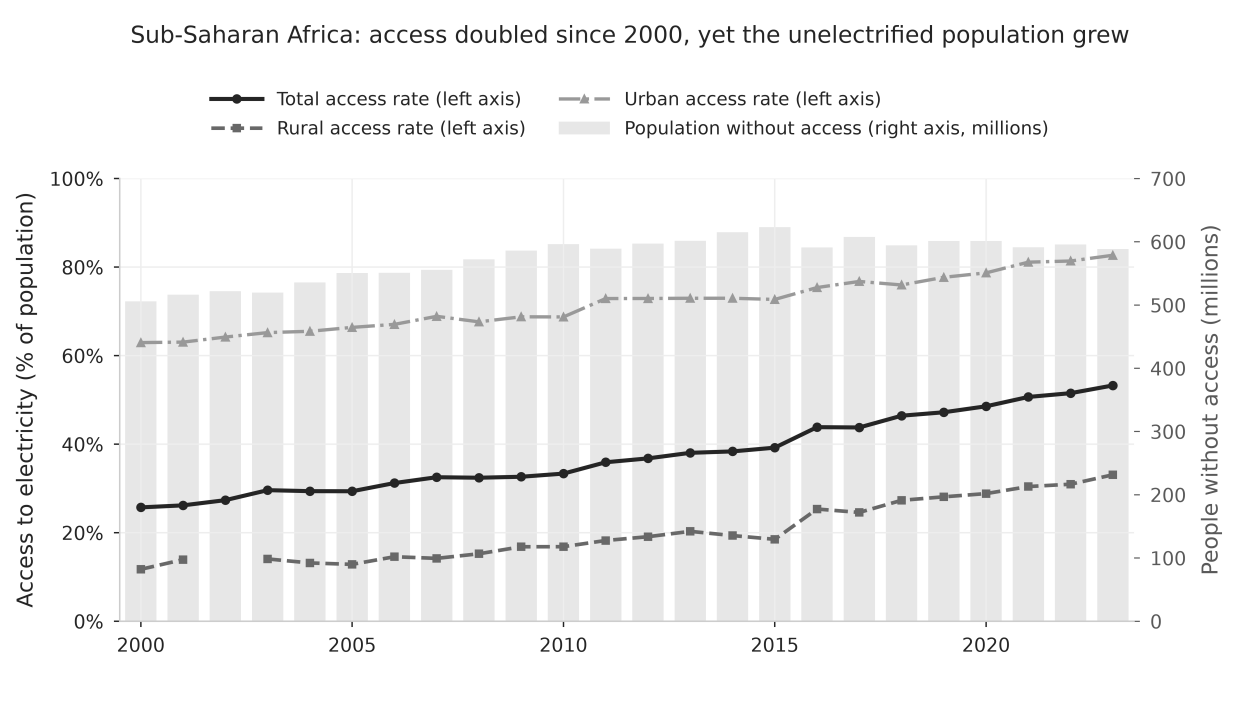
Access to electricity is a prerequisite for modern economic life, yet in 2023 roughly 666 million people still lived without it, 85 percent of them in Sub-Saharan Africa [1]. This paper asks whether Chinese energy investment has powered local electrification in Africa, where the pay-as-you-go (PAYG) off-grid solar model can succeed where sovereign finance has been weak, and what artificial intelligence (AI) can add to both. Linking the complete loan record of the Chinese Loans to Africa (CLA) Database - 1,319 commitments, US$180.87 billion, 2000-2024 - to World Bank access indicators for 18 Sub-Saharan countries over 2000-2023, we find no detectable country-level association between cumulative Chinese energy finance and electricity-access gains, in the cross-section (r = -0.08, p = 0.75) or in two-way fixed-effects panels. The reason is structural: the portfolio is concentrated in hydropower and extraction-linked oil finance, and in a handful of borrowers - Angola alone absorbed 41 percent of energy lending. Meanwhile, PAYG off-grid solar expanded along exactly the affordability margin the megaprojects miss: its share of affiliate off-grid sales rose from 24 to 39 percent over 2018-2023, driving 94 percent of affiliate sales growth and supplying most of the region's new connections. Finally, we show that AI attacks the information margin that both channels lack: machine learning maps the unelectrified from satellite imagery, scores repayment from mobile-phone metadata, and verifies impacts cheaply enough to make results-based finance credible - even as AI's own data centres triple their electricity demand by 2030. The future of African electrification is 'pay as you go, power as you grow', with AI as the sensing and verification layer that makes the model investable.
Show more
Read Article PDF
Cite
Research Article Open Access
Material Perception in Interactive 3D Food Animation: Combining Procedural Modelling, Shading and Motion Cues
Article thumbnail
Computer graphics can communicate not only object geometry but also perceived physical properties through surface appearance, illumination, and motion. This study investigates how static visual cues and dynamic motion cues work together to communicate contrasting materials in an interactive 3D food animation. A Chinese New Year food scene was developed using OpenSCAD and Three.js, contrasting a brittle almond pastry with a soft, translucent crystal osmanthus cake. Procedural modeling, triplanar texture mapping, physically based material parameters, multi-source lighting, geometry switching, particle effects, vertex deformation, and secondary motion were combined to construct the two material behaviors. An audience evaluation involving 22 participants was conducted using five-point rating scales. Overall visual quality received a mean rating of 4.09/5, while material-behavior consistency received 3.95/5. The almond pastry received a perceived-brittleness score of 3.86/5, while the crystal cake received a softness/elasticity score of 3.95/5. Crumb particles and post-movement wobbling were the most frequently identified cues for brittleness and softness, respectively.
Show more
Read Article PDF
Cite
Research Article Open Access
Research on Generative Artificial Intelligence Assisted Methods for Guzheng Composition
Article thumbnail
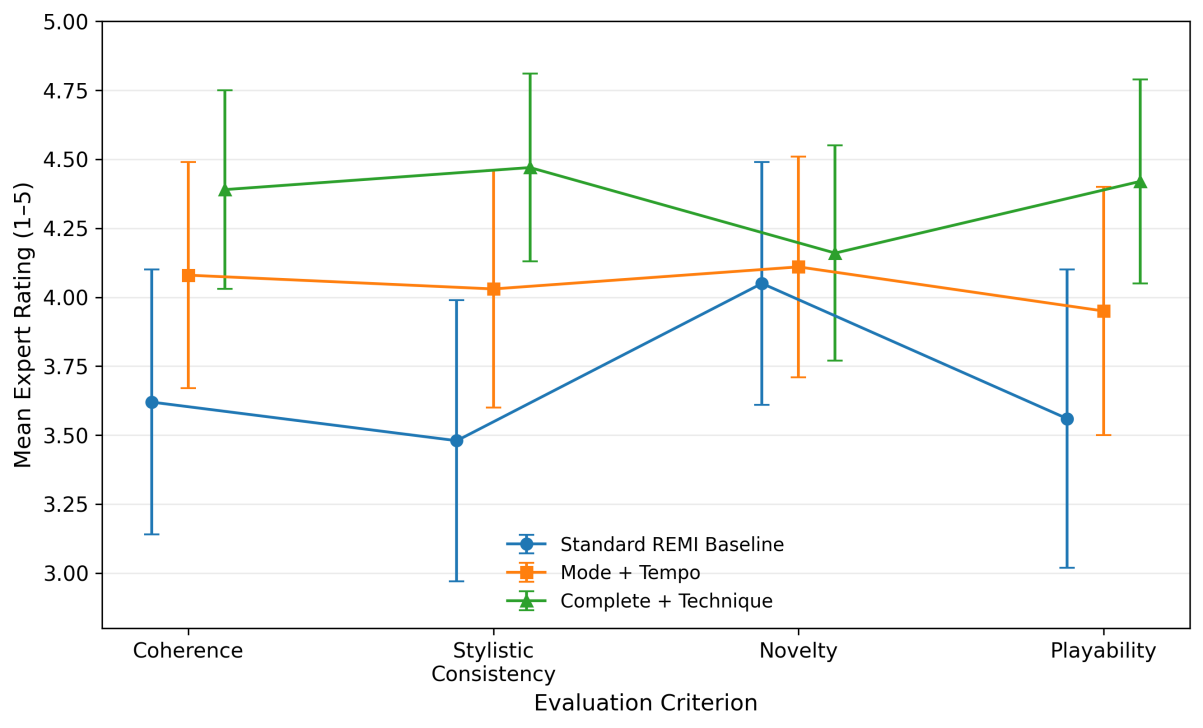
The creation of Guzheng music involves a coordinated management of modes, melody, phrasing, and performance techniques, whereas the generic symbolic music generator often represents pitch and rhythm better than specific Chinese instrumental characteristics. A framework for controlling the process of generative artificial intelligence creation based on the solo scores with the licensed or open access with REMI event encoding and the six-layer Transformer decoder is created. Modes, tempo, two-bar motif seeds, and tokens of sliding, bending, vibrato, and tremolo techniques are included in the list of generation conditions explicitly. Three configurations are tested on the basis of pitch distribution distance, rhythmic similarity, modal tone ratio, repetition frequency, novelty of n-grams, structural length validity, and evaluation by experts. Full model brings the value of pitch distribution distance to 0.098 ± 0.019, increases the modal tone ratio to 0.934 ± 0.024, and achieves the structural length validity of 0.946 ± 0.025. Expert evaluation scores become 4.47 ± 0.34 in stylistic consistency and 4.42 ± 0.37 in playability, while novelty score remains 4.16 ± 0.39. These findings show that the combination of symbolic control and conditioning with Guzheng technique brings an improvement of structural validity, stylistic appropriateness, and usability without reduction of novelty.
Show more
Read Article PDF
Cite
Research Article Open Access
Artificial Intelligence in Genetic Testing: From Variant Calling to Variant Interpretation
Article thumbnail
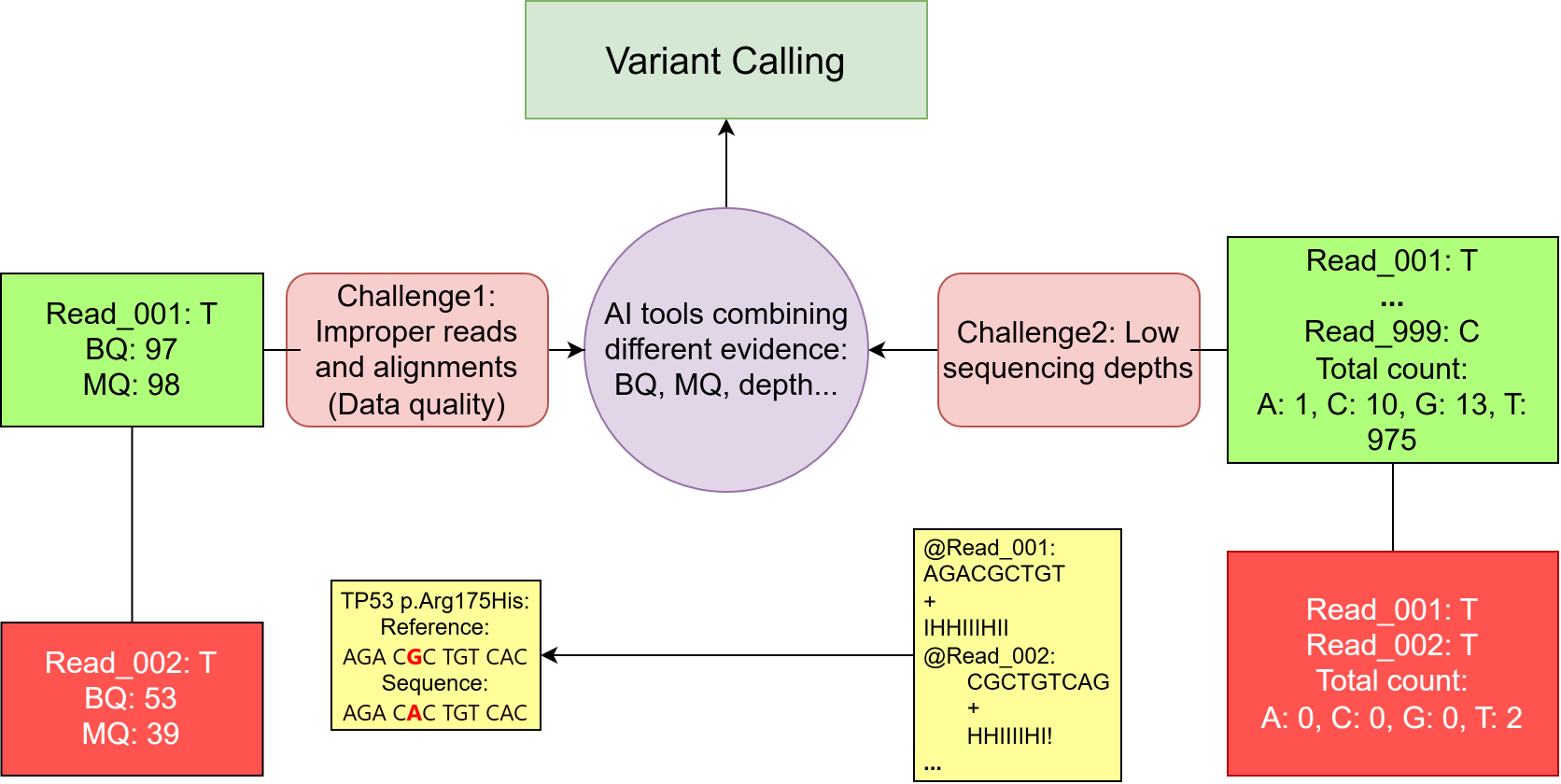
Genetic testing may help diagnose diseases by finding genetic variants, with variant calling and variant interpretation as its main steps. Variant calling compares sequencing data with a reference genome and identifies possible variants. Variant interpretation then assesses whether these variants may cause disease by using different types of evidence, such as allele frequency, phenotype matching, review status, and familial evidence. However, sequencing noise, alignment problems, and complex disease mechanisms can still affect both steps and reduce the accuracy of genetic testing. Artificial Intelligence (AI) tools can find patterns across these processes, but they currently work mainly as decision-support tools rather than independent evaluators. They also face three main problems: poor performance across different datasets, unexplainable outputs, and frequent errors in training data. New multimodal models and foundation models may help combine more types of information. Still, researchers need to confirm their safety and performance in clinical settings. This review examines the value of AI tools in genetic testing and discusses the main barriers to their independent use. It also explains why human expertise remains essential for final clinical diagnosis.
Show more
Read Article PDF
Cite