Articles in this Volume

Research Article Open Access
Privacy-Preserving Multi-Modal Bearing Fault Diagnosis: Dynamic FedProx Regularization Combined with Dual-Branch SE Attention Fusion
Article thumbnail
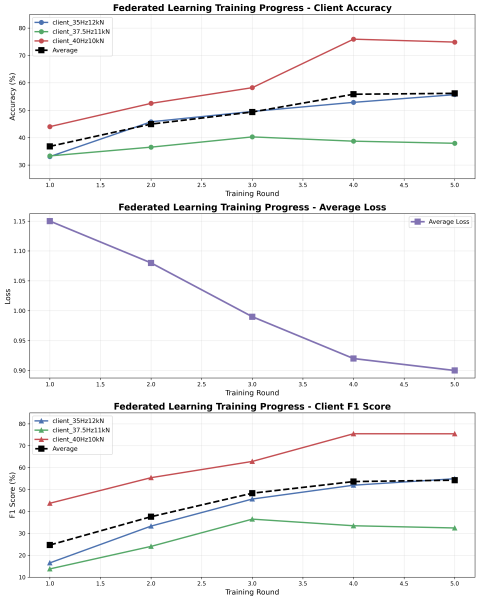
Bearing fault diagnosis in modern industrial applications frequently encounters severe challenges due to data privacy fragmentation, domain shifts induced by varying working conditions, and the insufficiency of single-sensor information. To address these critical bottlenecks, this paper proposes a multi-modal domain generalization federated learning framework. Specifically, a dual-branch 1D-CNN feature extraction network is constructed to independently process horizontal and vertical vibration signals, which are then integrated using multi-scale convolutional blocks and a Squeeze-and-Excitation (SE) channel attention mechanism for robust feature fusion. Furthermore, to mitigate the client drift issue caused by non-IID data distributions across different rotational speeds and loads, a FedProx-based federated optimization strategy with a dynamic proximal term regularization is implemented. Extensive experiments conducted on the XJTU-SY bearing dataset demonstrate that the proposed framework achieves an overall classification accuracy of 67.20% and an F1-score of 67.32% under strict differential privacy constraints (DP-SGD noise multiplier = 0.05). Compared with the baseline federated model, the optimized version provides a significant performance gain of +12.37% in diagnostic accuracy. The proposed approach successfully strikes an optimal balance between data privacy protection and cross-condition domain generalization, offering a reliable paradigm for distributed industrial intelligent maintenance.
Show more
Read Article PDF
Cite
Research Article Open Access
Report on the Deep Learning Transformation Project Concerning LLM-Based Automated Reward Design and Value Alignment
Article thumbnail
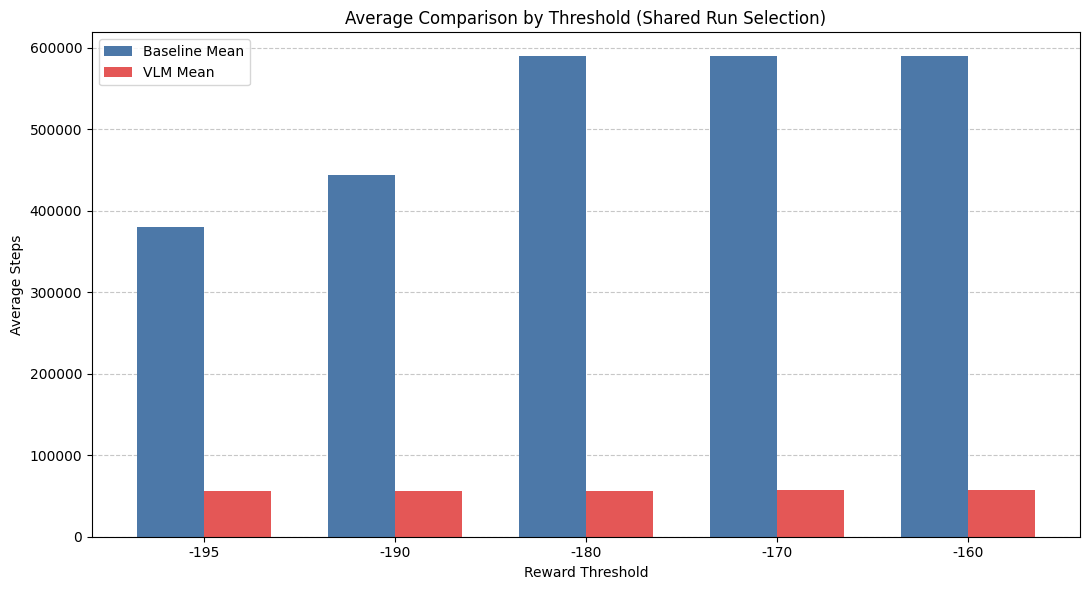
The report gives a very clear, systematic exposition of the major shortcomings in current Large Language Model (LLM)-based automated reward design methods for reinforcement learning, and after a careful analysis of EUREKA and LEARN-Opt, it naturally and elegantly identifies two fundamental issues: dependence on environment source code and absence of mathematical guarantees for policy optimality. In view of the existing limitations, this paper proposes a well-designed framework that combines Vision-Language Models (VLMs) for visual observation, Graph-of-Thoughts for hierarchical task decomposition, and Potential - based Reward Shaping for theoretical safety guarantees, hence naturally solving the problem of code dependency by using pure visual feedback and reducing generation variance by structured decomposition. The paper presents a method that achieves policy invariance by means of mathematically constrained reward generation, and accordingly gives a clear, logically organized discussion of the problem analysis, theoretical background, proposed approach, implementation architecture, current results, and experimental validation plan. It makes a very natural and important contribution to building robust, generalizable, and theoretically sound automated reward design systems.
Show more
Read Article PDF
Cite