
Articles in this Volume

Research Article Open Access
A Survey on Resource Scheduling and Optimization for Space‑Air‑Ground Integrated Communication‑Sensing‑Computation Networks
Article thumbnail
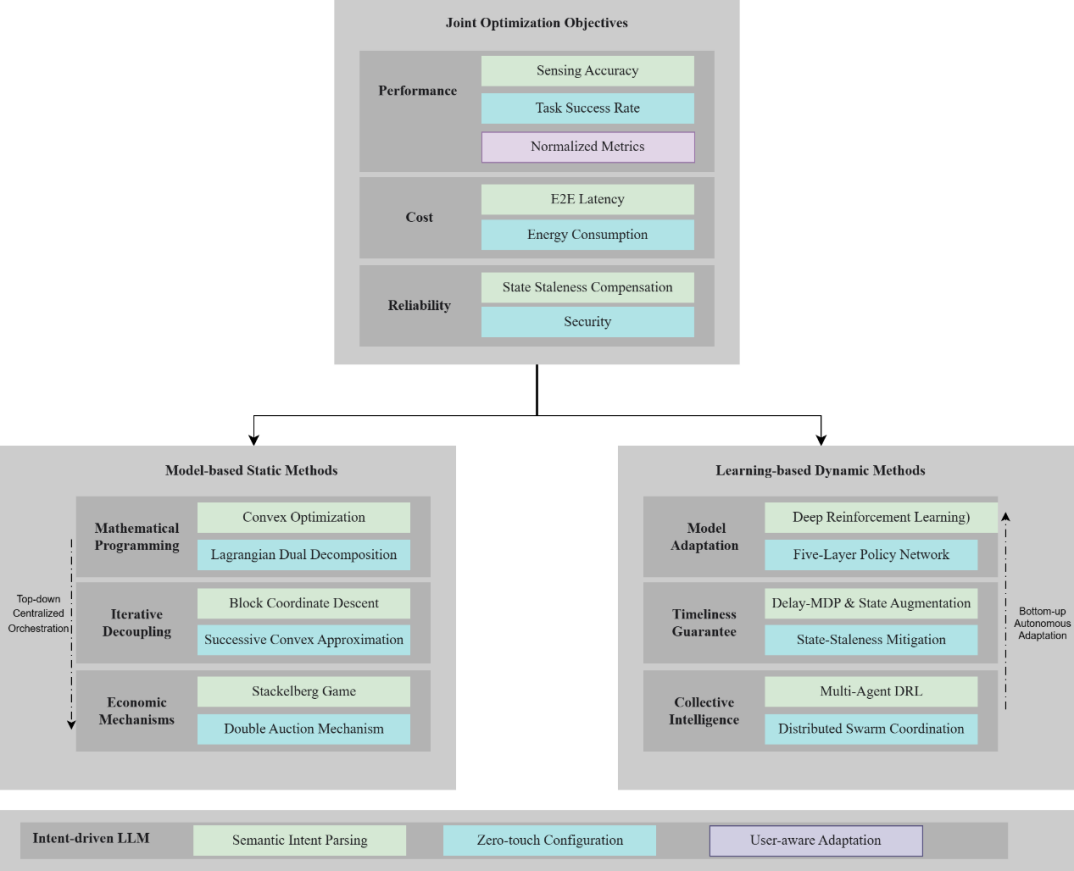
The development of sixth generation (6G) communications is aimed at achieving global connectivity, covering oceans and remote areas with limited ground infrastructure. With the integration of sensing, communication and computing (ISCC) technology, the space-air-ground integrated network (SAGIN) is evolving from a simple data transmission channel to an intelligent task processing platform. This paper uses a narrative review method to analyze the evolution path of resource orchestration technology in heterogeneous environments, and focuses on mathematical programming and data-driven intelligent methods to optimize resources. The existing research is classified according to the method system. This paper also examines the architecture paradigm, multi-dimensional resource modeling and algorithm system. Studies have shown that static methods such as Lagrangian dual decomposition and block coordinate descent provide the necessary performance benchmarks, and deep reinforcement learning can achieve fast response in high mobility links. In addition, this paper discusses the potential of large language model (LLM) as a semantic interpreter, which can accelerate the process of parsing task requirements into technical constraints in specific applications. This study provides a methodological reference for achieving task-centered connectivity, and believes that a hybrid framework that combines the accuracy of deterministic methods and the adaptability of learning methods is a feasible development direction for future space infrastructure.
Show more
Read Article PDF
Cite
Research Article Open Access
Deep Learning-Based Channel Equalization for Visible Light Communication Systems
Visible light communication (VLC) gets increasing attention with the continuous advancement of technology. In contrast to conventional wireless networks, VLC possesses numerous innovative advantages. It has an abundant optical spectrum with immunity to radio-frequency interference. More importantly, its compatibility with existing lighting infrastructure demonstrates its broad applicability. However, high-speed VLC systems still need to address numerous challenges during communication such as limited LED bandwidth, inter-symbol interference, device nonlinearity, and receiver noise. Due to the above-mentioned factors, the channel equalization becomes an important physical-layer function. This paper aims to clarify the strengths and limitations of different deep learning-based channel equalization methods with cross-method comparison. Meanwhile, finds suitable application scenarios for different VLC systems. This review explores neural-network architectures including artificial neural networks, convolutional neural networks, long short-term memory networks, and hybrid/model-driven structures. Finally, it also illustrates the importance of lightweight designs. The analysis shows that no single architecture is optimal for all VLC conditions. ANN is effective for nonlinear mapping, CNN is suitable for local feature extraction, while LSTM performs better for channel memory and inter-symbol interference.
Show more
Read Article PDF
Cite