Articles in this Volume

Research Article Open Access
Multimodal Recommendation Systems for Cultural and Tourism Applications: A Survey and Future Directions
Traditional cultural tourism interest point recommendation systems rely solely on single-modal data modeling, they fail to accurately uncover tourists' deeper preferences and dynamic travel needs, making it difficult to meet the evolving demands of contemporary cultural tourism consumption. This paper reviews the multimodal data architecture in the cultural tourism domain, categorizes cultural tourism data into five major types, and clarifies the applicable scenarios and application advantages of various domestic and international datasets. Furthermore, leveraging cutting-edge technologies, this paper constructs a comprehensive multimodal recommendation framework for cultural tourism. Subsequently, from the two core dimensions of data and algorithms, the paper conducts an in-depth analysis of the key bottlenecks and practical implementation challenges in current research and, in alignment with industry development trends, proposes several forward-looking research directions. This study enhances the theoretical and technical framework for multimodal recommendation in cultural tourism, providing a solid theoretical basis and engineering reference for numerous smart cultural tourism scenarios.
Show more
Read Article PDF
Cite
Research Article Open Access
Artificial Intelligence-Assisted Detection of Intracranial Aneurysms on CTA and TOF-MRA: Small Lesions, Error Patterns, and Human–AI Collaboration
Article thumbnail
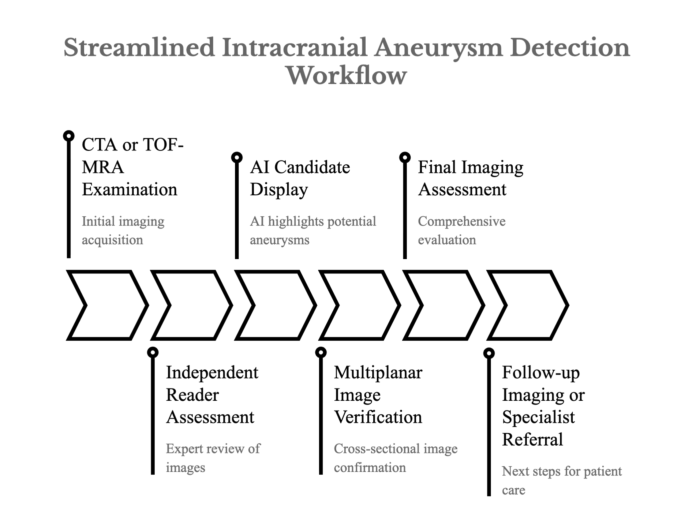
Accurate detection of intracranial aneurysms is essential for further imaging assessment, specialist referral, and clinical management. Computed tomography angiography and time-of-flight magnetic resonance angiography are commonly used non-invasive methods for cerebrovascular examination. However, small aneurysms may go unnoticed due to their limited size, complex vascular anatomy, and imaging artifacts. Artificial intelligence (AI) can automatically identify suspicious lesions and may improve reader performance. This review summarizes studies published between 2022 and 2026 on AI-assisted detection of intracranial aneurysms using computed tomography angiography and time-of-flight magnetic resonance angiography. It focuses on the detection performance for small lesions, common false-positive and false-negative patterns, and the clinical value of human–AI collaboration. Current evidence suggests that artificial intelligence provides satisfactory overall detection performance. In some studies, it also improved clinicians' detection sensitivity and reading efficiency. However, aneurysms measuring ≤3 mm and some atypical lesions remain difficult to detect. Increasing model sensitivity may also result in more false-positive markings. Incorrect artificial intelligence suggestions may further lead to automation bias. At present, AI is more suitable as a lesion-alert tool and a second reader than as a replacement for clinicians in final diagnosis. Future research should investigate the causes of detection errors in relation to dataset composition, model design, external validation, and human–AI interaction. Diagnostic performance, false-positive burden, and effects on patient management should also be evaluated in real clinical settings.
Show more
Read Article PDF
Cite
Research Article Open Access
AI‑Driven Multi‑Omics Integrative Model for Predicting Tumor‑Specific Drug Responses
Article thumbnail
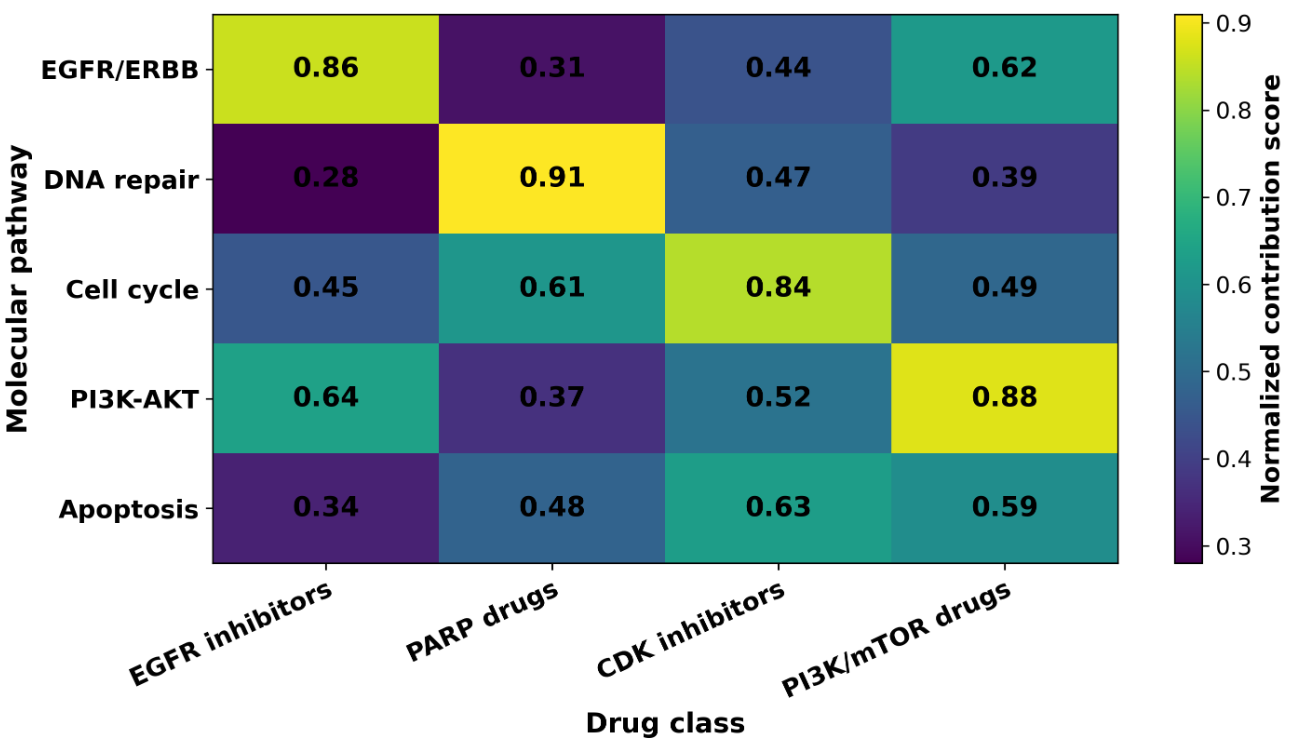
Precision oncology requires robust drug-response prediction because single biomarkers cannot fully explain therapeutic variation across tumors, cell lines, and drug structures. This study develops an AI-driven multi-omics model using GDSC, CCLE, DepMap, CTRP, and TCGA data, integrating mutation, copy-number variation, RNA expression, DNA methylation, drug SMILES, and IC50/AUC responses. Omics features are encoded separately, drug structures are modeled with a graph attention network, and cross-attention learns tumor-drug interactions. The model outperforms Elastic Net, Random Forest, XGBoost, and DeepCDR-style baselines, achieving RMSE of 0.684±0.014 and AUC of 0.872±0.011. Interpretability analysis highlights EGFR/ERBB, DNA repair, cell cycle, and PI3K-AKT pathways, demonstrating that multi-omics fusion and drug-structure modeling improve prediction stability and support interpretable precision-oncology drug screening.
Show more
Read Article PDF
Cite
Research Article Open Access
Research on the Prediction of the Remaining Life of Rolling Bearings Based on Long Short-Term Memory (LSTM)
Article thumbnail
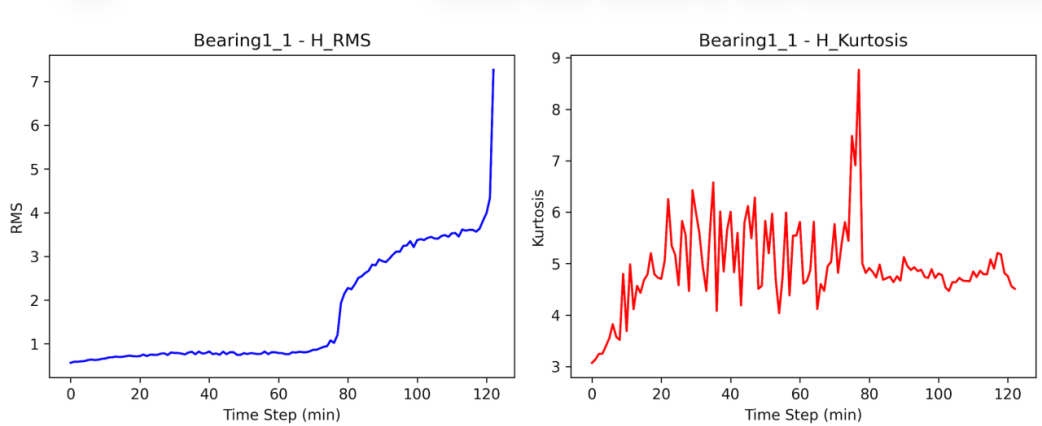
Rolling bearings are key components in rotating machinery. Their wear and failure can cause the entire equipment to stop operating. Therefore, it is extremely necessary to predict their remaining useful life (RUL). However, in reality, the wear of bearings does not change linearly and the uncertainty over time makes predicting RUL challenging. To address this issue, this paper proposes an end-to-end RUL prediction framework that combines multi-dimensional time-domain feature extraction with stacked long short-term memory (LSTM) networks. By extracting eight time-domain statistical indicators (such as RMS and Kurtosis), and using the sliding window mechanism to construct the feature sequence, it is input into the stacked LSTM model to capture the continuous degradation trajectory. The 15 bearings in the XJTU-SY benchmark dataset were evaluated against the ground-truth degradation targets. Experimental results show that the proposed framework can capture the degradation trends under different working conditions. The predictions are less accurate in the early stage, mainly because the time-domain features remain relatively stable during this period. However, the model provides reasonable overall accuracy and follows the degradation trend well in the later stage.
Show more
Read Article PDF
Cite
Research Article Open Access
From System Compensation to Semantic Adaptation: A Critical Survey of Latency Mitigation in Vision-Based Gesture Interaction
Article thumbnail
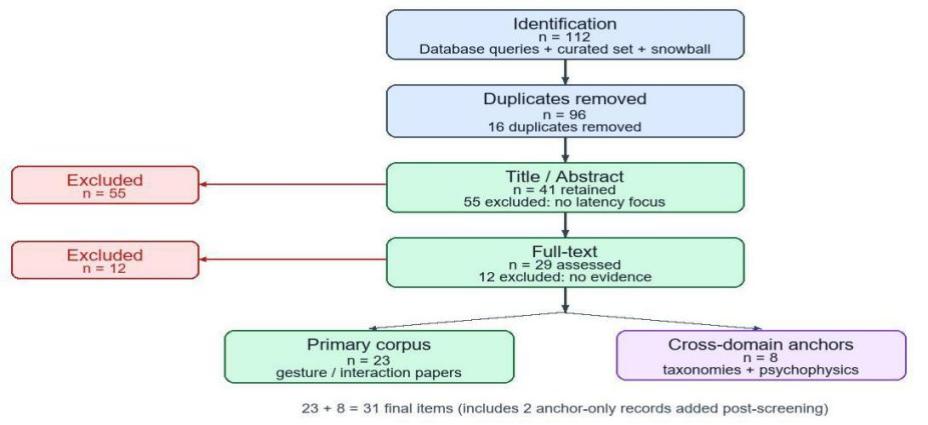
Vision-based gesture pipelines run sub-30 ms per frame, yet closed-loop interaction often exceeds ~200 ms. This study treats latency as an end-to-end property spanning perception, inference, decision and feedback. This critical survey synthesizes a purposively screened corpus of gesture and adjacent interactive systems (2020–2026), plus foundational anchors. This study uses a three-layer taxonomy: system compensation, semantic adaptive inference, and hybrid semantic–system coordination. This study finds that system-level remedies dominate MediaPipe-era pipelines but remain blind to recognition uncertainty. Semantic adaptivity optimizes compute under uncertainty but is rarely bound to interactive latency service level objectives (SLOs). The missing link is the runtime interface between confidence and load. This paper proposes a three-layer taxonomy that defines hybrid coordination as a missing layer, identifies the perception–E2E latency gap as the central empirical blind spot, and formalizes Load–Confidence Coupling as a testable proposition with falsification criteria.
Show more
Read Article PDF
Cite