Articles in this Volume

Research Article Open Access
Benchmarking Pre-Trained Vision-Language Models for Bidirectional Image-Text Retrieval on MS-COCO: BERT+ResNet, CLIP, and BLIP
Article thumbnail
Bidirectional image-text retrieval evaluates whether a model can align visual and textual representations for both text-to-image and image-to-text search. This paper presents a controlled benchmark on the Microsoft Common Objects in Context (MS-COCO) Karpathy split, using the same 5,000-image test gallery, 25,000 captions, similarity-matrix layout, and Recall@K/Recall Sum (RSUM) evaluation for four settings: a frozen Bidirectional Encoder Representations from Transformers (BERT)+ Residual Network (ResNet) dual encoder, Contrastive Language-Image Pre-training (CLIP) Vision Transformer Base (ViT-B)/32 zero-shot, CLIP ViT-B/32 fine-tuned on COCO, and Bootstrapping Language-Image Pre-training (BLIP) image-text contrastive only (ITC-only). The results show a clear gap between independently combined unimodal encoders and pre-trained vision-language models. BERT+ResNet obtains RSUM 148.740, while CLIP zero-shot reaches 361.868. Fine-tuning CLIP improves RSUM to 423.496, while the COCO-trained BLIP checkpoint evaluated with ITC-only scoring achieves the strongest result in this experiment, with RSUM 489.588. Image-to-text retrieval scores higher under COCO's asymmetric protocol, while longer captions are associated with higher text-to-image recall. Qualitative errors center on attributes, counting, spatial relations, and plausible false negatives. These results characterize the evaluated checkpoints and training conditions on this benchmark; they do not establish a universal model hierarchy.
Show more
Read Article PDF
Cite
Research Article Open Access
Research on Public Cognition Prediction Models for Audiovisual CSR Communication Based on Multimodal Semantic Fusion
Article thumbnail
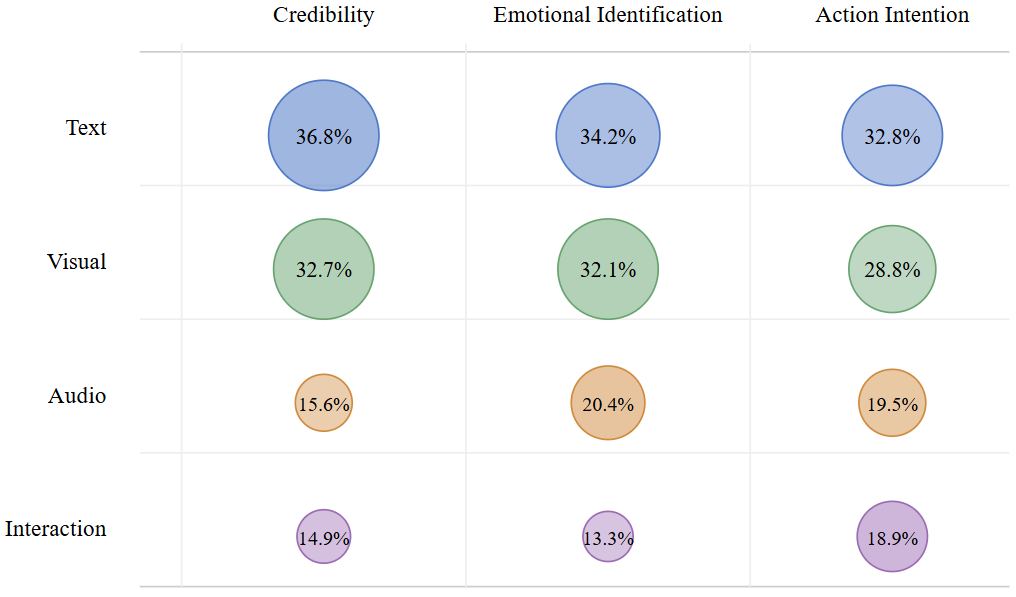
Digital platforms have transformed CSR communication from textual disclosure into audiovisual and interactive expression, where public cognition is shaped by visual, textual, audio, and platform features. This study combines film-based audiovisual analysis with multimodal learning to predict public cognition of CSR videos from 2020–2024. Key frames, subtitles, comments, audio affect, and interaction data were extracted, while cognition labels covered responsibility credibility, emotional empathy, and action intention. The cross-modal Transformer achieved 0.861 Accuracy, 0.858 Macro F1, and 0.902 AUC, outperforming single-modality and traditional fusion methods. Textual, visual, audio, and interaction features contributed 34.6%, 31.2%, 18.5%, and 15.7%, respectively. The findings show that public cognition results from the combined effects of responsibility narration, visual evidence, sound emotion, and platform interaction, providing a computational approach to audiovisual interpretation in film studies.
Show more
Read Article PDF
Cite
Research Article Open Access
RoundValue: A Complete-Trajectory Audit of Repair, Harm, and Correct-Candidate Non-Uptake in Multi-agent Reasoning
Article thumbnail
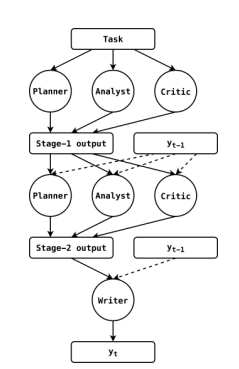
Additional rounds of multi-agent deliberation may correct, preserve, or worsen an earlier answer, but endpoint accuracy alone cannot reveal these trajectory-level events. RoundValue provides a trajectory audit of the full five-round, seven-call-per-round debate process using 350 stored trajectories from seven 50-task model–benchmark conditions. For locally served profiles, outputs are capped at 768 tokens. The framework measures round-level accuracy, adjacent correction and degradation transitions, six task-level trajectory archetypes, and the relationship between blind Stage-1 correct-candidate emergence and Writer ever-repair. Across conditions, R1-to-R5 accuracy changes range from +6 to −6 percentage points. Repair occurs in six conditions, while answer degradation affecting initially correct responses also appears in six. On Human Annotated Reasoning Problems (HARP), Mistral-7B shows at least one incorrect intermediate checkpoint in 8 of 10 R1-correct trajectories, with five recovering by R5. Correct candidates emerge without Writer repair in six of seven conditions, while two repairs occur without detected structured candidate emergence. These results show that additional rounds can both repair and degrade answers, and that candidate emergence and Writer repair are distinct empirical events.
Show more
Read Article PDF
Cite
Research Article Open Access
T erramechanics - B ased T raversability of M obile R obots on C omplex T errain
The traversability of wheeled and tracked mobile robots on deformable terrains such as soft sand, muddy ground, and gravel depends on the mechanical interaction between the wheel/track and the ground. Over the past six decades, four modeling paradigms have been developed to address the traversability of mobile robots: the semi-empirical, continuum mechanics, granular mechanics, and data-driven paradigms. This paper systematically reviews the applications of these four paradigms to wheeled robots, tracked robots, and planetary rovers, and compares them in terms of physical fidelity, calibration convenience, computational efficiency, and prediction capability, thereby clarifying the applicability and limitations of each paradigm at different research stages. In view of the lack of a common benchmark, the insufficient modeling of extreme terrains, and the gap in multi-robot formation terramechanics, this paper proposes future research directions, including the construction of benchmark datasets, the coupling of constitutive models for extreme media with the wheel boundary, and the terramechanics modeling of repeated passages in robot formations.
Show more
Read Article PDF
Cite
Research Article Open Access
Real‑Time Dynamic Dispatch Strategy for High‑Penetration Wind‑Solar Power Systems Based on Deep Reinforcement Learning
Article thumbnail
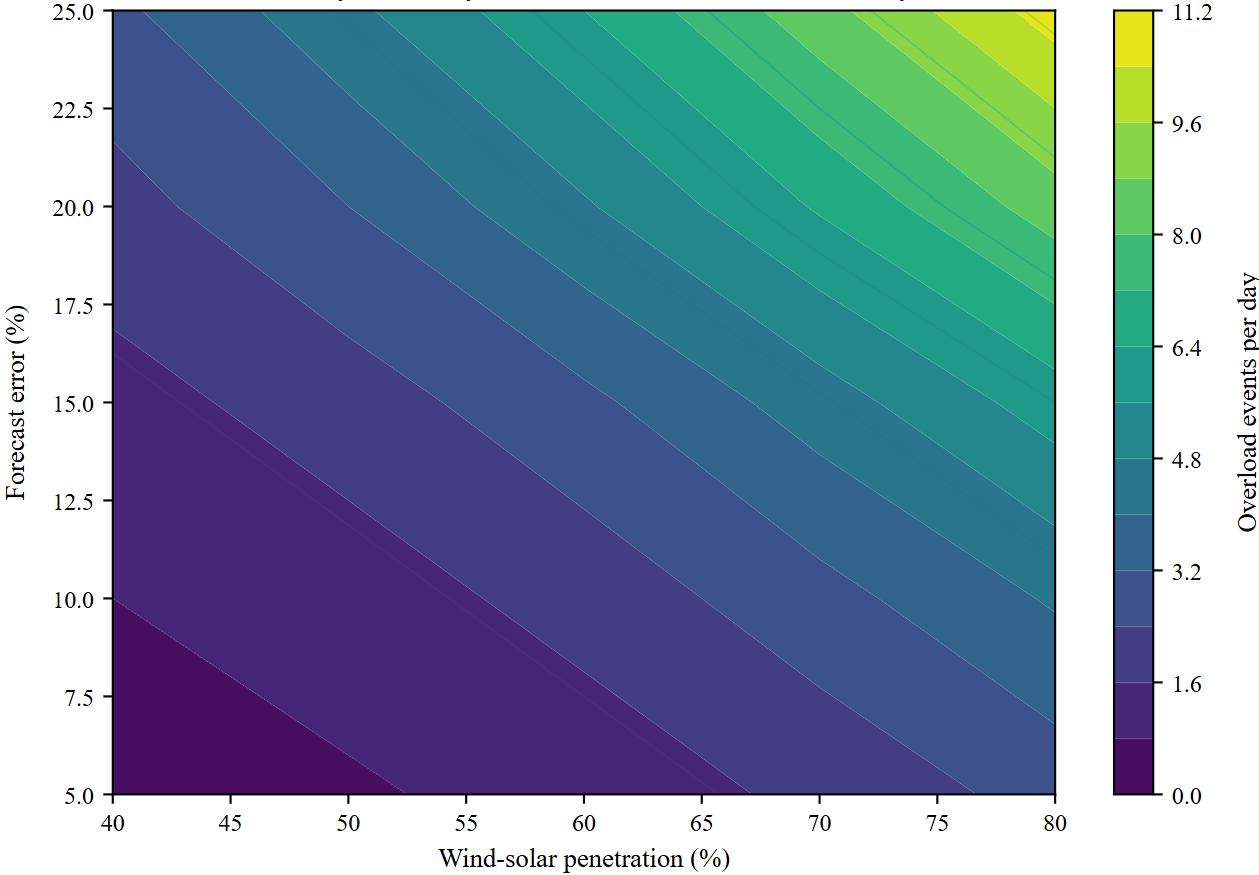
High-penetration wind and photovoltaic integration is driving smart grids from conventional deterministic dispatch toward real-time dynamic dispatch under random fluctuation and fast response requirements. Wind and solar outputs are strongly affected by weather conditions, and forecast errors may lead to rapid net-load ramping, insufficient reserve capacity, branch overload, and limited renewable accommodation. To address the operational requirements of high-penetration wind-solar power systems, a real-time dynamic dispatch strategy based on deep reinforcement learning is constructed. Nodal load, wind-solar forecast errors, conventional generator output, battery state of charge, branch loading ratio, and real-time electricity price are incorporated into the state space, while the SAC algorithm outputs continuous dispatch actions for coordinated thermal generation adjustment, battery charging and discharging, and interruptible load response. Experiments are conducted on a modified IEEE 118-bus system, where MATPOWER is used for AC power-flow verification and Python is used to build the reinforcement learning environment. PPO, DDPG, and rolling economic dispatch are selected as comparative methods. The results show that SAC reduces the daily operation cost to 45,820 USD, decreases the renewable curtailment rate to 4.82%, and lowers load shedding to 0.71 MWh under 70% wind-solar penetration. It also effectively controls branch-overload events in most medium forecast-error scenarios. These results indicate that deep reinforcement learning can form a stable dispatch balance among economic efficiency, renewable accommodation, and security constraints, providing a feasible computational solution for real-time control in high-renewable smart grids.
Show more
Read Article PDF
Cite
Research Article Open Access
Multi-robot Path Planning in Dynamic Environments Using the Coati Optimization Algorithm
Article thumbnail
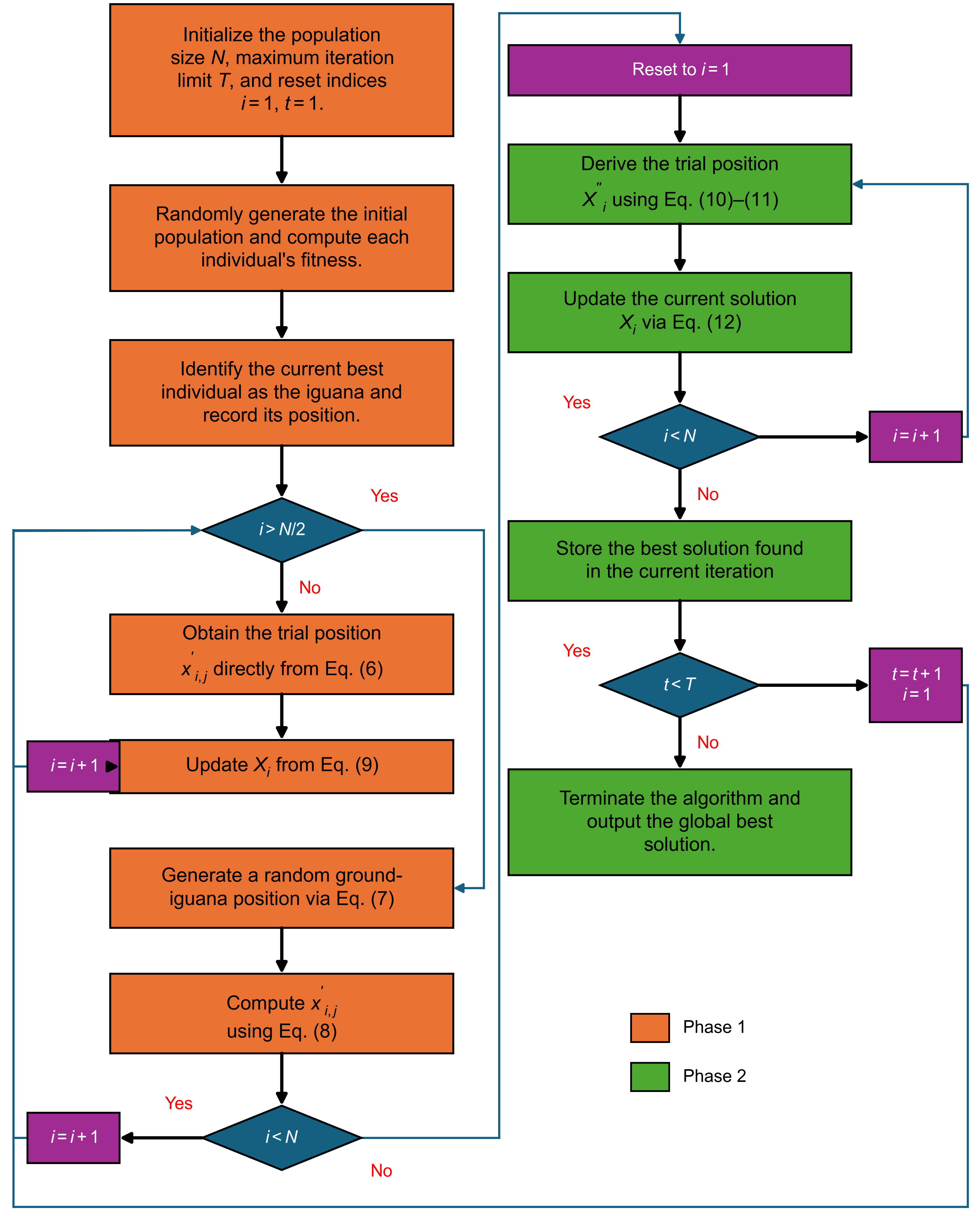
Multi-robot path planning in complex dynamic environments is a challenging optimization problem due to the simultaneous requirements of path efficiency, obstacle avoidance, and inter-robot collision prevention. To address these challenges, this study applies the Coati Optimization Algorithm (COA), a bio-inspired swarm intelligence optimization method, to multi-robot path planning. The trajectories of multiple robots are represented by a set of continuous control waypoints, and a comprehensive objective function is formulated by jointly considering path length, static obstacle avoidance, and inter-robot collision penalties. By exploiting the global exploration and local exploitation capabilities of COA, feasible and smooth collision-free trajectories can be generated in environments containing both static and dynamic obstacles. Simulation experiments were conducted in MATLAB R2024a with 12 mobile robots, 9 static obstacles, and 5 dynamic obstacles, and the performance of COA was compared with that of the A* algorithm. The results show that COA produces smoother paths with fewer unnecessary turns and reduces the total travel distance from 670.9 to 617.8355, corresponding to an improvement of approximately 7.9%. These results demonstrate that COA provides an effective approach for coordinated multi-robot path planning in complex dynamic environments and has potential for further application to practical multi-AGV and mobile robot systems.
Show more
Read Article PDF
Cite
Research Article Open Access
Lightweight Vision Models for Galaxy Morphology Classification: A Comparative Study of ResNet, MobileNet, EfficientNet, and MobileViT on Galaxy10 DECaLS
Article thumbnail
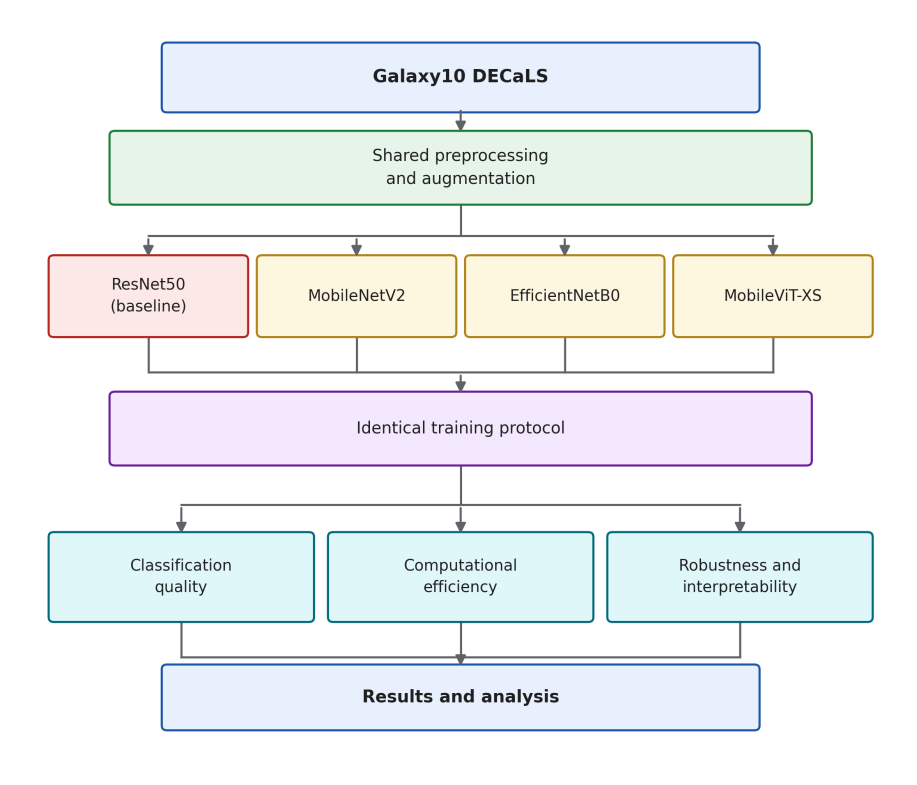
Automated galaxy morphology classification now rests on parameter-heavy convolutional backbones, whose cost becomes a design constraint as survey volumes grow. This paper compares three lightweight architectures (MobileNetV2, EfficientNetB0, and MobileViT-Extra Small (XS)) against a ResNet50 baseline on the Galaxy10 Dark Energy Camera Legacy Survey (DECaLS) benchmark of 17,736 images in ten classes, holding data splits, augmentation, optimizer, loss, and stopping rule fixed so that the backbone is the only variable. The lightweight models give up between 2.07 and 2.55 percentage points of support-weighted accuracy while removing 82.9% to 91.8% of the parameters and 42% to 59% of the per-image inference latency, which makes them 5.7 to 11.8 times more efficient per parameter. Two results run against expectations. The hardest class is not the rarest one. In a redshift-stratified comparison, the only attention-based backbone falls furthest behind the baseline on exactly the smallest and faintest galaxies, so the advantage reported for Vision Transformers does not carry over to a lightweight hybrid. For survey-scale processing, the trade is worth making; for a catalogue of a few thousand galaxies, it is not.
Show more
Read Article PDF
Cite
Research Article Open Access
Virtual Reality Based Cultural Heritage Tourism Experience Design
Article thumbnail
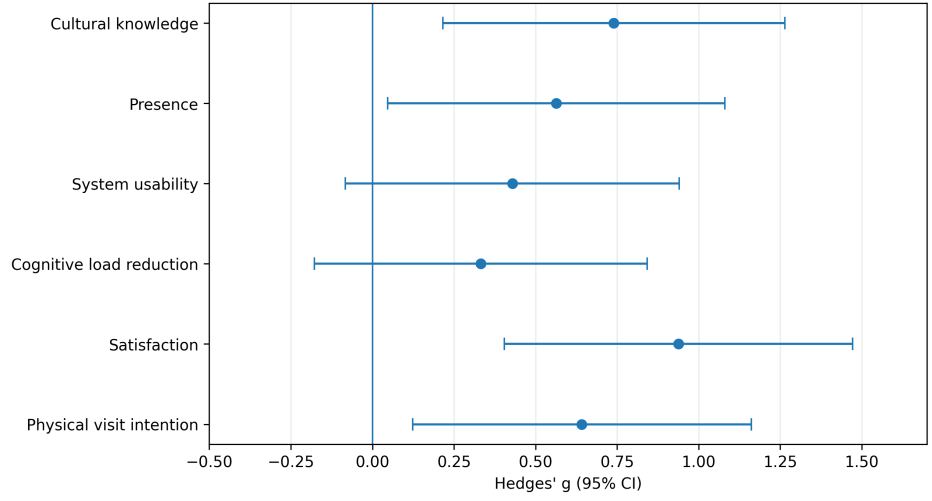
Virtual reality supports immersive cultural heritage tourism beyond spatial and temporal constraints, but fixed routes cannot fully reflect visitors' individual interests. This study develops a Unity-based virtual environment using Open Heritage 3D data, with CLIP extracting multimodal features from cultural-node images, descriptions, and user interests. A weighted A* algorithm generates personalized routes by combining interest scores, distance, dwell time, and total visit duration. Compared with fixed routes, personalized routing improves high-interest node coverage and interest gain per unit time while maintaining low planning latency. It also shows positive effects on satisfaction, cultural knowledge, and visitation intention. The results demonstrate that multimodal interest matching and explainable route optimization can improve cultural relevance without increasing route cost.
Show more
Read Article PDF
Cite
Research Article Open Access
Dynamic Identification of Hotel Service Experience Quality Based on Semantic Mining of Online Reviews
Article thumbnail
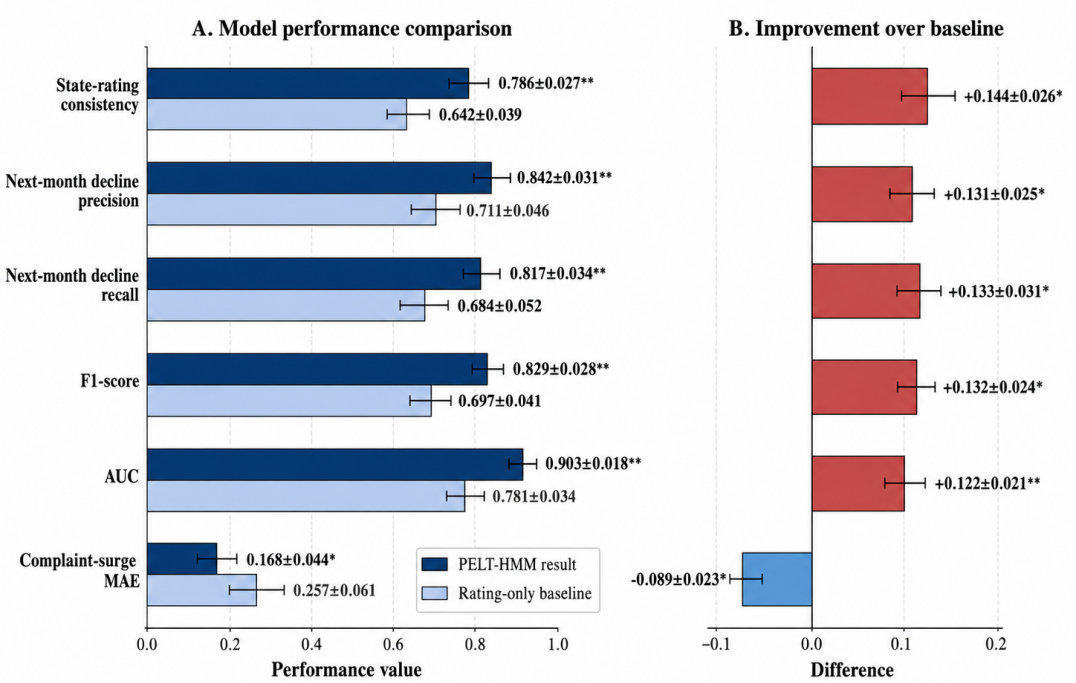
This study develops a dynamic framework for identifying hotel service experience quality through semantic mining of online reviews. Ctrip reviews from 260 hotels in Shanghai, Beijing, Guangzhou, Chengdu, and Hangzhou between 2021 and 2024 were cleaned into 156,000 valid reviews and 10,842 hotel-month observations. The framework combines a service-experience ontology, dependency-based aspect extraction, SKEP sentiment scoring, complaint intensity, change-point detection, and Gaussian hidden Markov modeling across eight service dimensions. Results show that semantic indicators detect deterioration earlier than numerical ratings, especially in cleanliness, facility reliability, and problem recovery, where complaint intensity rose 18%–27% above the sample mean during risk periods. The model classifies four quality states and achieves an F1-score of 0.829 and AUC of 0.903 for predicting next-month service decline, providing a reproducible method for dynamic hotel quality monitoring.
Show more
Read Article PDF
Cite
Research Article Open Access
P ath P lanning M ethods for B io- I nspired S oft R obots
Due to their flexible morphology and strong adaptability in complex environments, soft robots have shown considerable potential in applications such as healthcare, underwater exploration, and disaster response. Their continuous, highly deformable nature, however, makes path planning especially difficult. This paper provides a systematic review of three main approaches to bio-inspired soft robot path planning: model-based methods, learning-based methods, and hybrid approaches. Model-based methods construct kinematic or mechanical models of robot behavior to support planning, while learning-based methods learn action policies directly from data to establish perception–action mappings. Hybrid approaches combine the prior knowledge embedded in physical models with the adaptability of learning-based methods. In particular, approaches that integrate model-based reinforcement learning (MBRL) with model predictive control (MPC) have achieved a strong balance between planning accuracy and sample efficiency. This review examines the fundamental principles, strengths, and limitations of each approach and identifies several key challenges, including the trade-off between real-time performance and model fidelity, limited contact perception, and the absence of standardized evaluation benchmarks. Finally, the paper discusses future research directions, such as integrating morphological computation into perception–planning frameworks and developing more adaptive and intelligent control systems for soft robots.
Show more
Read Article PDF
Cite