


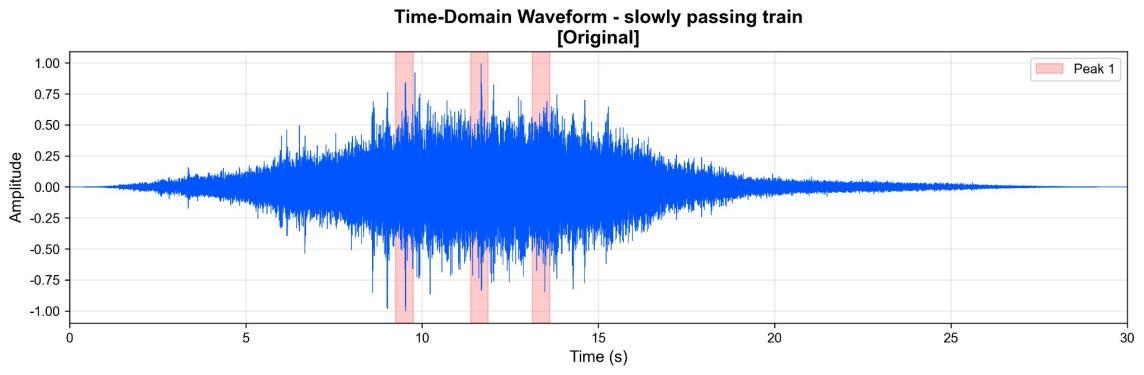
Railway external noise becomes more difficult to diagnose as train speed rises because wheel-rail, aerodynamic, structural, and environmental contributions overlap in both time and frequency. This study combines a literature-based comparison of mitigation measures with Python analysis of three single-channel train pass-by recordings. The review links the TWINS wheel-rail framework, computational fluid dynamics for aerodynamic sources, and acoustic imaging methods to practical source-, path-, and receiver-side control. Time waveforms, fast Fourier transforms, spectrograms, and one-third-octave bands show persistent energy between 500 and 1000 Hz, but the 300 km/h recording does not display the aerodynamic dominance expected from speed-based theory. Because microphone position, reflection, wind, wheel and rail condition, and the use of one recording channel can all change the apparent spectrum, the measurements are interpreted as band-based indicators rather than definitive source separation. The comparison also shows that noise control requires trade-offs among acoustic performance, maintenance, cost, and operating conditions. A future diagnostic architecture is therefore proposed using synchronised microphone and vibration arrays, moving-source beamforming, source-separation algorithms, and edge feature extraction before wireless transmission. This extension would connect physical noise models with spatially resolved measurements and more reliable intervention decisions.