Articles in this Volume

Research Article Open Access
Balancing Affordability and Accuracy: A Hardware Selection Guide for Wearable Fall Detection Systems
Unintentional falls among older adults represent a severe global health concern, necessitating reliable, automated wearable Fall Detection Systems (FDS). However, developing practical wearable solutions requires navigating intricate engineering trade-offs among diagnostic accuracy, power consumption, memory footprint, and software development overhead. This paper presents a structured hardware selection guide evaluating three representative embedded design paradigms: low-cost threshold logic on 8-bit microcontrollers (Profile A), balanced classical machine learning on standard 32-bit platforms (Profile B), and compressed on-chip TinyML neural networks on edge-capable microcontrollers (Profile C). Comparative analysis reveals that while threshold methods achieve multi-week battery longevity at sub-$12 costs, they suffer from high false-alarm rates during dynamic daily activities. Conversely, TinyML architectures deliver superior classification accuracy (98%) on raw kinematic streams, but introduce steep memory quantization barriers, complex toolchains, and shorter battery recharge intervals. Classical machine learning emerges as the optimal design compromise for most developers, achieving robust diagnostic discrimination (95% sensitivity and specificity) with manageable computational demands at $15-$25. Finally, this review evaluates sensor placement ergonomics, addresses pervasive demographic bias in youth-simulated training datasets, and delivers a practical hardware selection framework for student researchers and independent developers.
Show more
Read Article PDF
Cite
Research Article Open Access
Multi-agent Reinforcement Learning for Coordinated Emergency Building Sweeps
Article thumbnail
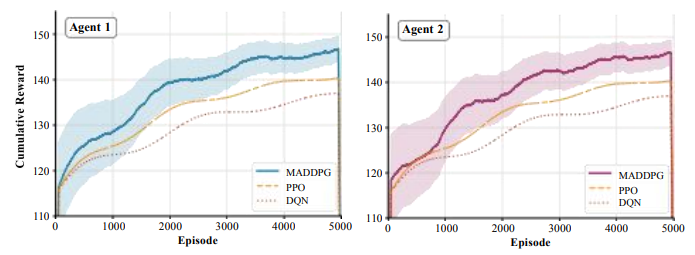
We develop a Multi-Agent Deep Deterministic Policy Gradient (MADDPG) framework for coordinating emergency responders during building sweeps. The problem is formulated as a Decentralized Partially Observable Markov Decision Process (Dec-POMDP) that captures building topology, occupant vulnerability, dynamic hazards, and partial observability. In the six-room office baseline, MADDPG reaches a 134-second sweep time after 5,000 episodes, within 6.3% of the 126-second theoretical optimum and outperforming PPO and DQN. Extensions to a two-story school and a U-shaped warehouse achieve 120 seconds with five responders and 105 seconds with four responders, respectively, with diminishing returns beyond these staffing levels. Under communication failure, coverage remains about 98% while sweep time rises 15–20%; reduced staffing triggers workload redistribution, and dynamic hazards cause threatened areas to be prioritized. Occupancy sensing, mesh networks, and environmental sensing are projected to reduce sweep time by 35–50%. Sensitivity analysis confirms robust performance across realistic parameter ranges.
Show more
Read Article PDF
Cite
Research Article Open Access
Multi-Robot Collaborative SLAM in Warehouses: A Review
With the rapid growth of e-commerce, Automated Guided Vehicles (AGVs) are increasingly deployed in intelligent warehouses, where Simultaneous Localization and Mapping (SLAM) provides the core localization capability. Warehouses differ from domestic or outdoor scenarios in four respects: highly structured regular rack layouts, quasi-static conditions with dynamic goods movement, GPS-denied weak-network communication, and perceptual degradation caused by long corridors and repetitive textures. This paper reviews recent progress in multi-robot collaborative SLAM tailored for warehouse scenarios. It analyzes warehouse-specific environmental characteristics, discusses single-robot SLAM solutions under weak-network constraints, examines anti-drift localization methods for degraded scenes, and compares multi-robot collaborative architectures and map fusion techniques. The review also identifies a gap between academic algorithms and industrial practice, and points to future directions including semantic-geometric fusion, edge computing, and large-model empowered intelligent warehouses.
Show more
Read Article PDF
Cite