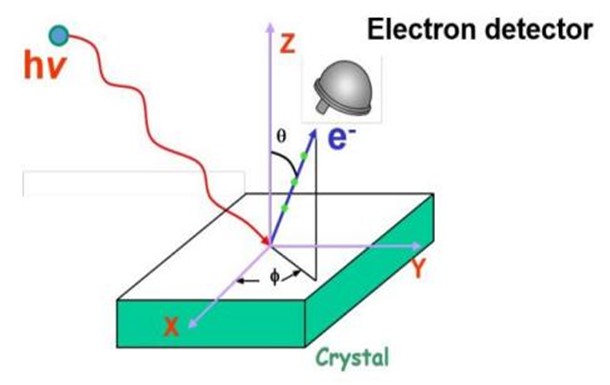
In this paper, the history of superconducting materials and the superconducting phenomena are first briefly described, followed by a corresponding introduction to the characterization techniques that may be used in the study of superconducting materials. For example, scanning tunneling microscope is used to demonstrate the hole Fermi and electron Fermi surfaces in Fe-based superconducting materials. Fourier-transform infrared (FTIR) spectroscopy is used to study the symmetry of the superconducting band gap in Fe-based superconducting materials. Four-probe electrical transport measurements are used to measure the resistivity of superconducting materials. Angle-resolved photoemission spectroscopy (ARPES) is used to study the multi-orbital-to-electron structure of Fe-based superconducting materials, the symmetry of the superconducting band gap and its size, the various ordered states to electron. The use of ARPES to study the multi-orbital pair electron structure of Fe-based superconducting materials, the symmetry and size of the superconducting energy band gap, the structure of the various ordered states and the possible electronic coupling modes, etc. have made a great contribution to the exploration and study of superconducting materials.