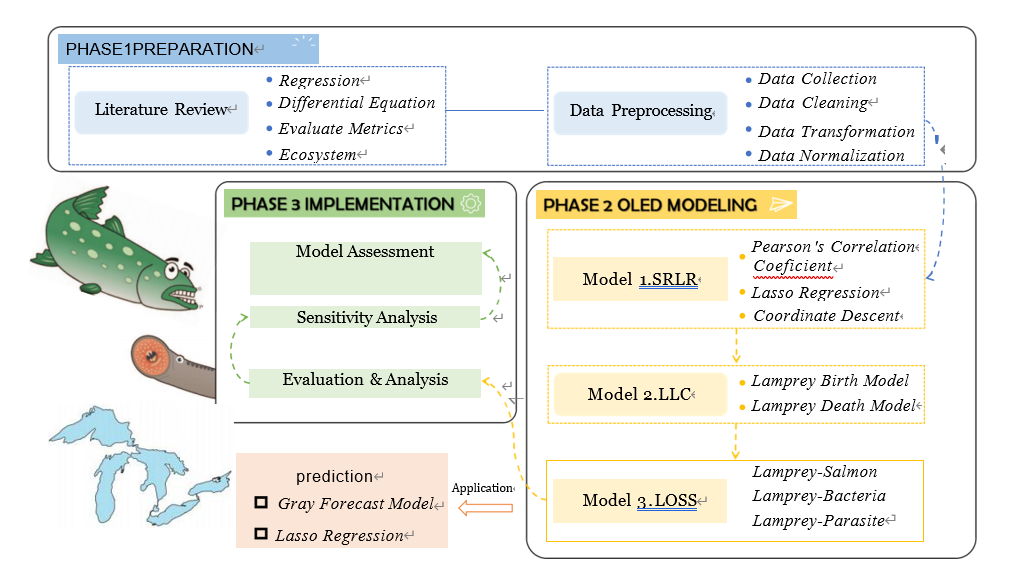
This study focuses on the sea lampreys that have invaded the Great Lakes. Considering the significant impact of their sex ratio changes with the environment on the ecosystem, the aim is to construct a model to explore its mechanism. Data from various sources such as government departments, scientific research institutions, and academic articles were collected and preprocessed. The Lake Ontario Lamprey Ecosystem Dynamics Model (OLED) was created, which consists of the Sex Ratio Relationship (SRR), Lamprey Life Cycle (LLC), and Lake Ontario Species Survival (LOSS) modules. The Lasso regression and other algorithms were used to analyze the impact of environmental factors on the sex ratio. Based on the Lotka-Volterra and other models, the relationships between sea lampreys and other species were studied. The Gray Forecast Model was also adopted to predict relevant variables and calculate the sex ratio. The results show that the changes in the sex ratio of sea lampreys significantly affect the ecosystem, such as influencing fish populations and nutrient cycling. Moreover, the model is robust under small data perturbations and is sensitive to the reproduction rate. This research provides theoretical support for the ecological control of sea lampreys.