Articles in this Volume

Research Article Open Access
Serverless Computing Core Technology and Research Status
As an emerging cloud computing paradigm, serverless computing, based on "function as a service", splits applications into fine-grained functions, and automatically manages underlying resources by the platform, significantly improving resource utilization and reducing operation and maintenance costs. It has gradually become the preferred architecture for cloud native application development and deployment with its unique advantages of lightweight and event driven. However, there are still many challenges in performance, security and resource scheduling. This paper systematically summarizes the core technologies of serverless computing, including performance optimization, resource scheduling, security protection, and integration with emerging technologies such as webassembly, micro front end, and artificial intelligence; On this basis, the main challenges faced at present are analyzed, such as insufficient support for large-scale tasks, immature cross domain scheduling, and security model to be improved. The development trends of intelligent scheduling, cross domain computing integration, and trusted execution environment in the future are prospected. This paper aims to provide a systematic reference for the research and application of serverless computing.
Show more
Read Article PDF
Cite
Research Article Open Access
Survival Prediction of the Titanic: A Comparison of Multiple Machine Learning Algorithms
The sinking of the Titanic is one of the most famous marine perils in history. Predicting survival data has become a classic practice in machine learning. This research used the Titanic passengers dataset to explore the performance variation of 3 classical statistical models (logistic regression, decision trees, and random forests). The research included data preprocessing (missing value imputation, categorical feature encoding, and feature standardisation). Model evaluation was conducted using 5-fold cross-validation to identify key survival factors and to ensure robustness against data-split bias. The results show that the average accuracy of the random forest and decision tree models under 5-fold cross-validation is 0.81, while the logistic regression is 0.78. The random forest demonstrated slightly greater stability than the decision tree. Feature importance analysis indicates that Gender, Fare, and Age collectively account for 79.4% of the total importance. This research provides a reference for machine learning on small-sample classification tasks and enriches similar survival prediction analyses.
Show more
Read Article PDF
Cite
Research Article Open Access
Research on Financial Risk Prediction of Listed Companies Based on CNN-Transformer Ensemble Learning
Article thumbnail
Traditional financial risk prediction models for listed companies mostly rely on annual quantitative indicators for modeling. With a long data update cycle, such models cannot effectively capture the dynamic evolution characteristics of corporate financial status within the year, making it difficult to realize timely early warning of financial risks. Quarterly financial data feature higher temporal resolution, which can accurately reflect the intra-year fluctuation pattern of corporate financial conditions and effectively improve the timeliness of financial risk identification. However, when such data are applied to risk prediction, there still exist problems including difficulty in extracting multi-dimensional feature matrices and insufficient modeling of time-series correlation features. In view of this, this paper constructs an ensemble learning model for financial risk prediction by integrating CNN and Transformer. Firstly, multi-dimensional quarterly financial risk indicators of enterprises are reconstructed into matrix-valued input features. Convolutional Neural Network (CNN) is used to mine the time-series evolution features of financial indicators, while Transformer is adopted to capture the complex correlations and global dependency features among different financial indicators. Meanwhile, an ensemble learning strategy based on stratified sampling is introduced to effectively alleviate the class imbalance caused by the scarcity of ST risk samples of listed companies and achieve a balanced trade-off between model bias and variance. The proposed model is verified with the financial risk prediction of A-share listed companies as an empirical scenario. Experimental results show that the CNN-Transformer ensemble model outperforms traditional benchmark models in prediction performance. In addition, the SHAP explainable framework is introduced to interpret the model prediction results. It is found that financial information of quarters close to the prediction point carries higher risk-discriminating weights, and indicators such as corporate debt-servicing and financing pressure as well as abnormal costs and expenses are key factors driving financial risks of listed companies.
Show more
Read Article PDF
Cite
Research Article Open Access
LLM-Driven Evolutionary Program Search: From FunSearch to Automated Scientific Discovery
Article thumbnail
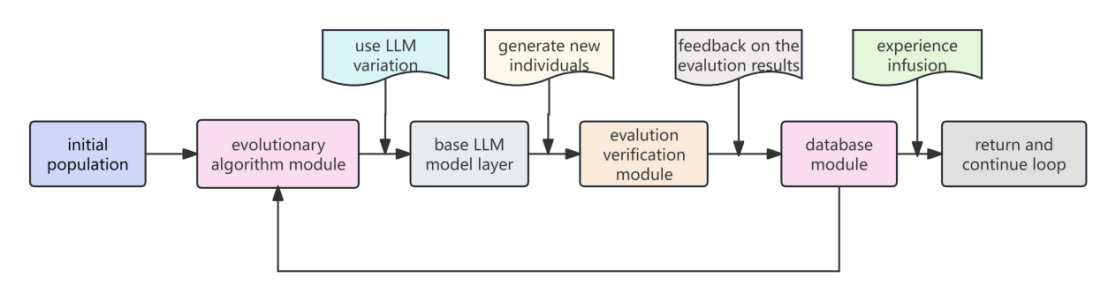
Large language models (LLMs) suffer from logical illusions, while evolutionary algorithms (EAs) face search blindness in program generation. The LLM + EA paradigm addresses these issues.This paper systematically discusses its core technologies: program search space representation, memory-based semantic mutation, hierarchical evaluation feedback, and island population management. Using the car movement problem as a case study, it shows how historical code injection, multi‑objective evolution, and distributed islands evolve an effective and interpretable control strategy. It also constructs a multi-dimensional evaluation system (objective performance + subjective interpretability), and compares methods such as AlphaEvolve, ShinkaEvolve, and OpenEvolve in combinatorial optimization, mathematical algorithm discovery, and software engineering, including new matrix multiplication algorithms and GPU kernel optimization.Finally, it identifies challenges (credibility illusion, dimension disaster, black-box interpretability, data leakage) and future directions (formal verification, context expansion, enhanced interpretability). This paper provides a systematic framework for LLM-driven evolutionary program search, pushing automated scientific discovery from "generative" to "verifiable".
Show more
Read Article PDF
Cite
Research Article Open Access
The impact of back-to-back games on NBA team performance across different eras
Article thumbnail
NBA fans often follow the schedule and performance of their favorite players and teams, such as the Boston Celtics and their star player Jayson Tatum. It has been long noticed that even some competitive teams, like the Celtics and the Los Angeles Lakers, may lose their games more often during stretches of consecutive matches. Previous work found that teams were more likely to win after one day of rest than when playing back-to-back games. This raises a natural question: does schedule tightness affect the on-court performance and winning rates of NBA teams? To answer this question, I analyzed official statistics of all NBA teams for the 2024-2025 Season and the 1970-1971 Season. By dividing the games into two groups: back-to-back games, defined as games played on consecutive days with no rest day in between, and non-back-to-back games, defined as games with at least one day of rest before them, I then compared the winning rates of the teams and the quality of their offense and defense under these two scenarios. The results show that the winning rate of most teams in the NBA in back-to-back games was lower than their winning rate in non-back-to-back games. This suggests that short rest periods may negatively affect team performance. Therefore, to promote fairness in competition, NBA scheduling, and in general the scheduling of any sport games, should take the amount of rest between games into consideration.
Show more
Read Article PDF
Cite
Research Article Open Access
Confidence-Driven Region Refinement for Small Object Detection in UAV Image
Article thumbnail
UAV target detection has become increasingly indispensable in the fields of public safety, traffic monitoring, and disaster relief. However, there are still some problems in practical application, such as the difficulty of small target detection and the computational power limitation of edge devices. To tackle the aforementioned challenges, a confidence-driven region adaptive YOLOv5 detection method is developed in this paper. This method detects the global low-resolution of the input image quickly and obtains the rough position and category information of the target. Through the dynamic region selection mechanism driven by confidence, the differentiated reasoning strategy is implemented for the detection regions with different confidence, and only local high-resolution fine detection is carried out for the regions with medium confidence to restore the target details. The non-maximum suppression method is used to fuse the global and local detection results to obtain the final detection output. The experimental results on the VisDrone dataset show that, compared with the baseline YOLOv5 algorithm, the average accuracy of this method is improved by 3.6%, and the detection frame rate is increased from 30 to 35. On the basis of ensuring the real-time detection performance, this method effectively improves the small target detection effect in the UAV scene, and provides a feasible technical scheme for the UAV target detection task on edge devices.
Show more
Read Article PDF
Cite
Research Article Open Access
The Mechanism of Fintech Alleviating Information Asymmetry in the CreditMarket:ALiterature Review Based on Big Data and Artificial Intelligence
Article thumbnail
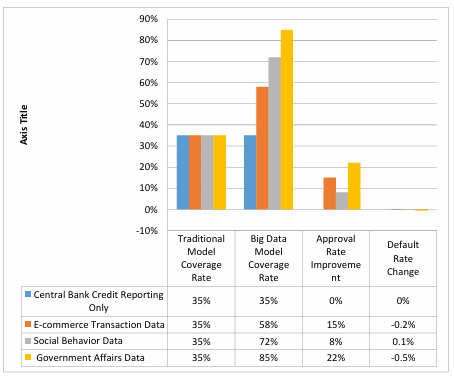
The traditional credit system heavily relies on "hard information" such as financial statements, collateral, and credit records for risk assessment, resulting in a large number of small and medium-sized enterprises and low-income groups lacking traditional credit records being excluded from formal financial services for a long time. In recent years, the rapid development of big data and artificial intelligence technology has provided new possibilities for breaking through this dilemma - by mining "alternative data" and constructing intelligent risk control models, fintech is fundamentally reshaping the information production and risk pricing methods of the credit market. Based on the "lemon market" theory and credit rationing model, this paper systematically reviews the latest literature on FinTech in alleviating information asymmetry. The review focuses on the technology enabling mechanisms of big Data and artificial intelligence (AI), with an emphasis on how "Alternative Data" reconstructs the pre-event information screening system and how AI risk control models enable real-time monitoring of post-event behavior, thereby reducing adverse selection and moral hazard. At the same time, this paper analyzes emerging limitations in the field, such as algorithmic discrimination, privacy leaks and data silos, aiming to provide a theoretical framework and literature support for understanding the reshaping effect of digital finance on the credit market.
Show more
Read Article PDF
Cite
Research Article Open Access
Application of Explainable Ensemble Learning in Credit Card Fraud Detection
Article thumbnail
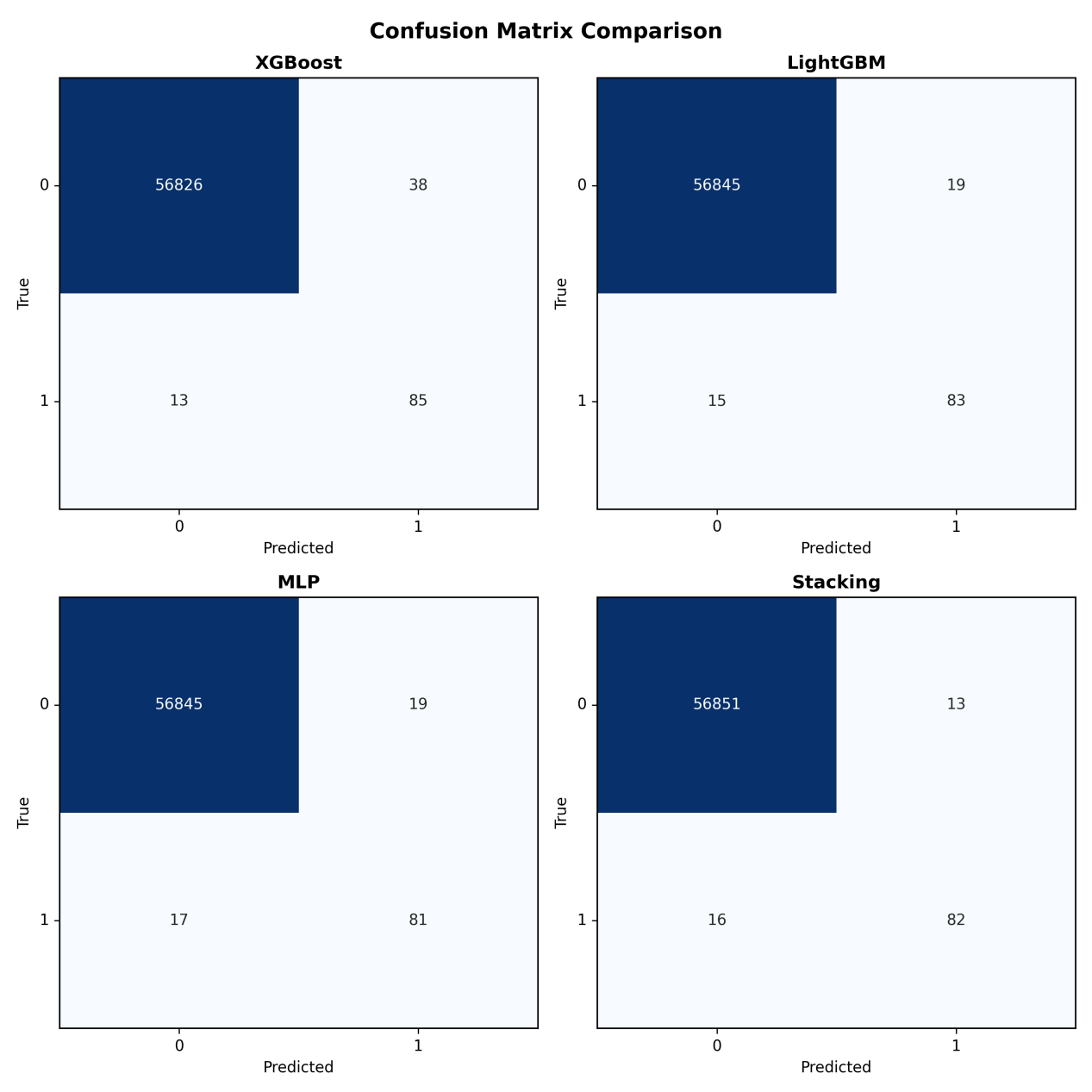
Credit card fraud is a global problem, which causes huge economic losses every year and reduces consumers' trust in the digital transactions. Therefore, it is very important to detect the credit card fraud. Nowadays, traditional machine learning models have limited detection of increasingly complex fraud means and often has black box characteristics, which lack explainability and bring obstacles to financial institutions. However, the current research on the credit card fraud detection still lacks explainability. Therefore, this paper proposes a stacking model integrating XGBoost, LightGBM and MLP, and compares the stacking model with a single model. The results show that the stacking model has the best performance. Finally, Explainable AI (SHAP and LIME) is used to identify the complex features of the stacking model and interpret the output. This study provides a feasible scheme and explanation for credit card fraud detection in the contemporary digital economy, and effectively reduces financial losses.
Show more
Read Article PDF
Cite
Research Article Open Access
Quantitative Analysis of Group Behavior from a Gaze Interaction Network Perspective: Deception Detection and Temporal Topological Features in the Resistance Game
Article thumbnail
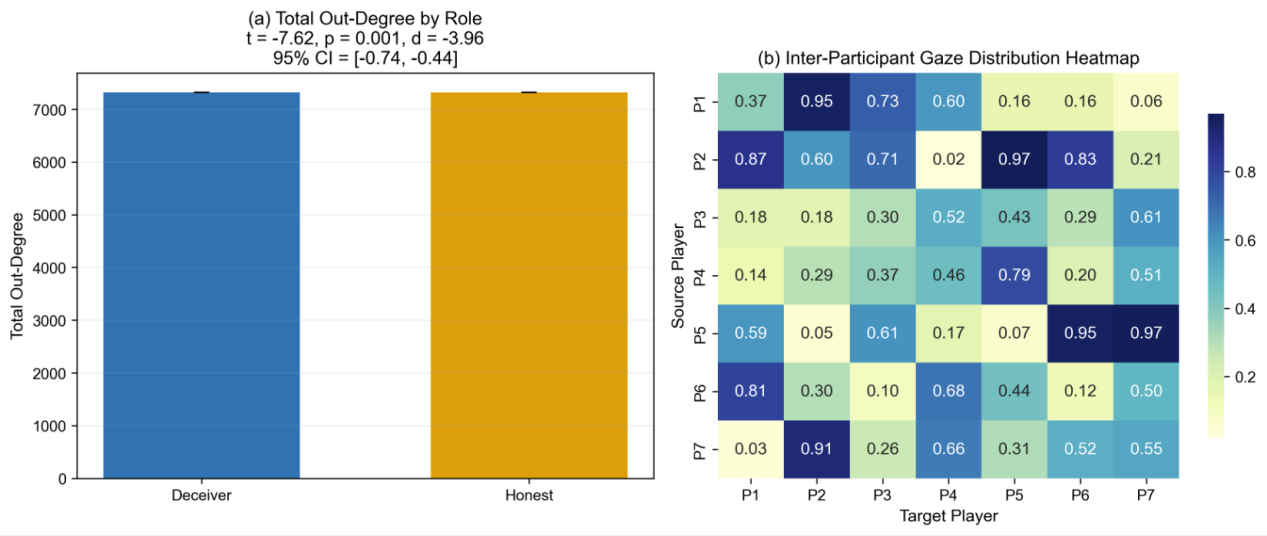
Non-verbal cues in group interaction, particularly gaze, are central to understanding social dynamics and intention inference. To address the difficulty of identifying deception and the unclear mechanisms of consensus formation in dynamic multi-party scenarios, this paper constructs and validates a temporal weighted gaze-interaction network (TW-GIN) analytic framework on preprocessed data from the Resistance social-deduction game. We mine 62 group interaction networks twice: (i) descriptively, we compute out-degree volume, entropy of distribution, network density, weighted in-degree centralization, and notebook-gaze ratio to address three research questions on (a) gaze differences between deceivers and honest players, (b) temporal evolution of network structure, and (c) gaze-based representation of consensus; (ii) predictively, we couple the TW-GIN with a temporal graph neural network (T-GNN) to forecast early deceivers, future network density, and core-node transitions. Key findings: deceivers' total gaze output is significantly lower than that of honest players; network density during high-deception phases is significantly higher than during information-exchange phases, and over 70% of groups exhibit a shift in attention focus; weighted in-degree centralization and notebook-gaze ratio are significantly negatively correlated, jointly capturing the dynamic balance and fragility of consensus. The predictive model attains AUC=0.78 for deceiver identification, R²=0.85 for density forecasting, and 64% Top-1 accuracy for core-node prediction. The framework provides empirical support for understanding the micro-mechanisms of group non-verbal interaction and a reproducible pipeline for the secondary analysis of existing datasets.
Show more
Read Article PDF
Cite
Research Article Open Access
LPGFusion: Enhancing Spatial Saliency in Image Fusion via Coordinate Positional Encoding and Cross-Modal Gating
Article thumbnail
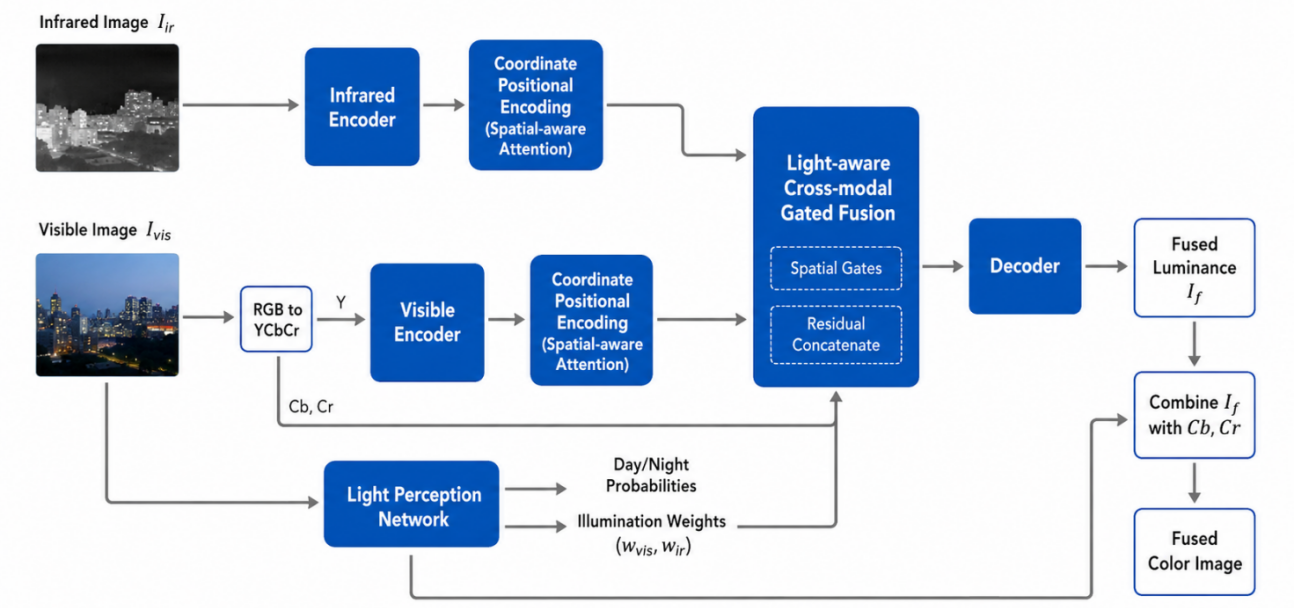
Infrared and visible image fusion aims to integrate thermal saliency from infrared images with texture and structural details from visible images. However, existing fusion methods often weaken spatial positional information during feature compression, resulting in blurred target boundaries and incomplete texture preservation. To address this issue, this paper proposes LPGFusion, a light-aware position-gated fusion network. The method employs dual-branch encoders to extract modality-specific features and introduces coordinate positional encoding to preserve horizontal and vertical spatial cues. A light perception network provides global illumination guidance, while a cross-modal gating module performs adaptive modality selection at each spatial location. In addition, Sobel edge loss and multi-scale structural similarity loss are incorporated to enhance edge fidelity and multi-scale structural consistency. Experiments on the MSRS dataset show that LPGFusion achieves superior or competitive performance against thirteen representative methods. Ablation studies verify the complementary contributions of the proposed modules, and qualitative YOLOv11 results further demonstrate the effectiveness of LPGFusion for downstream tasks.
Show more
Read Article PDF
Cite