Articles in this Volume

Research Article Open Access
Embodied Carbon Reduction Performance in the Adaptive Reuse of Existing Public Buildings: A BIM-Based Life Cycle Assessment Framework
Article thumbnail
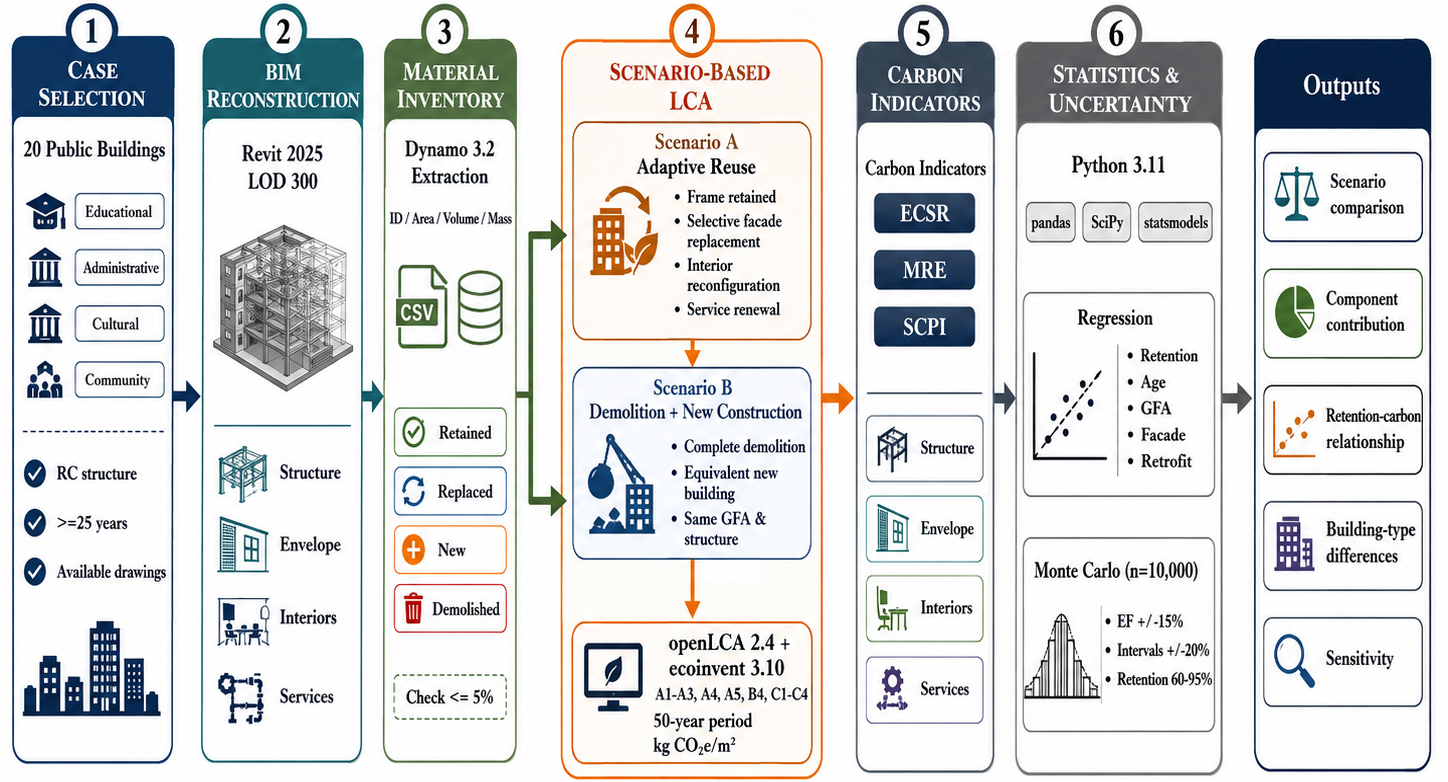
Adaptive reuse can preserve carbon-intensive building components while avoiding material production associated with demolition and reconstruction, but its carbon benefit depends on structural retention, retrofit intensity, and future replacement cycles. This study develops a BIM-based life cycle assessment framework for 20 existing public buildings evaluated under adaptive-reuse and demolition-and-reconstruction scenarios. Autodesk Revit 2025 and Dynamo 3.2 are used to construct element-level material inventories, and openLCA 2.4 with ecoinvent 3.10 quantifies emissions across A1–A5, B4, and C1–C4 over 50 years. Illustrative analytical results show that adaptive reuse decreases embodied carbon from 842.3 ± 78.6 to 470.0 ± 61.4 kg CO₂e/m², giving a mean saving of 44.1 ± 5.8%. Structural retention contributes 59.8 ± 7.1% of avoided emissions and is the strongest predictor of carbon saving performance (β = 0.671 ± 0.112, p < 0.001). Monte Carlo analysis produces a median saving rate of 42.8% with a 95% uncertainty interval of 31.6–53.7%. The framework provides a reproducible basis for carbon-informed public-building renewal decisions.
Show more
Read Article PDF
Cite
Research Article Open Access
Large-Scale Population Screening for Type 2 Diadetes Based on TabNet and BRFSS 2021 Data
Article thumbnail
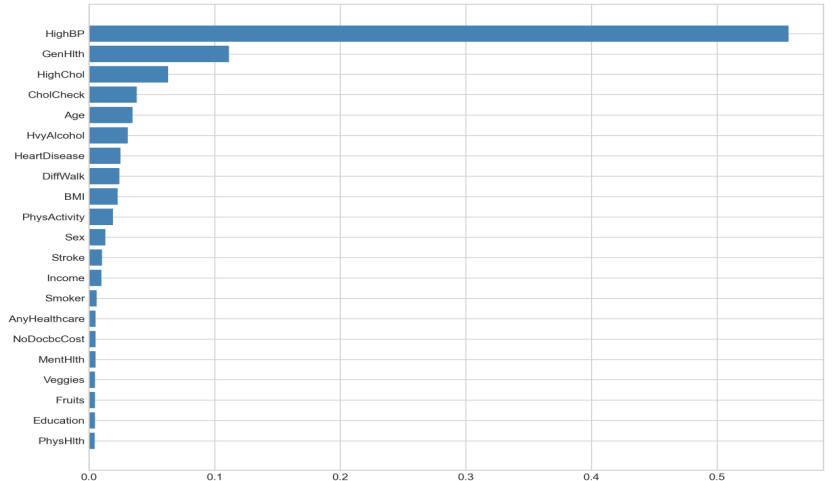
Type 2 diabetes is a global health crisis. Early screening is of great significance for disease prevention and control. Based on the data from the CDC BRFSS 2021 large-scale real population survey (236378 cases, 21 characteristics), this study systematically evaluated the performance of TabNet, XGBoost and random forest in diabetes screening. 50% cross validation results showed that the recall rate of TabNet reached 77.81% ± 2.02%, which was significantly better than XGBoost (35.92% ± 0.51%) and random forest (32.64%±0.39%), and the AUC reached 0.8043±0.0031. The age subgroup analysis showed that among the high-risk population aged 30-50, the TabNet recall rate was as high as 80.88%, 51.93% higher than XGBoost. SHAP interpretability analysis showed that self-rated health, hypertension and age were the core characteristics for predicting diabetes. This result shows that TabNet's attention mechanism can effectively capture complex feature interactions and significantly improve the recognition ability of patients on unbalanced data. This study shows that TabNet has significant advantages of high recall rate in large-scale real population diabetes screening, and has important clinical application value.
Show more
Read Article PDF
Cite
Research Article Open Access
Digital Twin Technology in Marine Power System Operation and Maintenance
Article thumbnail
The marine power system is the core for propulsion, generating electricity and supporting operation of main equipment. Its operation and maintenance is therefore particularly important. However, traditional operation and maintenance approaches have certain deficiencies in equipment condition monitoring, anomaly detection, and maintenance decision-making, and remain reactive rather than proactive. Digital twin technology applied to intelligent operation and maintenance of the marine power system can identify faults in advance and suggest maintenance decisions. This paper adopts the methods of literature review and case analysis to summarise the applications of digital twin technology in the monitoring of marine power system operations, fault diagnosis and predictive maintenance. Digital twin technology connects physical devices with virtual models and plays a key role in monitoring, analysing and predicting the operating status of equipment as well as providing intelligent maintenance decisions. However, the current application still faces issues such as difficulties in data acquisition and sharing, single models and insufficient engineering verification. The future will require progress in areas such as standardising data formats, uploading to globally shared cloud platforms, upgrading hybrid virtual models, and conducting long-term experimental verification.
Show more
Read Article PDF
Cite
Research Article Open Access
Systems and Strategies for Refined Management over the Full Life Cycle of Water Conservancy Projects
Water conservancy projects are key national engineering facilities, and their construction quality and operation have direct impact on regional economic and social development. However, traditional management mostly focuses on the construction stage but pays insufficient attention to planning, design, operation and maintenance stages, resulting in data discontinuity and delayed decision-making. This paper analyzes the connotation of full life cycle management and refined management from a system perspective. It studies the main barriers to realization of full life cycle refined management from the perspectives of technical obstacles (incompatible data systems and weak automated diagnosis), management mechanism problems (capability gap and fragmentation of activities), and imperfect policies or standards. Four enabling technologies are then discussed, namely building information modeling (BIM), intelligent monitoring based on the Internet of Things (IoT), big data analysis and prediction, and smart management platforms based on digital twin concepts. Finally, development suggestions are put forward, including establishment of a full life cycle refined management framework with maturity assessment and collaborative learning, and improvement of specialized and lightweight standards accompanied by incentive mechanisms. The findings provide a reference for the transformation of water conservancy project management modes.
Show more
Read Article PDF
Cite
Research Article Open Access
The Current Progress of Studies on How Camber Variation Affects the Aerodynamic Performance of NACA Airfoils
Article thumbnail
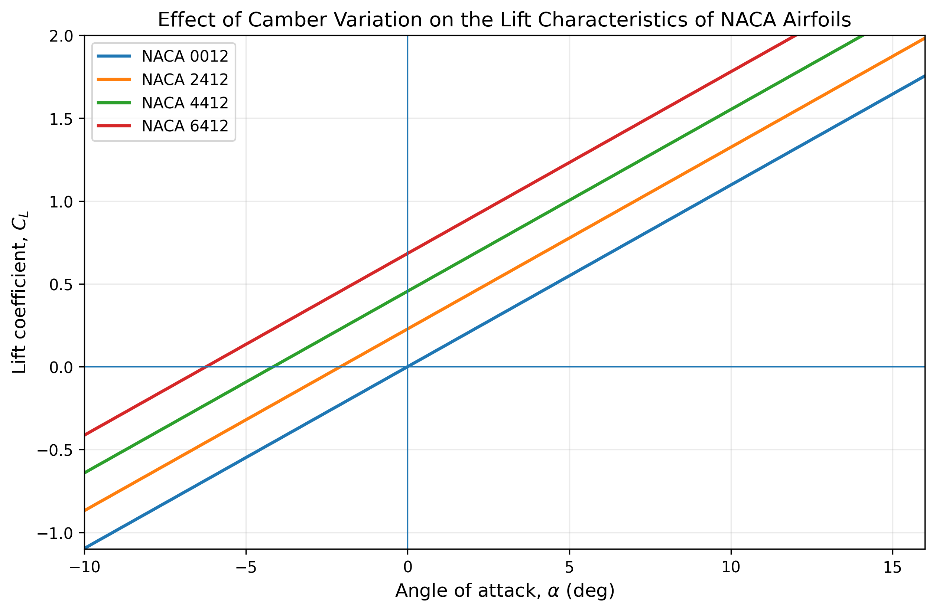
Camber is an important factor affecting the aerodynamic performance of NACA airfoils. This paper reviews previous studies on the effects of camber variations on lift, drag, lift-to-drag ratio, pitching moment, and stall characteristics. Using the thin airfoil theory, the basic relationship between camber parameters and aerodynamic performance is introduced. Based on experimental and numerical studies, the effects of different camber magnitudes, camber positions, and camber distributions on the aerodynamic characteristics of NACA airfoils are explored. Some studies indicate that increasing positive camber at the same angle of attack can increase lift and shift the zero-lift angle of attack to negative values. However, greater camber does not always result in better aerodynamic performance. Under the certain conditions, it may also increase adverse pressure gradients, drag, pitching moment, and the risk of flow separation. The paper also discusses the prospects of variable camber airfoils for adapting aerodynamic performance to different flight conditions.
Show more
Read Article PDF
Cite
Research Article Open Access
Digital Twin-Based Construction Project Management Integrating Progress Monitoring with Safety Control and Resource Coordination
Construction projects are characterized by long cycles, numerous stakeholders, and constantly shifting site conditions. Managers need current information on progress, safety, and resource use. Traditional methods fall short in meeting these demands. Data acquisition is slow, multi-source integration is weak, and real-time status updating rarely happens. Digital twin (DT) technology links physical engineering assets to digital models and field data. This linkage provides a way to monitor and manage construction processes dynamically. This paper adopts a literature synthesis approach combined with representative case analysis to examine the technical foundations of DT in construction projects. The work summarizes principal applications from three angles: construction progress monitoring, construction safety control, and construction resource coordination. Existing applications show that DT can link building information modeling (BIM) models, sensor data, unmanned aerial vehicle (UAV) imagery, and equipment operation data to actual site conditions. This supports progress deviation identification, safety risk assessment, and resource utilization monitoring. Notably, different scenarios impose different requirements on data types, collection frequency, and model updating methods. Practical applications also face constraints. Data quality, system integration, implementation cost, and continuous model updating are all critical factors. DT in construction projects must be configured to specific management demands and site conditions. Only then does it enhance practical applicability in construction management.
Show more
Read Article PDF
Cite
Research Article Open Access
GIS-Based Maritime Traffic Risk Identification and Assessment
Maritime traffic risk shows significant spatial and temporal differences among vessel activities, navigation conditions, and environments. The further development of Automatic Identification System (AIS) and Geographic Information System (GIS) provides useful tools to analyze vessel trajectories, accident hotspots and environmental risks. This paper reviews the major spatial data, GIS methods and applications used in maritime traffic risk identification and assessment. The main data sources include AIS data, historical accident records, environmental conditions and spatial data. GIS methods include traffic density and hotspot analysis, spatial overlay and spatial relationship analysis. Representative cases from the Malacca Strait, the Istanbul Strait and the Dover Strait, and the Bohai Sea show the different applications. This study employs GIS and various data sources to gain insight into the spatial distribution of maritime traffic and traffic hotspot areas, and historical accident data to identify accident-prone areas. Combining AIS, remote sensing and environmental data can also reveal the temporal and spatial distribution of maritime traffic risk. However, data quality, multi-source data matching and scale issues in space and time are still problems. Future research is needed to improve multi-source data fusion and dynamic risk analysis to further increase the reliability of maritime traffic risk assessment and risk management.
Show more
Read Article PDF
Cite
Research Article Open Access
Regulation Mechanisms, Material Systems and Application Progress of Dynamic Radiative Cooling
Article thumbnail
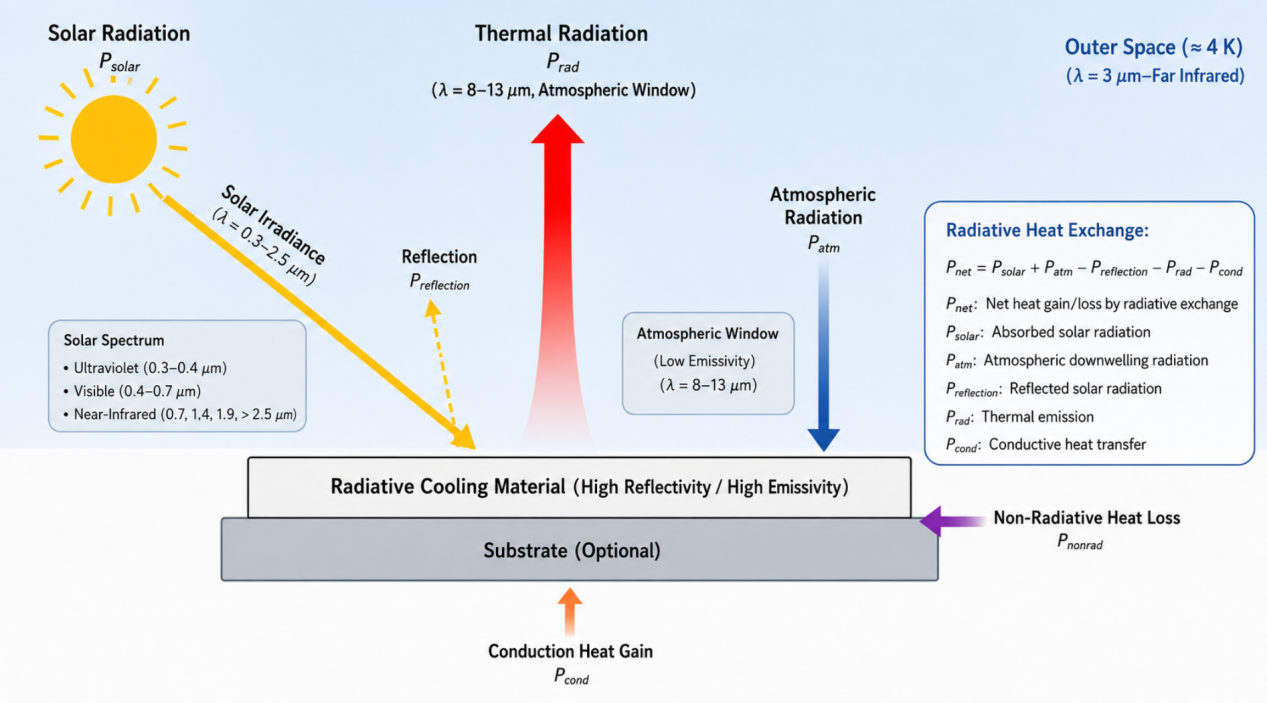
Radiative cooling achieves low-energy heat rejection via radiative heat exchange between the ground surface and outer space. Nevertheless, static materials possess fixed spectral properties and tend to trigger overcooling in winter, at night or under low thermal loads. This paper reviews active regulation, passive self-adaptation, near-zero energy consumption and active-passive synergy mechanisms. It compares the regulation characteristics of electrochromism, mechanical/fluid switching, thermally induced phase change, thermosensitive hydrogel, humidity response and bistable structures. Applications in buildings, electronic devices, smart textiles, vehicle energy storage and aerospace thermal management are summarized. Finally, engineering challenges including cycle life, outdoor weather resistance, encapsulation, large-area fabrication, energy consumption accounting and testing standards are discussed.
Show more
Read Article PDF
Cite
Research Article Open Access
A Comparative Aerodynamic Performance Analysis of Fixed-Wing UAVs NACA0015 and NACA2415
Article thumbnail
Airfoil camber is a critical geometric parameter affecting aerodynamic characteristics, which directly determines the aerodynamic performance of aircraft. In recent years, unmanned aerial vehicles have been widely applied in various fields, and cargo Unmanned Aerial Vehicles (UAVs) are expected to become mainstream equipment for freight transportation. NACA0015 and NACA2415 are two airfoils with great potential for cargo UAV design. In this work, NACA2415 and NACA0015 are chosen as research cases. The computational fluid dynamics (CFD) method based on Reynolds-Averaged Navier-Stokes (RANS) equations and the SST k-ω turbulence model is used to perform numerical simulations and aerodynamic comparisons within the angle-of-attack range of 0° to 24°. The simulation results demonstrate that the NACA2415 airfoil achieves a higher lift coefficient and superior stall resistance at low angles of attack. Compared with NACA0015, NACA2415 is more suitable for fixed-wing cargo UAVs. Furthermore, this study reveals that airfoils with larger camber can generate higher lift under low angle-of-attack conditions.
Show more
Read Article PDF
Cite