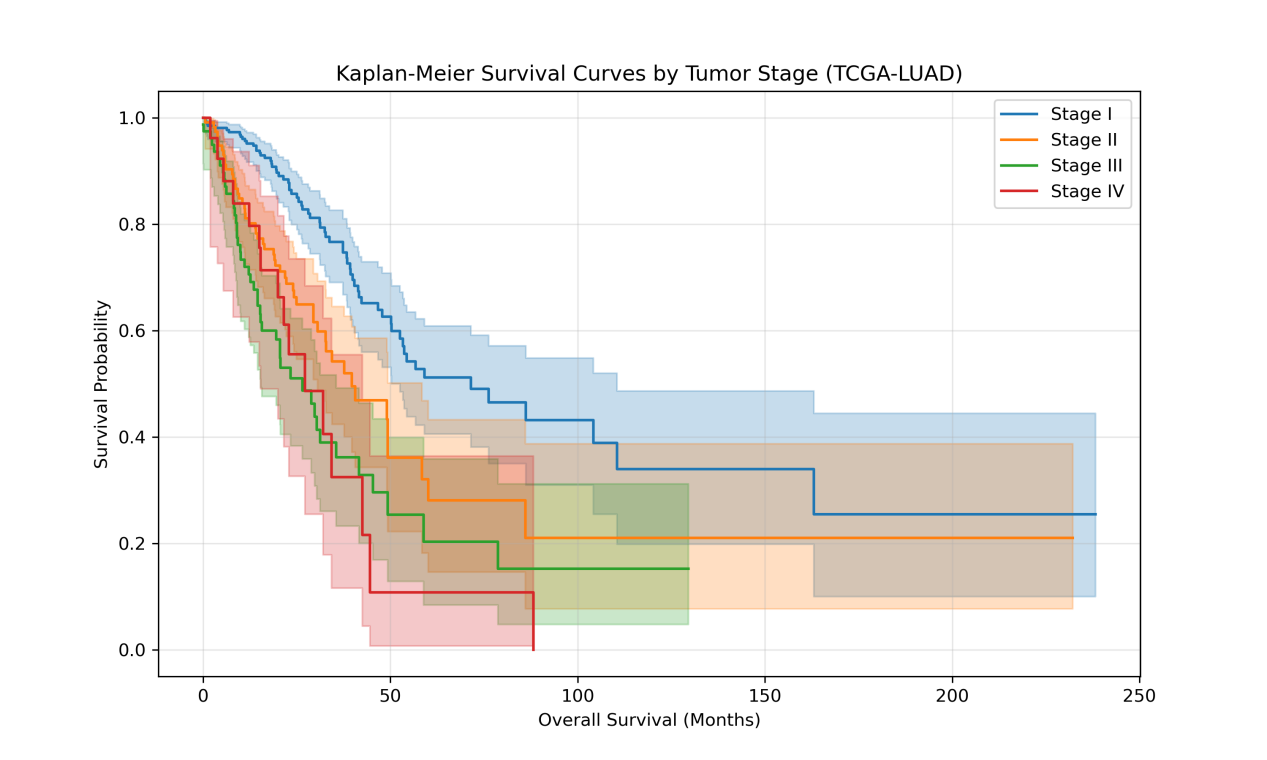
Accurate survival prognosis is essential for personalized prognostic assessment and treatment planning in lung adenocarcinoma. This study compares non-parametric and semi-parametric statistical methods for survival prognostic modeling using clinical data from the TCGA-LUAD cohort(n=493). The Kaplan-Meier estimator and the multivariate Cox proportional hazards model were applied to evaluate the prognostic roles of tumor stage, age, and gender. The dataset was divided into a training set (70%) for model fitting and a testing set (30%) for independent validation. The results show that the Kaplan-Meier estimator provides an intuitive visualization of survival differences across tumor stages, with Log-rank tests confirming significant differences among subgroups(p<0.001). The Cox model identified tumor stage as the dominant independent prognostic factor. Compared with Stage I patients, Stage IV patients had a 3.58-fold higher hazard of death(HR = 3.58, 95% CI: 1.67–7.69, p<0.005). Although the C-index increased only slightly from 0.686 to 0.689, the Cox model offered added value through multivariate adjustment and the estimation of interpretable hazard ratios. These findings suggest that Kaplan-Meier estimation and Cox regression play complementary roles in lung cancer survival analysis.