Articles in this Volume

Research Article Open Access
Research Progress on Hydrogen Evolution Reaction Driven by Nanostructure Regulation and Electronic Structure Engineering in Electrocatalysis
Article thumbnail
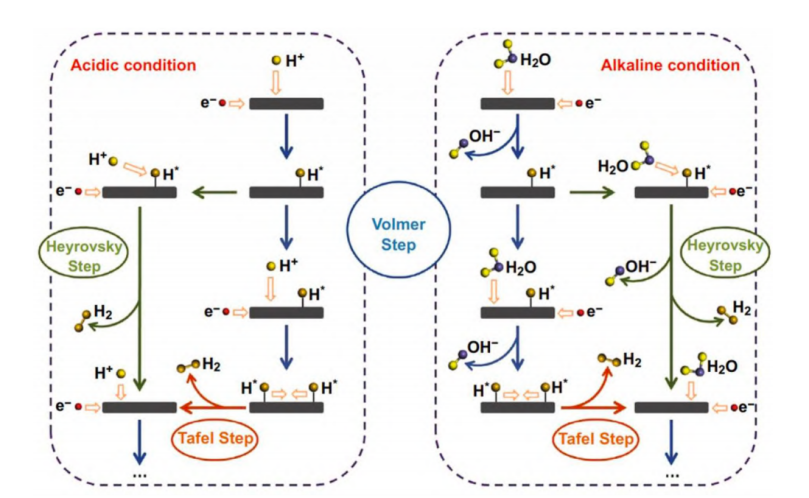
Electrolysis of water for hydrogen production is one of the key technologies for achieving the "dual carbon" goals and the sustainable energy transition. Developing efficient and stable hydrogen evolution reaction (HER) electrocatalysts is the core prerequisite for improving the overall efficiency of water electrolysis hydrogen production. This review systematically summarizes the research progress of HER electrocatalysts driven by nanostructure regulation and electronic structure engineering. This article elaborates on the reaction mechanism and structure-activity relationship of HER and reviews the latest progress of nanomaterial electrocatalyst systems. It systematically summarizes the multi-dimensional control strategies for performance optimization, including defect and vacancy regulation, crystal plane and crystal phase engineering, d-band electronic structure regulation, and design of multiple active sites in synergy. Finally, targeting practical industrial application demands, this work analyzes key challenges including long-term operational stability, structural reconstruction, electrolyzer compatibility, large-scale fabrication of nanomaterials and cost control, and presents a perspective on future research directions.
Show more
Read Article PDF
Cite
Research Article Open Access
Creep and Recovery Behaviors and Deformation Mechanism of Silicone Rubber Foams with Different Systems
Article thumbnail
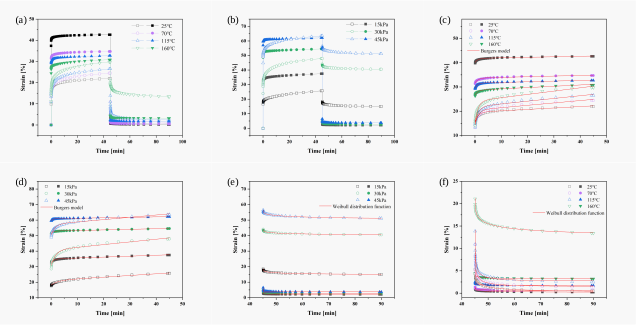
Creep and recovery behaviors of polymer composites are fundamental manifestations of their viscoelastic nature and directly determine the material's reliability in complex environments. In-depth investigation of the creep and recovery behaviors of materials plays an indispensable role in illustrating their deformation and failure mechanisms. In this study, we employed DMA to investigate the creep and recovery behaviors of SHF and PVF under different temperatures and stresses. The Burgers model and Weibull distribution function were also used to fit the results. It was found that SHF exhibits predominantly elastic deformation with only 3.72% unrecovered deformation at 45 kPa and 205 °C, whereas PVF is dominated by viscous plastic deformation with 51.15% unrecovered deformation under the same condition. Fitting results reveal that the Burgers model accurately describes the viscoelastic creep processes of both materials and that the Weibull distribution function effectively quantifies their residual deformation characteristics. This performance disparity can be attributed to their different crosslinked networks. Thermally induced post-curing of residual Si–H groups in SHF increases crosslink density and enhances elasticity. However, high temperatures and stresses induce softening of PVF matrix, leading to irreversible chain dynamics.
Show more
Read Article PDF
Cite
Research Article Open Access
Application of Semiconductor Nanomaterials in Water Treatment: A Study on MXene Membranes, α-MoO₃ Nanotubes, and MoS₂-Modified Ceramic Membranes
Article thumbnail
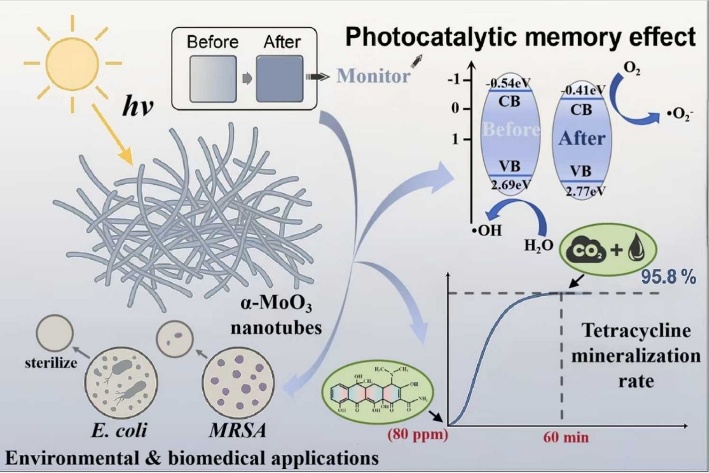
Global water pollution from industrial, agricultural, and domestic sources poses a serious threat to water security. Conventional treatment technologies face limitations such as secondary pollution, low efficiency, high cost, and membrane fouling. Semiconductor nanomaterials offer new solutions through quantum size effects, surface effects, and optoelectronic properties. This paper, through a systematic literature review, investigates three innovative processes: vacancy-engineered single-atom MXene membranes, α-MoO₃ nanotubes with a photocatalytic memory effect, and PEI-functionalized MoS₂-modified ceramic membranes. The results show that MXene membranes achieve an ultrahigh water flux of 2157 LMH and 98.7% TOC removal. α-MoO₃ nanotubes enable continuous purification in the dark with over 95% TOC removal. MoS₂-modified ceramic membranes provide nanofiltration-level separation for fluoride-containing wastewater. The paper concludes that deep integration of material properties and process design is key for future water treatment technologies.
Show more
Read Article PDF
Cite
Research Article Open Access
β-Ga2O3Ultra-Wide Bandgap Semiconductors: Bridging Material Synthesis, Defect Mechanisms, and Power Applications
With the continuous growth in demand for high-efficiency and high-voltage power electronic devices, β-gallium oxide (β-Ga2O3) has become a key ultra-wide bandgap (UWBG) semiconductor material. Owing to its ultra-wide bandgap of approximately 4.8 eV and far exceeding the theoretical Baliga Figure of Merit (BFOM) of silicon carbide and gallium nitride, β-Ga2O3 demonstrates great potential in the next-generation power systems. This article systematically summarizes the latest advancements in the research of β-Ga2O3, with a particular focus on the transition from basic material science to device engineering. By employing a systematic review and comparative analysis approach, this paper focuses on evaluating mainstream crystal growth techniques, the intrinsic defect engineering and doping mechanisms, and the performance of cutting-edge power devices such as Schottky barrier diodes (SBDs). This paper looks into the remaining technical obstacles and future prospects, aiming to provide a comprehensive reference path for the commercialization process of β-Ga2O3 electronic devices.
Show more
Read Article PDF
Cite
Research Article Open Access
Deep Ultraviolet Light-Emitting Diodes: Efficiency Limitations, Mechanisms, and Design Strategies
Article thumbnail
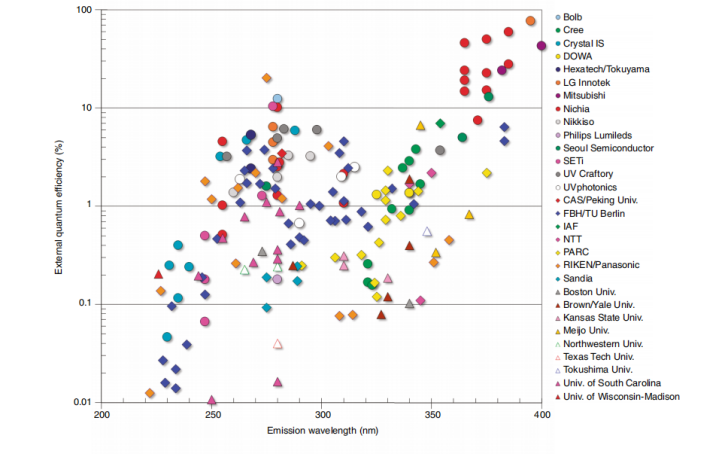
The external quantum efficiency of Deep Ultraviolet Light-Emitting Diodes (DUV LEDs) remains significantly lower than that of mature blue LEDs, which continues to be a key bottleneck hindering their development. This paper reviews the research background, current performance status, and efficiency limitation mechanisms of DUV LEDs. It systematically analyzes technical challenges ranging from internal quantum efficiency, light extraction efficiency, and thermal management to electrical losses, along with their corresponding solutions. The analysis indicates that to improve DUV LED performance, it is essential to comprehensively optimize internal quantum efficiency, light extraction efficiency, and electrical and thermal properties. The study also summarizes future development trends. Future research focuses on silicon-based epitaxial growth, novel light extraction structures, and integrated thermal management. Industrial progress relies on large-scale substrate production, higher yields and local manufacturing to reduce costs and expand applications, aiming to provide theoretical and technical references for performance enhancement and industrial applications of DUV LEDs.
Show more
Read Article PDF
Cite