Articles in this Volume

Research Article Open Access
From CNNs to Transformers: The Architectural Shift in Face Recognition
For almost the past decade, face recognition has been dominated by convolutional neural networks. Margin-based losses (CosFace, ArcFace) have achieved over 99.6% verification accuracy on classic benchmarks. For a long time, further performance gains were believed to rely solely on larger-scale datasets and more sophisticated loss functions. This perspective has since shifted. Having demonstrated strong performance across general computer vision tasks, Vision Transformers are now adopted for face recognition to directly remedy key CNN deficiencies. This paper explores the architectural evolution of margin‑based CNNs, wherein hybrid CNN‑Transformer designs and fully Transformer‑based systems have emerged, drawing upon a range of relevant studies published between 2024 and 2026, such as LVFace (ICCV 2025), NPTFace and PaCo-FR (CVPR 2026), and the FaceLiVT series for mobile deployment, etc. The findings reveal that the the core issue lies not in Transformers outperforming CNNs on existing benchmarks, but in the shifts in computational models underlying face‑representation mechanisms.
Show more
Read Article PDF
Cite
Research Article Open Access
Research Progress on Robotic Arm-Based Automatic Charging Systems for Electric Vehicles
With the increasing adoption of electric vehicles (EVs), conventional human-operated charging methods face limitations under challenging conditions, including low illumination, adverse weather, and accessibility constraints for users with limited mobility. Meanwhile, advances in robotic perception, multi-sensor fusion, and autonomous control technologies provide new possibilities for automated charging systems. This paper reviews recent developments in automatic EV charging technologies and proposes a design framework based on vision-based perception, sensor-fusion, and robotic manipulation. The proposed system integrates cameras and radar sensors for charging interface detection, position estimation, and robotic connector operation, aiming to improve charging efficiency and operational safety. The research focuses on several key challenges including accurate charging inlet localization, environmental adaptability, mechanical positioning accuracy, and safety control during charging operations. Existing studies indicate that automatic charging systems are technically feasible, however, practical deployment remains constrained by high equipment costs, variations in charging interface configurations, and robustness requirements under complex environments. This paper further analyzes potential optimization directions, including low-cost sensing solutions, intelligent perception algorithms, and improved cross-model compatibility. The study provides a comprehensive reference for the future development of automated EV charging systems.
Show more
Read Article PDF
Cite
Research Article Open Access
Time Difference of Arrival Localization Based on Ultra-Wideband: A Synergistic Method of System and Algorithm II
Article thumbnail
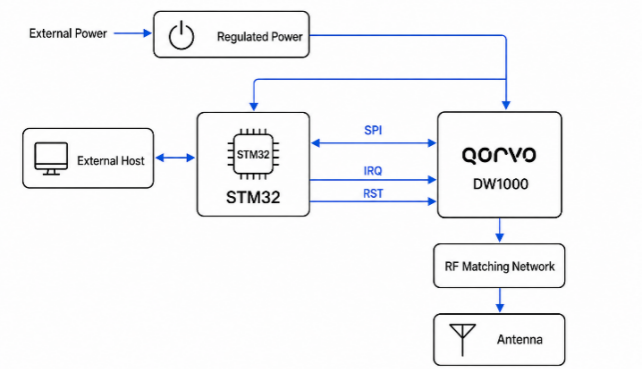
Following the previous study of TDoA localization algorithms and hardware-assisted calibration, this paper develops a configurable DW1000-based ultra-wideband (UWB) platform for indoor localization with multiple anchors. Dedicated PCBs for the anchor and tag were designed to combine the DW1000 transceiver, STM32 controller interface, regulated power supply, controlled RF path, and customized antenna in one module. Three antenna candidates, including a modified circular radiator, a conventional circular patch, and a rectangular patch, were modelled in CST Studio Suite under the same conditions using a 1.2-mm F4B substrate. With the -6 dB level used as the preliminary comparison standard, the modified circular radiator obtained the widest simulated range from 6.0313 to 6.4318 GHz, giving an approximate bandwidth of 400.5 MHz. However, its -10 dB impedance bandwidth still requires further optimization before the antenna can be fabricated. The software was divided into three layers: an STM32 driver layer, a DW1000 API layer, and an application layer. This structure supports radio configuration, packet transmission and reception, timestamp reading, and future TDoA implementation. An infrared-synchronized ultrasonic unit was also developed as an additional short-range reference. It can be used to investigate UWB bias and to provide an initial region for the Taylor-series estimator. Nevertheless, one ultrasonic distance cannot independently determine a two-dimensional position or remove the clock drift between anchors. Qualitative tests were also carried out for multipath propagation, obstacle blockage, antenna orientation, and nearby wireless activity. These tests indicate several practical risks for system installation and provide a hardware and firmware basis for future synchronized multi-anchor experiments and quantitative localization evaluation.
Show more
Read Article PDF
Cite
Research Article Open Access
Analysis of Actuator Selection for Low-Cost Bionic Limbs
With the continuous advancement of mechatronics, low-cost bionic hands have been widely used in educational experiments and lightweight robotic research. As the core power components, actuators determine the mechanical output, power consumption and overall practical performance of bionic hands. A small mistake made during the choice making of actuators is fatal, which can result in problems such as insufficient gripping force or exceeding cost. This paper first establishes three evaluation criteria for bionic hand actuators: mechanical performance, electrical power requirements and practical application conditions. Then, the operating principles, hardware characteristics and inherent drawbacks of three mainstream actuators which are massively used in this area are elaborated respectively. A comparison is conducted through a table clearly showing the differences between the three types of actuators, and targeted selection suggestions are provided for different application scenarios. This paper finds that servo motors fit low-difficulty rapid teaching prototypes, geared direct current (DC) motors are suitable for stable long-term laboratory experimental platforms, and shape memory alloy (SMA) actuators are limited to lightweight exploratory research due to power consumption and response speed constraints. This research aims to build systematic hardware reference standards for beginners engaged in low-cost bionic hand design, avoiding biased actuator selection caused by ignoring integrated mechanical and electrical constraints.
Show more
Read Article PDF
Cite