


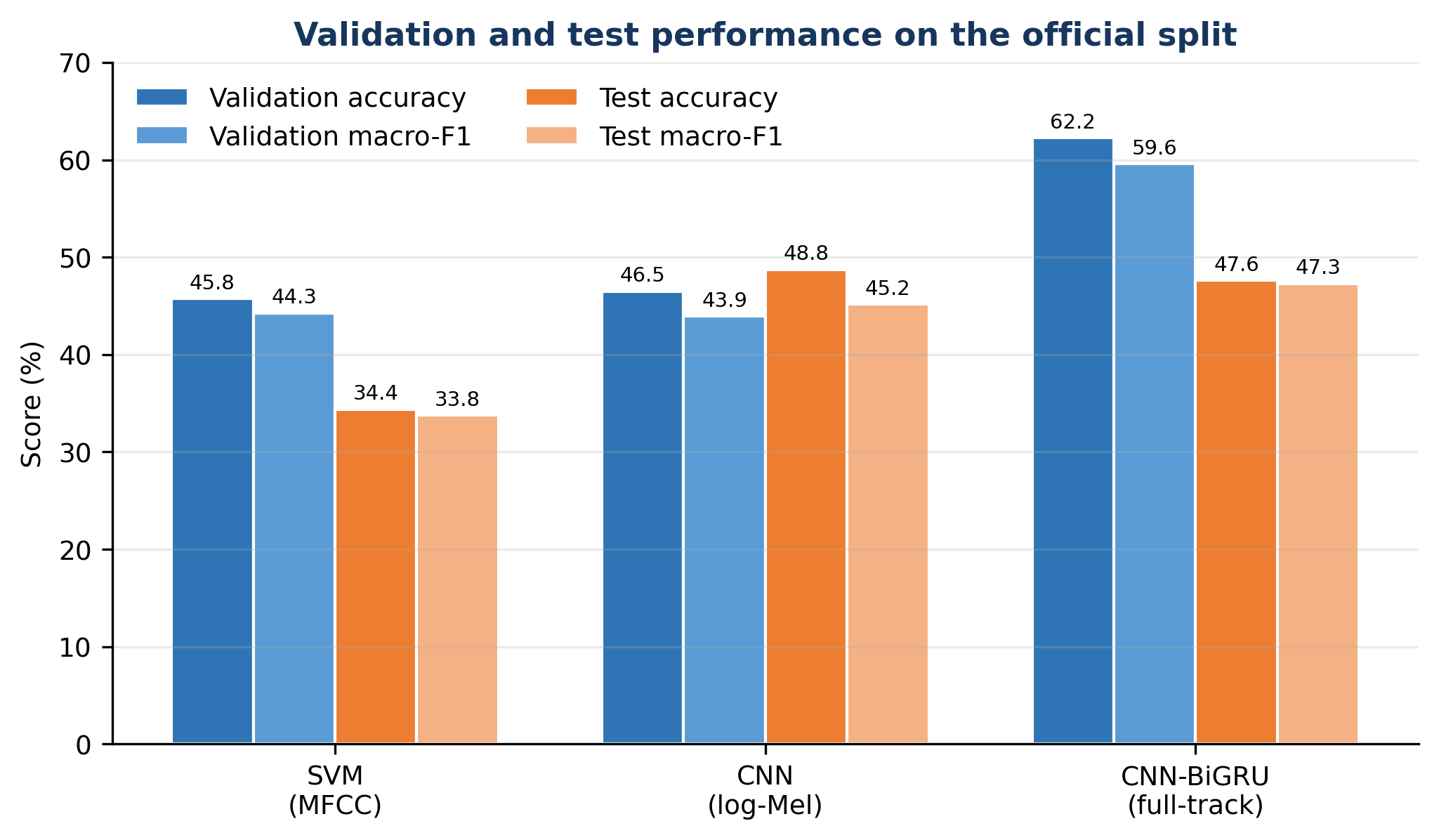
Automatic music genre classification is complicated by overlapping genre boundaries and by distribution differences between development and test data. This study evaluates whether expanding temporal coverage and recurrent modeling improves a compact convolutional baseline on the official FMA-small split. All 8,000 thirty-second clips are represented as 128-bin log-Mel spectrograms. The baseline CNN uses a fixed 512-frame excerpt, whereas the proposed system retains the full track, samples random 512-frame crops during training, uses a bidirectional gated recurrent unit after convolutional feature extraction, and averages five deterministic crops at inference. SpecAugment, mixup, class-weighted cross-entropy, AdamW, and cosine learning-rate decay are applied without changing the official 6,400/800/800 train-validation-test partition. The proposed system raises validation accuracy from 46.50% to 62.25% and validation macro-F1 from 43.93% to 59.62%. However, test accuracy changes from 48.75% to 47.63%, while test macro-F1 increases modestly from 45.19% to 47.30%. The resulting 14.62-percentage-point validation-to-test accuracy gap shows that the optimization package improved development-set performance but did not establish stronger overall generalization. The work therefore contributes a reproducible, leakage-aware evaluation and demonstrates why final claims must be based on held-out test behavior rather than validation gains alone.