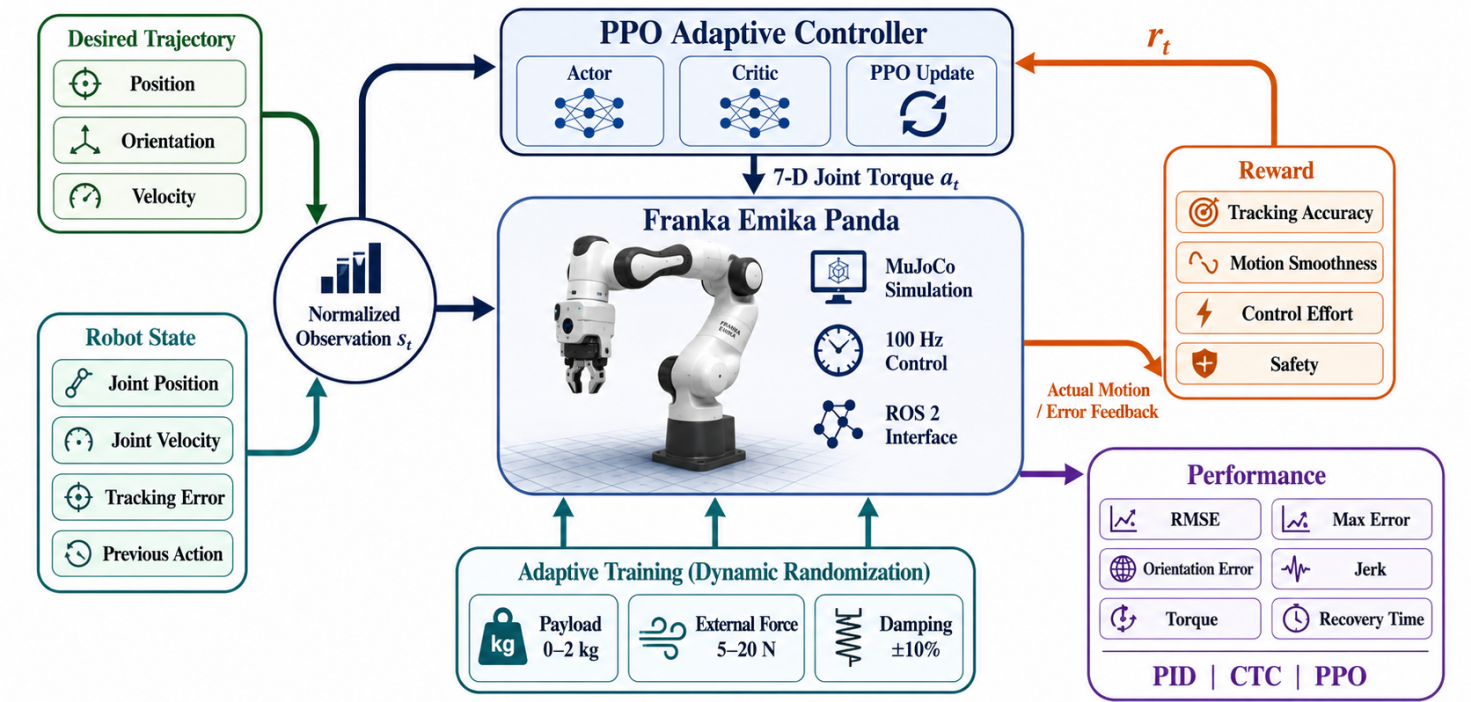
Accurate manipulator trajectory control becomes difficult when nonlinear joint coupling, payload variation, and external disturbances invalidate fixed controller parameters. This study develops an adaptive trajectory controller based on Proximal Policy Optimization for a seven-degree-of-freedom Franka Emika Panda manipulator. The controller maps joint states, Cartesian tracking errors, target motion, and previous actions directly to continuous joint torques. Training is conducted in MuJoCo with randomized 0–2 kg payloads and 5–20 N external forces, while a composite reward simultaneously regulates Cartesian accuracy, orientation error, motion smoothness, control effort, and safety. Illustrative evaluation results show that PPO achieves a Cartesian RMSE of 6.84 ± 0.73 mm on the three-dimensional trajectory, compared with 13.27 ± 1.46 mm for computed-torque control and 21.63 ± 2.11 mm for PID. Under a 20 N disturbance, recovery time decreases to 0.41 ± 0.06 s, while trajectory jerk remains 31.7 ± 3.8 m/s³. The results indicate that dynamic randomization and multi-objective reward shaping enable the learned controller to preserve tracking accuracy and smoothness under changing robot dynamics.