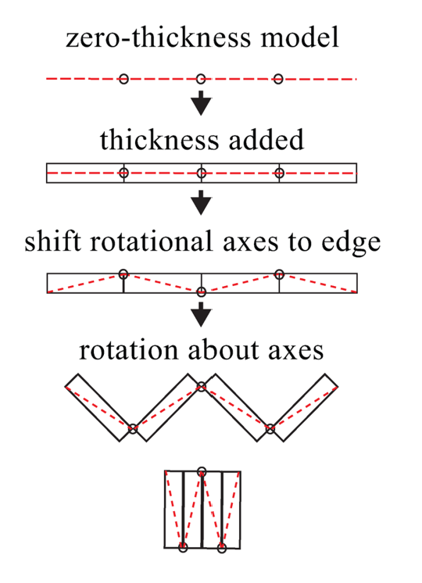
Real-world material thickness imposes constraints that spatial mechanisms cannot ignore—physical joints must move without binding, and the overall geometry has to stay compatible throughout deployment. Working within the Modular and Uniformly Thick Origami-Inspired Structures (MUTOIS) framework, Degree-6 (D6) and Degree-10 (D10) vertices were evaluated through a combination of cardstock/MDF physical prototyping and Denavit-Hartenberg (D-H) kinematic formulations. From benchtop load trials, it was found that spatial symmetry enables the overconstrained D6 node to preserve a rigid single-DOF folding trajectory. For the D10 configuration, four internal degrees of freedom were identified; while its geometry does provide clearance against facet collisions, the joint network still tends to bind under manual actuation. Connecting two modules together introduces angle-dependent non-linear torque at the inter-unit interfaces, and the operational mobility drops from a theoretical M=9 to an effective M eff =4. These empirical results offer concrete kinematic guidelines for choosing between different node types in thick-panel deployable lattices.