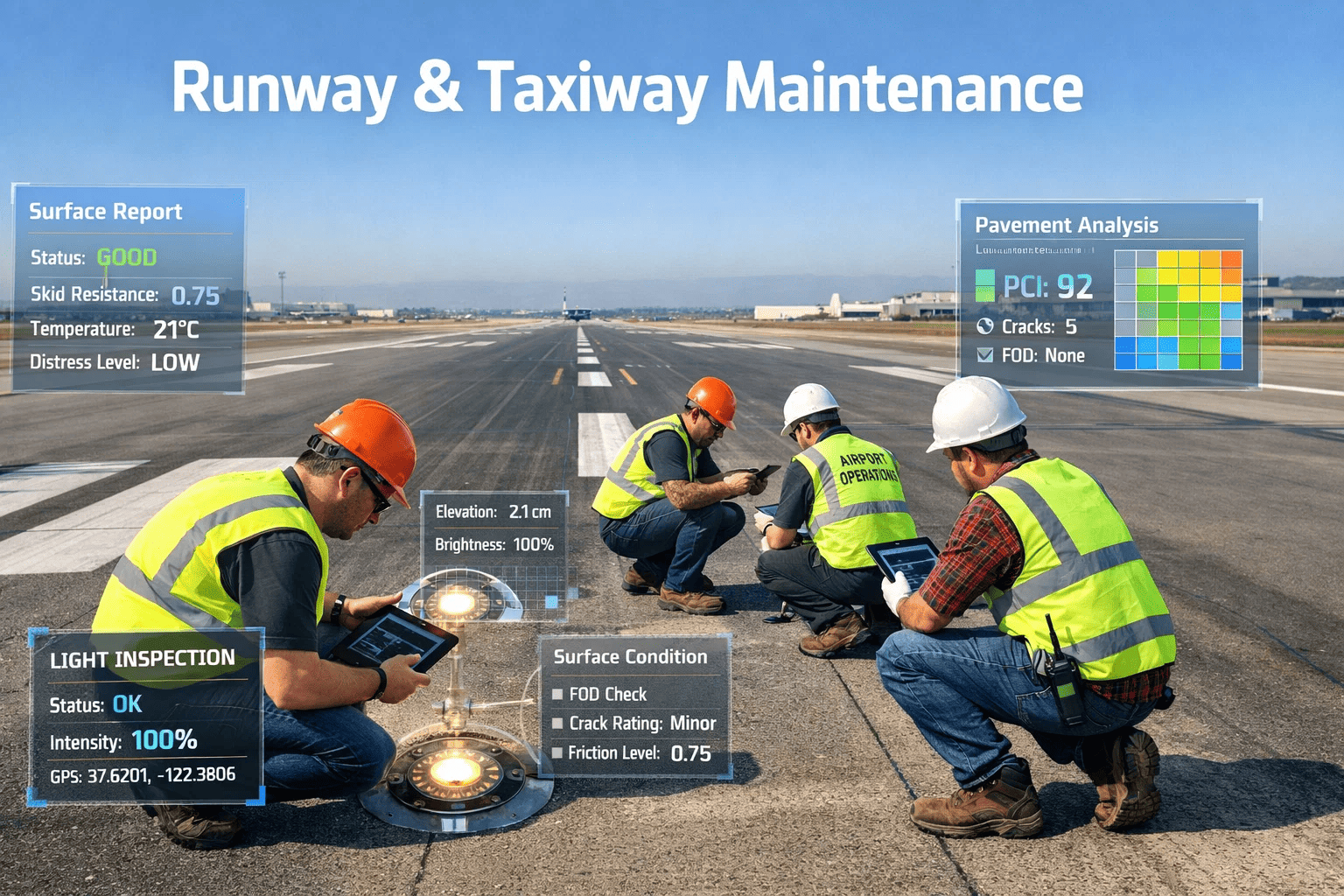
The degradation of airport runway surfaces poses persistent safety risks in aviation operations. Runway cracks tend to expand under environmental loads and aircraft cyclic impacts, generating Foreign Object Deposition (FOD) that directly jeopardize aircraft takeoff and landing safety. The International Civil Aviation Organization (ICAO) mandates mandatory inspections for runway surface integrity . However, current inspection methods predominantly rely on manual patrols, which suffer from low efficiency and inadequate early-stage crack detection capabilities—particularly challenging for routine inspections at resource-constrained regional and general aviation airports.This study presents the design and evaluation of an autonomous unmanned ground vehicle (UGV) system for runway crack detection, integrating real-time vision-based deep learning, geospatial localization, and optimal coverage path planning . A YOLO-based model is implemented for onboard crack detection, while a Chinese Postman-based algorithm ensures complete and efficient runway traversal . The system is developed using a Raspberry Pi and STM32 architecture within a ROS framework, and validated through simulation and controlled testing. Results focus on inspection coverage efficiency, localization consistency, detection accuracy, and the practical utility of generated inspection reports . The proposed framework demonstrates the feasibility of a low-cost, integrated solution for automated runway inspection, with potential to reduce manual labor and enable more frequent monitoring.