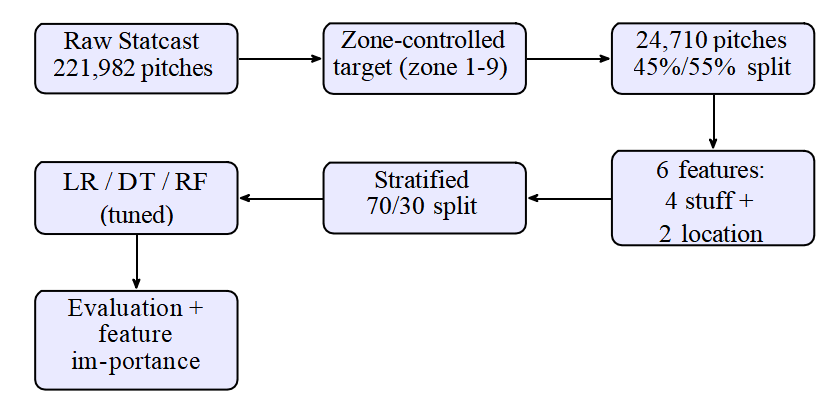
In modern baseball, the relative contributions of velocity, spin, and pitch location to swinging-strike outcomes are still not well understood, and many earlier studies mix up location-driven outcomes with actual pitch quality. This study uses MLB Statcast pitch-level data from 2024–2025, drawn from 221,982 pitches thrown by World Baseball Classic 2026 roster pitchers across 16 countries, to analyze what physical factors predict pitch effectiveness. To separate pitch quality from location effects, this study defines a zone-controlled binary target: in-zone swinging strikes versus in-zone hard-hit contact, while excluding out-of-zone pitches, called strikes, foul balls, and other ambiguous outcomes. This yields a modeling sample of 24,710 pitches with a balanced 45.0%/55.0% class split that needs no resampling. Using a stratified 70/30 split that preserves this class ratio, three classification models are trained and compared: logistic regression, decision tree and random forest, with the two tree models tuned by cross-validated grid search. Exploratory data analysis shows that pitch velocity and vertical plate location separate the two classes most clearly. The random forest classifier achieves the best performance with an accuracy of 67.84%, an ROC AUC of 0.7359, and an F1-score of 0.62, outperforming the decision tree (accuracy 65.72%, AUC 0.7042) and the logistic regression baseline (accuracy 57.37%, AUC 0.5759). Notably, feature importance analysis shows that stuff-related features together account for 46.7% of importance in the random forest—nearly as much as the two location features (53.3%)—showing that pitch quality, not just placement, is an important and often overlooked driver of swinging strikes.