Articles in this Volume

Research Article Open Access
Digital Twin Applications in Metro Systems: Infrastructure Monitoring and Operational Management
Recently, more and more digital twin technologies are getting attention in managing and operating urban metros. The fact that integrating time-monitor data like a metro digital twin right now has chances to improve its operation and dependability. This essay is mostly about the applications of digital twins for the metro system: infrastructure monitoring and operation management. Digital twin, at the infrastructure level, can be utilized in observing the structure inside the metro tunnel to see if there is a dangerous situation. For example, a swelling on Earth. After applying our collected data to a predictive analysis, this will offer us an early warning and allow preventive maintenance. In terms of operation, a digital twin system would help people to monitor the operation of metro network, which means smoother passenger flow. Although the metro system's digital twin technology has great benefits, problems like data integration, reliability of the whole system and its security still need to be solved. More studies and practices need to take place to make sure that digital twin tech is employed safely and correctly on future metros.
Show more
Read Article PDF
Cite
Research Article Open Access
Prospects for the Application of BIM in the Building Operation and Maintenance Phase
This study takes a literature review approach on the current status of Building Information Modeling (BIM) applications in the building operation and maintenance (O&M) phase. Current studies show that the application of BIM in this field is still struggling with several problems including information fragmentation, unfixed operation patterns, and over-dependence on human decision-making. To address the above problems, this paper puts forward three development directions of BIM by integrating with digital twin technology, machine learning algorithms, and others. First, a digital twin-based integrated platform is put forward to solve the problem of information fragmentation. Secondly, the integration with artificial intelligence (AI) is discussed to change the decision-making method from passive to active. Finally, the contribution of BIM is extended from the use phase to the resource circulation phase in the circular economy. This paper summarizes the three development directions put forward in this paper, as well as the challenges that may be faced in the future development of BIM in the O&M phase.
Show more
Read Article PDF
Cite
Research Article Open Access
Digital Twin Technology for Smart Shipping: Applications, Challenges, and Future Directions
Maritime shipping business has been an important event in global trade, but it is still marred by serious challenges such as high prices, environmental effects, hazards on ships and port congestion. With the use of technologies like Internet of Things, cloud computing, and artificial intelligence gaining an ever-increasing significance in the Industry 4.0 epoch, smarter and more efficient shipping solutions are getting recognized as an issue of even greater importance. In that case, the digital twin technology that is the development of virtual depictions of physical systems in real-time opportunity presents great potential to overcome these difficulties. The review is a collection of research on the topic carried out during the last five years to explore how digital twins are applied to smart ships, ports, and logistics systems and determine the main trends in technologies, application patterns, and gaps in research. It also addresses the way, in which digital twins can influence the forthcoming alteration of the maritime industry. Thus, the study of the digital twin technology in marine shipping is both theoretical and practical.
Show more
Read Article PDF
Cite
Research Article Open Access
Low-Power and High-Density Dynamic Random Access Memory
Dynamic Random-Access Memory (DRAM), as the core component of storage systems, offers a simple structure, high storage density, low unit cost, and fast read and write speeds. It is a key support for smart Internet of Things (IoT) devices to achieve low power consumption and high-density upgrades. Low-power, high-density DRAM technology has become a current research hotspot in the field of storage. In sense amplifiers, research focuses on offset compensation, noise immunity, and pre-sensing technology to improve accuracy under low-voltage operation and reduce power consumption. Using advanced Complementary Metal-Oxide-Semiconductor (CMOS) processes can reduce leakage current, lower operating voltage, and enhance process compatibility for high-density integration. 3D stacking technology breaks the physical limitations of planar DRAM through vertical integration that improves DRAM density and data retention capability. Starting from the above three major modules, this paper systematically reviews representative research achievements in low-power, high-density DRAM over the past few years. It analyzes the innovation paths and performance optimization effects of each module, and summarizes the development trends of low-power DRAM technology.
Show more
Read Article PDF
Cite
Research Article Open Access
Core Peripherical Circuit Design for High-Capacity STT-MRAM
STT-MRAM has become a potential technique in System-on-Chip(SoC) application depending on low consumption, high-density, high speed and non-volatility. Parasitic resistance and capacitance in high-capacity STT-MRAM have higher requirements for high-accuracy read-and-write circuits. This paper elaborates on a sense amplifier with a high sensing margin, which can effectively improve the reading accuracy. It also reviews the adaptive self-termination circuit, which can effectively alleviate the high write power consumption and unnecessary write delay caused by the fixed write pulses in traditional write operations. Furthermore, this paper reviews the relevant circuit design schemes, including wordline driver circuits, for the problem of insufficient write drive in large-capacity arrays, which provides design references for improving the stability and reliability of the overall circuit.
Show more
Read Article PDF
Cite
Research Article Open Access
High-Density Static Random Access Memory Circuits Design
Article thumbnail
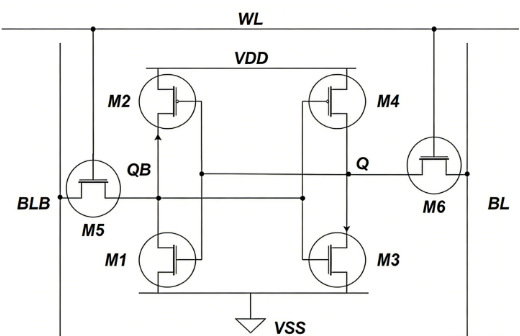
Advanced Internet of Things (IOT), electronic devices are trending toward miniaturization. Contemporary System-on-Chip (SoC) implementations demand both high density and superior energy efficiency. As a critical building block in SoC systems, Static Random Access Memory (SRAM) is widely adopted due to its outstanding symmetric characteristics, superior stability and low power consumption. High-density SRAM is critical to optimizing SOC performance and area efficiency, making its design an essential research focus. This paper focuses on the circuit design of high-density SRAM, conducting an in-depth exploration of key design technologies, including SRAM optimization based on advanced CMOS processes like FinFET, the development of high-accuracy sense amplifiers and the research of peripheral circuit assist technologies for improving read/write yield and energy efficiency. It also summarizes the current development status of high-density SRAM circuits and puts forward feasible research directions for its future advancement, providing technical references for high-density SRAM design adapted to IOT and advanced SOC applications.
Show more
Read Article PDF
Cite
Research Article Open Access
Aerodynamic Performance Analysis of Wind Turbine Blades Based on Bézier and Blade Element Momentum
Article thumbnail
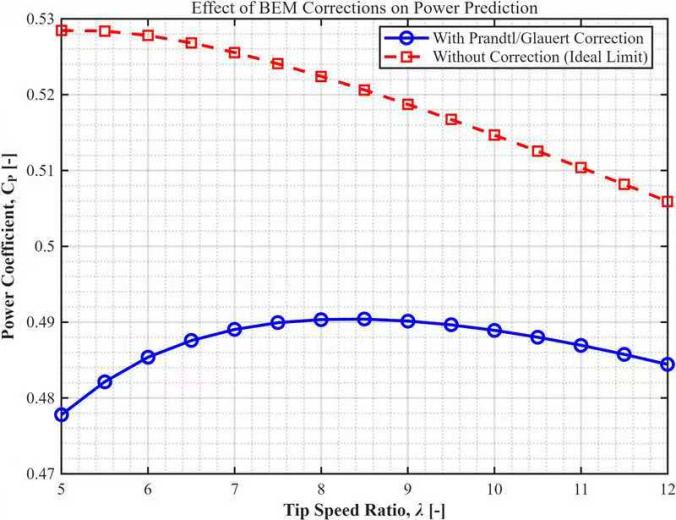
Accurate aerodynamic performance prediction and blade geometry optimization are critical for enhancing wind turbine energy efficiency. This study establishes a Blade Element Momentum (BEM) simulation framework for a wind turbine, focusing on the impacts of correction models, blade parameterization methods, and operating parameters on rotor performance. The results demonstrate that uncorrected ideal Betz models severely overestimate power coefficients, while Prandtl/Glauert corrections yield physically realistic predictions, confirming their necessity in BEM simulations. Comparative analysis reveals that the Bézier curve parameterization achieves a peak power coefficient of 0.4762, significantly outperforming the polynomial method, and is thus selected for blade geometry definition. Further investigation quantifies the combined effects of pitch angle and tip speed ratio, showing that moderate pitch angles optimize aerodynamic loading across operating ranges. Finally, the wind turbine power curve from 4 to 12 m/s is derived, validating the high efficiency of the optimized design. This work provides a systematic reference for wind turbine rotor design and performance evaluation.
Show more
Read Article PDF
Cite
Research Article Open Access
Digital Twin for Road Condition Monitoring and Predictive Maintenance
A digital twin-based framework is developed in this paper for road condition monitoring and predictive maintenance, aiming to tackle the inefficiencies of traditional road inspection methods and the practical dilemmas in the operation of complex road infrastructure systems. Road maintenance management is confronted with prominent challenges including the spatial complexity of road networks, the nonlinear evolution of pavement damage, and the heterogeneity of multi-source monitoring data. To solve these practical problems, this research designs a three-layer digital twin architecture composed of physical space, data interaction space and virtual space, and puts forward three targeted innovative design strategies. First, autonomous inspection vehicles integrated with a multi-sensor system are deployed to realize continuous and real-time data acquisition under normal traffic conditions, without interrupting the regular road operation. Second, a unified data integration platform is constructed to standardize the format of heterogeneous monitoring data, thereby improving the interoperability and data sharing efficiency of different road monitoring systems. Third, a robotic maintenance system is designed to support targeted and automated repair operations, with maintenance decisions generated based on the predictive analysis results of the digital twin model. The case test results show that the proposed digital twin framework can significantly improve the efficiency of road condition inspection and provide reliable technical support for the formulation of predictive maintenance strategies for road infrastructure. Overall, the framework developed in this study provides a practical approach for improving road maintenance using digital twin technology. It shows potential for supporting more efficient and scalable maintenance processes in real-world applications.
Show more
Read Article PDF
Cite
Research Article Open Access
Identifying Renewal Priority of Aging Neighborhoods: A GIS-MCDA-AHP Approach in the Bronx
Article thumbnail
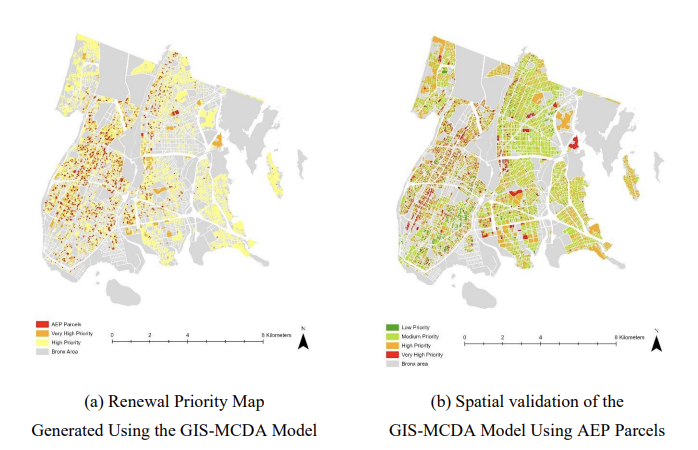
Many cities today are experiencing problems of old neighborhoods and unequal access to public services. Addressing the issue of urban regeneration has become a key factor. This study aims to identify the priority areas for urban regeneration using a GIS-based MCDA method. A number of factors, including accessibility of public services, have been selected and standardized. The Analytic Hierarchy Process (AHP) method has been employed to assign weights to each factor. Finally, a weighted overlay method has been used to combine all the factors, and a regeneration priority map has been created. The results have been classified into four levels: low, medium, high, and very high priority. The areas with high priority are located in old neighborhoods with poor accessibility. The results have also been compared with the Alternative Enforcement Program (AEP) data, which shows a certain degree of coincidence. The study shows that the GIS MCDA method can be an important tool for improving the issue of urban regeneration, although there are still some limitations.
Show more
Read Article PDF
Cite